
—Sticky note: The only cleaning worth covering is the cleaning of the great outdoors. I think New York Post reporters are pointing fingers at sidewalks so no one ever knocks on our doors to take a look at what goes on inside. We live increasingly interiorized lives, but not interior in the sense of self-obsession, but literally interior: we barely get outside anymore, so much so that we develop rituals to stay fit. But unlike, say, monks, we don’t spend our days reading and thinking about reading and then writing. Instead, we buy shit—a lot of shit (in the last two months, I’ve seen two court summons on behalf of Capital One taped to my apartment building’s front door…)—so much shit that we can’t keep up with all of the shit—or, ”stuff,” says Zach Katz, formerly the founder/CEO of Framed Tweets, and now a full-time home organizer, aka Everything In Its Right Place, which services Brooklyn and Midtown to farthest Harlem and beyond. I spoke with Katz about work, the nature of clutter, and what’s going on behind our neighbors’ doors.
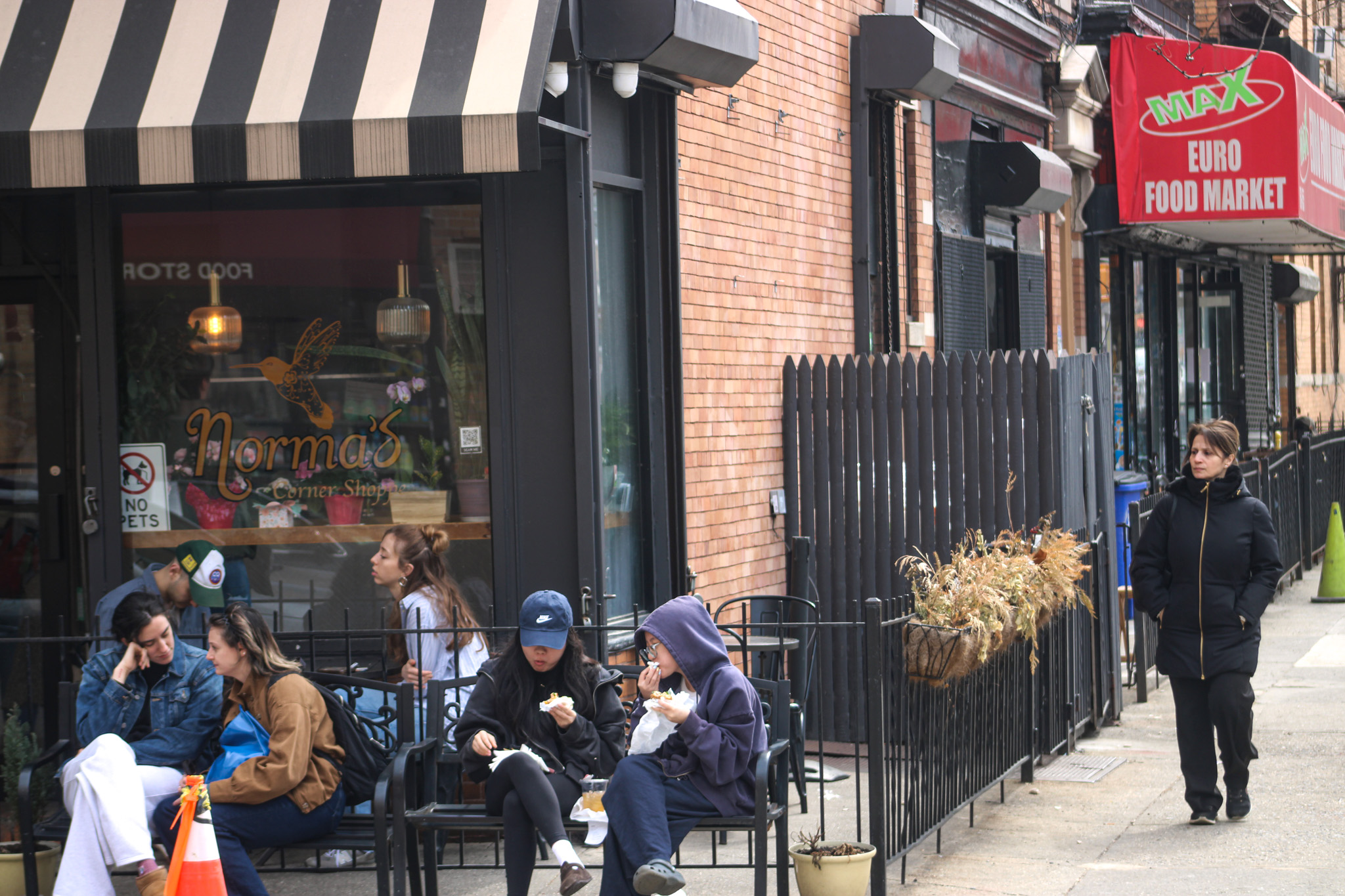
—Coffee mugs, misc. tchotchkes: It turns out it’s good to own as few mugs as possible. Katz and I are at Nook past 10 p.m., on the patio outside of a R&B oldies listening party with talkbacks going on inside. Katz had decided against Boobie Trap after remembering he angered the owner years ago during a crusade against traffic on Kickerbocker (“Opinion: Make Knickerbocker Car-Free,” published on a mostly defunct local rag.
“Tchotchke, to me, insinuates decorative things which should be displayed,” he says. “If you’re storing a bunch of like sentimental items under your bed, you probably want an opaque bin, for spiritual reasons, to hold the energy of those objects.”
I used to own so many coffee mugs before I moved here: Minnesota Vikings mug, a mug painted in a pink that was Pantone 2021’s color of the year, one with “Fuck Off, I’m Reading” in flowing cursive bought by my most millennial friend. I’ve got one actual tchotchke: a little totem of Jarry’s Ubu Roi on my desk. I’m used to knickknacks from where I come. I’m still getting used to calling them tchotchkes.
—Mitski record, purple string lights, glowing orb whispering our pasts: I’ve been wondering what are the essential objects for a room in North Brooklyn. Katz shoots them all down: “My philosophy is less stuff. The analogy I always bring up with clients—some people like it, others are like what the fuck are you talking about—is a monk. With monks, the only possessions they have are two robes and a bowl, and they’re perfectly happy. I encourage people to remember that material possessions don’t equate to happiness. That’s not to say you need to be ultraminimalist, but it’s important to keep in mind: the less stuff you have, life generally becomes a lot simpler.”

—Spray of clothes on bedroom floor: “People are often really shocked at how much they have, even though even going into the session they’re expecting to be getting rid of a bunch of stuff, they’re still shocked at how much stuff they end up getting rid of.”
—Resume (printed): “I started organizing because it’s fun, I’m good at it, and it pays better than my previous job. I was hosting at a restaurant in Flatiron and kept trying to organize the host stand, which the manager appreciated, but she was also annoyed by it because she didn’t want to help declutter.” Katz continues: “So I emailed every professional organizer in the city—over 100 people (incidentally, they’re all women)—asking if I could work for them, but no one was really hiring. So I made some flyers and got to work on my own.”
—Impossibly loud vacuum: As to why people become messy, Katz says, “It being New York, everyone’s working super hard all the time. And they’re living in tiny apartments, so they don’t even have space. They end up drowning in their stuff.” As Byung-Chul Han writes in Non-Things, “The present hyperinflation and proliferation of things are precisely a sign of an increasing indifference towards them.” It feels like we’re indifferent to things, but not their effects on us. We want tons of stuff, but we yearn for infinite storage.
—Shoe cubbie: On the nature of clutter, Katz tells me, “clutter is anything that you have that you don’t love, need, use, or want. You know it’s stuff that’s not really useful in any way, whether practically or spiritually. They don’t teach anyone in school to consider their stuff intentionally, to reconsider it all every now and then, whether it’s really serving you. So that’s the main service that I provide: giving people an opportunity to consider their stuff more intentionally.”
—Stack of six folded t-shirts: What’s the distinction between collection and mess/accumulation? Says Katz: “The distinction is how it makes you feel. If you have an intentional curation of things, like figurines or records, that’s a collection. But, if it makes you feel stressed out, and you have a lot of stuff that you don’t actually love, or if it’s not organized, then I would call it a mess.”
—Books: in Working, Nick, a garbage man, is interviewed about the changing nature of his job, and he says, “It’s not like years ago, where people used everything.” Now, more than then, things hang around longer. Katz says, “I tell clients who are ashamed of the amount of stuff that it’s not even their fault.” Current modes and quality of production bake in decay, but we have identical brains to people centuries ago who had the same pants for twenty years. Fast fashion, Apple’s assault on battery life: it’s all piling up at speeds we can’t handle. Nick the garbage man says, “They’ll throw anything away.” Nick’s all wrong now. Now it’s the opposite.
—Invoice (folded): “I’ve worked with clients where it’s just impossible to do a whole apartment, even a one-bedroom, in one day. The longest one day I’ve done was 11 hours. Long days can be intense, but if we find a flow, it becomes fun. There’ve definitely been people that I would’ve liked to be friends with, but there’s like the professionalism thing.”
—Empty box of chocolates: I ask Katz about the love lives of messy people. He says, “People have told me that I’ve saved their relationships and their lives. When both people in a couple want my help and we’re all working together, it’s really efficient,”—I offer, “Like a super platonic threesome kind of thing,”— and he adds, ”Sure, but like everyone’s in sync and considerate of each other. Though if it’s just the girlfriend or the boyfriend who’s the messy one, it’s trickier. Like one time the guy hires me for their apartment and his closet was already organized, but his partner had too much stuff and so he had me take everything out of her closet, lay it out all over the kitchen and living room, and ambush her when she came home from work, like, “Honey, it’s time to go through your stuff and pick,” and she was also really happy that he did that. There can be a little resistance, too. There was this guy who wanted me to help with his stuff and his partner’s stuff, and she was like, ‘Hell no, that’s not happening.’”
—The shoes in that shoe cubbie: Regarding the strangest accumulations he’s seen, Katz says, “I’ve worked with a couple of TikTok influencers who have piles of gifts they’ve been given from companies to woo them into partnering with them. One Nike influencer had like 200 pairs of shoes. They filled up like six or seven contractor bags.” Katz doesn’t mind: “Clients also try to give me a lot of stuff. One guy gave me an electric scooter. A lot of blenders, too. Most of my wardrobe is from clients; actually this jacket I’ve got on right now, too.”
—Transparent or opaque bins: “It depends. I am not a fan of bins, really at all. Sometimes a bin is necessary to corral stuff. And labels—labels on bins is like the hallmark of most professional organizers. I’m 100% anti-label: I can jive with the bin, but labels are ridiculous because what’s in the bin should be self-evident—with the exception of really tiny things, like buttons.”

—Codenames on flashcards: I ask what euphemisms he uses when describing people’s messes. He says, “Decluttering, or deciding—what to get rid of, what not. One of my clients used the word ‘edit,’ and I adopted that with other clients. I just try to be genuine and not prescriptive with my language. I wouldn’t be rude and call it shit, even if they’re calling it shit. I’m not going there.”
—Tatami mat: I ask what advice he gives to people that he himself doesn’t use. He says, “Keeping anything, really. I’m not a very sentimental person myself. I don’t have any mementos.” I ask what tools he brings, if he has a utility belt, and he says, “I kind of like to just bring myself.”
—Chakra map poster (unframed): “People accumulating stuff—I wouldn’t equate it with addiction, per se, but one interesting spiritual aspect of accumulating stuff is that the root chakra is associated with having, with holding and clinging onto stuff. It’s the chakra associated with your sense of security and safety in the world, your groundedness. People hang onto stuff because it provides a sense of grounding. A lot of people derive their identity from their stuff. I don’t mean to say there’s anything wrong with that, but professionally speaking, I think there’s a world beyond that.”

—The dumper outside: “Usually people just need a little encouragement, an accountability partner. Like, we’ll be considering a waffle maker or whatever, and they’re trying to decide whether or not they need it, and I always feel comfortable suggesting they get rid of it. A waffle maker is just a superficial object. The lightness you’ll feel getting rid of this thing will be amazing.”
—Stiff paintbrush: When asked if he ever draws in the dust around people’s things, he says, “That would be unprofessional. It’d call attention to the dust.”
—Moving company calling card: “It’s strictly me. I’ll generally help schedule a donation pickup with Saint Mary’s. I’ll figure out the time for the client and text them the website and we schedule it together.” I bet I could hire someone to take the train for me. I once walked into a notary in East Williamsburg that was also a driving school. I asked the receptionist if they did weddings, too. She said no, but they had a tax accountant on staff. Wow, New York City: where else can you find someone to do your taxes for you? I’m thinking of a marketing agency six floors above the pizza shop and the newsstand, a block from a row of tailors. I’m sure it exists in Midtown. We mill about our odd jobs before going home to piles of unopened letters. In all the abnormal agglomerations of work, of stuff, there’s us, knee-deep in it on the best of days.
—ID badge: I expected this all to be a part-time gig for Zach, but he says it’s his job all the time now. New York never ceases to nurture an ecosystem of work not seen in the heartland. Picture framers, assistants to celebrities or celebrities’ parents, Amazon e-cargo bicyclists or guys who drive those cute utility three-wheelers up and down Flushing Avenue. Or professional flyer distributors, like the one Zach hired. “For a while, I started putting up flyers when I first started the business, but I kind of lost motivation after 20 flyers,” Zach says. “Then I found this guy’s flyer, and I was, like, allright, I’ll just pay him 100 bucks.”
Aaron Tomey is from Georgia, lived in St. Louis, and now lives in Brooklyn. His essays have previously appeared in Hobart, Bushwick Burner Phone, and Apocalypse Confidential. He can also be found on Twitter: @ecstatic_donut.
Photos by Andrew Karpan.



Leave a Reply