
An ominous message now sits on Brooklyn Made’s website:
“Brooklyn Made is closed. All shows are canceled. Ticket refunds will be issued at the point of purchase.”
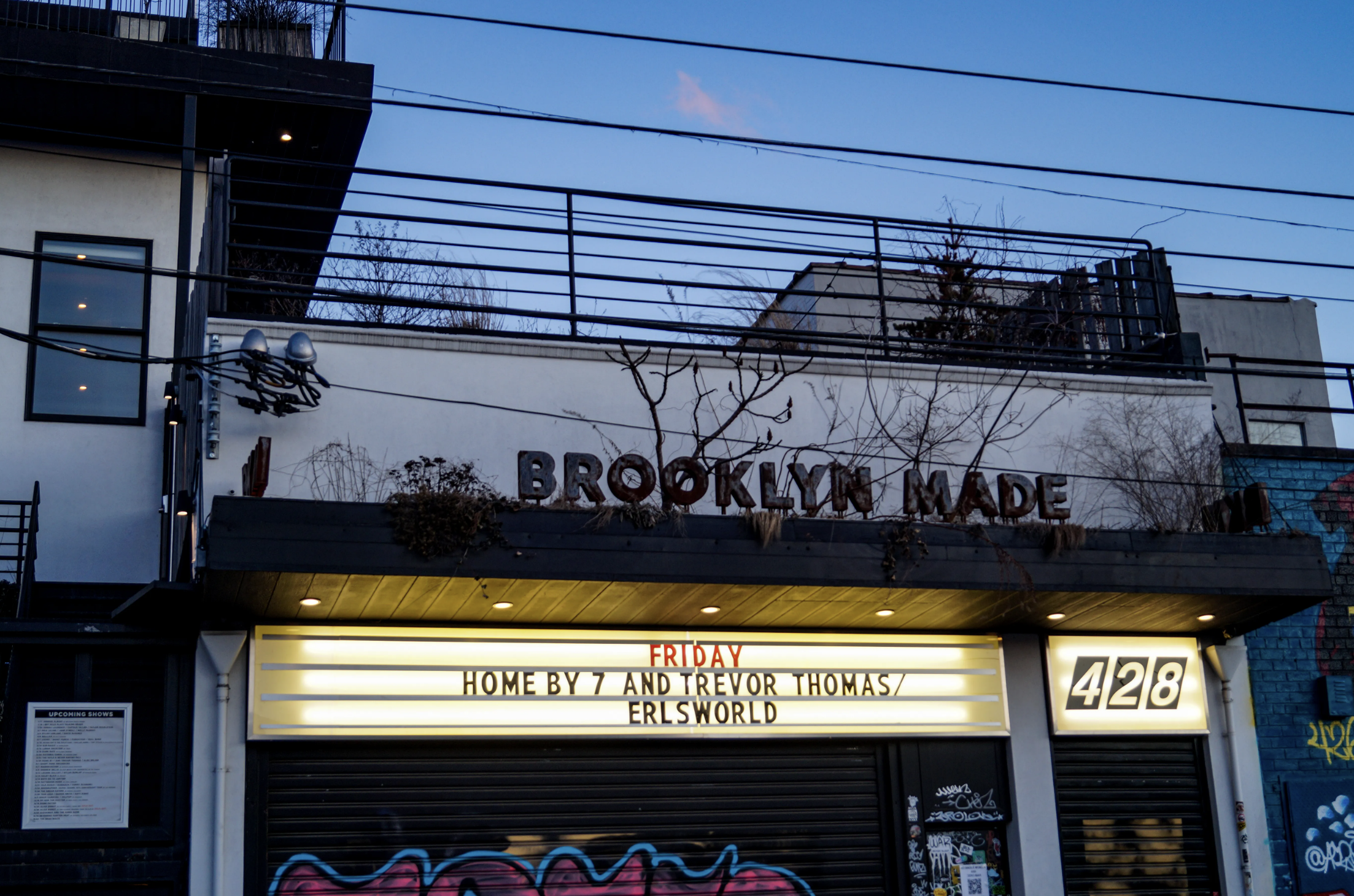
Outside, the venue’s big, garage-like door was shuttered, and the final marquee read: “FRIDAY / HOME BY SEVEN & TREVOR THOMAS / ERLSWORLD.”
Brooklyn Made first opened its doors in the Fall of 2021, just as concertgoers were returning in full force after the pandemic. The venue quickly became a home for local acts: bands with 400 followers on Instagram that were mostly made up of their friends and family. It felt like it was Bushwick’s own, a landmark to help you map the neighborhood from L Train Vintage to Starr Street.
You’d walk past it on a first date that’s going well and say something to the effect of “yeah my friends and I go there all the time, sometimes we’ll just go on a random Wednesday.” You’d tell them so they’d think you did more than just go to bars and restaurants. “We should go sometime,” they’d sometimes reply and you could look forward and smile knowing there’d probably be a second date.
It was a place to go on Halloween when House of Yes was $175 with no re-entry, and you didn’t even have that much fun last year anyway. Like in 2023 when Brooklyn Made put on “Hex Appeal” featuring Big Girl, Tetchy, members from Vivian Girls and more local acts, who all did covers of various big names like Kate Bush and Britney Spears to a half-full audience of Bushwick attendants. My friends and I went dressed as the three Liza Minelli’s from SEX AND THE CITY TWO, no one got it, but everyone was very excited to see three Liza Minelli’s all the same.

Brooklyn Made was a cornerstone of my first three years in the city. The first concert I saw there was Marlon Williams, a Māori folk singer from New Zealand. It was months before my friends and I had even signed the lease on our first apartment in Bushwick and Williams announced a rare visit to the States. We bought the tickets not knowing Jefferson Street from Jefferson Ave, and the only Ls we were familiar with were our dating lives.

Knowing that the beauty of living in New York lies in its public transportation, I impulsively bought tickets without even checking the venue’s location. I assumed Brooklyn Made might be in a more commercial area, like Downtown Brooklyn. The day before the show, I finally looked it up, only to discover it was just a 12-minute walk from my Bushwick apartment.
That night, not only did I finally see an artist I discovered at the peak of the pandemic, a cosmic end to that chapter of my life, but as I stood in line, I spotted Marlon and his band eating at The Rookery, a likewise now-closed Celtic bar that boasted fairly good burgers and cocktails across from Brooklyn Made. It filled me with a thrill that affirmed why I moved to Bushwick, because you could be standing in line to see a Kiwi Crooner and he’s right across the street with a beer, taking in the sun.
The intimate venue had killer acoustics, a stunning criss-cross backdrop behind the band, and a hallway bathed in Suspiria-red lighting for the bathroom stalls that you couldn’t resist but take pictures in while you were waiting in line. Best of all was a bar not just in the lobby but inside the venue itself. That meant you never had to choose between grabbing a drink and enjoying the show, a true win for concertgoers.

Over the years, I saw countless shows there, snagging $15–$30 tickets from the little silver trailer box office on a whim during a Bushwick night out. Brooklyn Made became a totem of Bushwick’s laid-back, post-hippie charm; a place where new establishments came with oddly upscale flourishes (a private pool for touring musicians?), yet the acts and ticket prices still felt refreshingly unpretentious and vaguely local.
Earlier this March, Digital Music News reported that Brooklyn Made’s abrupt closure has since been linked to a heated legal dispute between the venue’s co-owners, Anthony Makes and Kelly Winrich. Rising tensions over the management and financial direction of the space ultimately terminated the shared venture. Owner Anthony Makes, formerly of Live Nation and Bowery Presents, expressed relief at the partnership’s dissolution, stating, “I am very pleased that this partnership has ended and I am out of those buildings.”
This conflict not only shut down the beloved venue but also left two neighboring warehouses, once slated to become additional music spaces with 1500- and 2500-person capacities, now abandoned mid-construction. While specifics of the case remain largely undisclosed, the fallout underscores the challenges of running independent music spaces in an increasingly commercialized Bushwick.
The construction site sits, for now, as a reminder of what was to be a very loud street filled with music. Walking on this part of Troutman now between St. Nicholas and Wyckoff feels like gazing at an abandoned playground, imagining the life that once filled it.



Leave a Reply