“I know the government is really fucked up right now,” said a Canadian singer, who records as margø and was dressed in an all-black outfit complete with giant combat boots and crimped hair, who appeared on stage at Elsewhere on Friday. Originally from Edmonton, she had moved to the U.S. earlier this year, she admitted awkwardly. She was happy to be in a space like this, she told the slowly filling crowd, dressed in a wide variety of outfits, from PROTECT THE DOLLS and FUCK TRUMP t-shirts to full face paint and tights, belonging to a performance artist, whose accompanying photographer tells me, goes by the sobriquet The Misfit, and does shows at 3 Dollar Bill.
They were all here to see a lineup of the punk band and performance art group Pussy Riot, an aesthetically unified collective of Russian feminists, turned cause célèbre in the mid-2010s after two would spend a year in prison over a demonstration in a Moscow cathedral, released in 2013 only after much international protest.
Maria Alyokhina was one of those two and she’s been leading this run of the group after finally fleeing Russia in 2022, reportedly by disguising herself as a food courier “to evade the Moscow police who had been staking out the friend’s apartment where she was staying.” Like a riot grrrl Solzhenitsyn, she has since moved into the project of writing books about the repressive Russian regime, called Riot Days and she has adapted these texts into a hour-long performance piece that has been moving through the U.S. and Canada for the last year. “They’re, like, more than just a band. They’re, like, a movement,” a fan told the CBC last month, before a performance in Toronto.


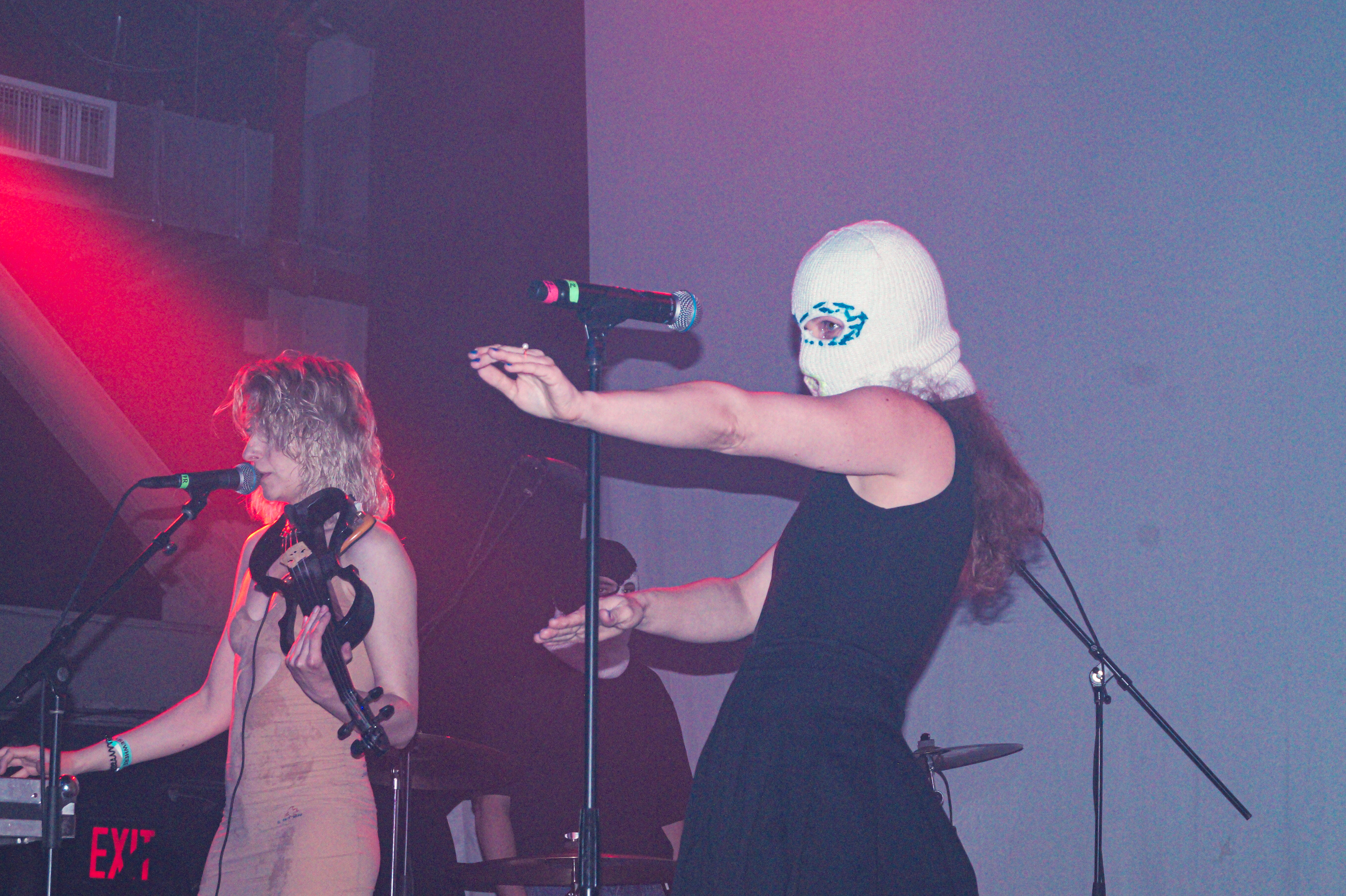
In Bushwick, Alyokhina appeared on stage wearing a simple, sharp dress, her face pointing stridently forward, when not covered in the group’s iconographic ski masks. Repeatedly she would lead the group in holding their fists downward, a gesture of continued protest. On stage, she was joined by Alina Petrova, a composer who, on stage, played a clear, glass electrical violin and Taso Pletner, a flautist who wore a bulletproof vest decorated with protest insignia. Pletner is involved in the group’s protest work as well, having been briefly arrested for a few hours by police in Switzerland for spraying anti-war graffiti in 2022.
Alyokhina’s piece was performed entirely in Russian, with subtitles above the stage, not unlike at an opera. They worked as a narration of Alyokhina’s arrest, over singing an anti-Putin song in a Moscow, an event she was using the piece to turn into a rallying cry against authoritarianism . Some of them read: “What do ordinary girls do in church?” “You mean to say it was not church music?” “Absolutely not.” This state may be stronger than time in jail. The more arrests, the happier it is. This is where the first GULAG camps were opened, and the last ones for those opposed to the Soviet regime.
At times, the group would don the characteristic ski masks they had worn; they would reenact the sharp, rap-rock “Punk Prayer,” the anti-Putin song that sent them to jail. They would reenact the violence of getting arrested, the sexual harassment from prison guards; they would empty water bottles on the crowd, some of whom had come in their own colorful Pussy Riot ski masks. Appropriating the brashness of the American punk tradition felt thrilling outside the traditional malaise of the suburbs or the griminess of North Brooklyn.
Before the show began, a serious-looking man took the stage; Alexander Cheparukhin, the show’s producer. “And by the way, who here has been at the show in Warsaw?” he asked the crowd, to a surprisingly resounding cheer. “Today, at least more than half of the show is new,” he assured them; the newer half of the show venerated the anti-Putin politician Alexei Navalny, himself recently killed in Putin’s gulag archipelago.
Cheparukhin went on: “I met Masha in her prison colony, exactly on the day of her 25th birthday. I wasn’t a prisoner, I was artistic director of a big Russian festival, and I was so shocked by what happened to Pussy Riot. By the laws of 2012, they deserved three or five days of community service, but not two years of fucking Russian prison. For fifteen years, I was naive enough to think that we lived in a free country in the world. Like, from the late Soviet Union and early Russia. Not in terms of, say, electoral democracy, no. But in terms of artistic freedom, definitely yes. No boundaries. Much less boundaries than in America, than anywhere else in the world. Artists could do anything they want.”


Photos taken by Andrew Karpan and Michelle Maier.


Leave a Reply