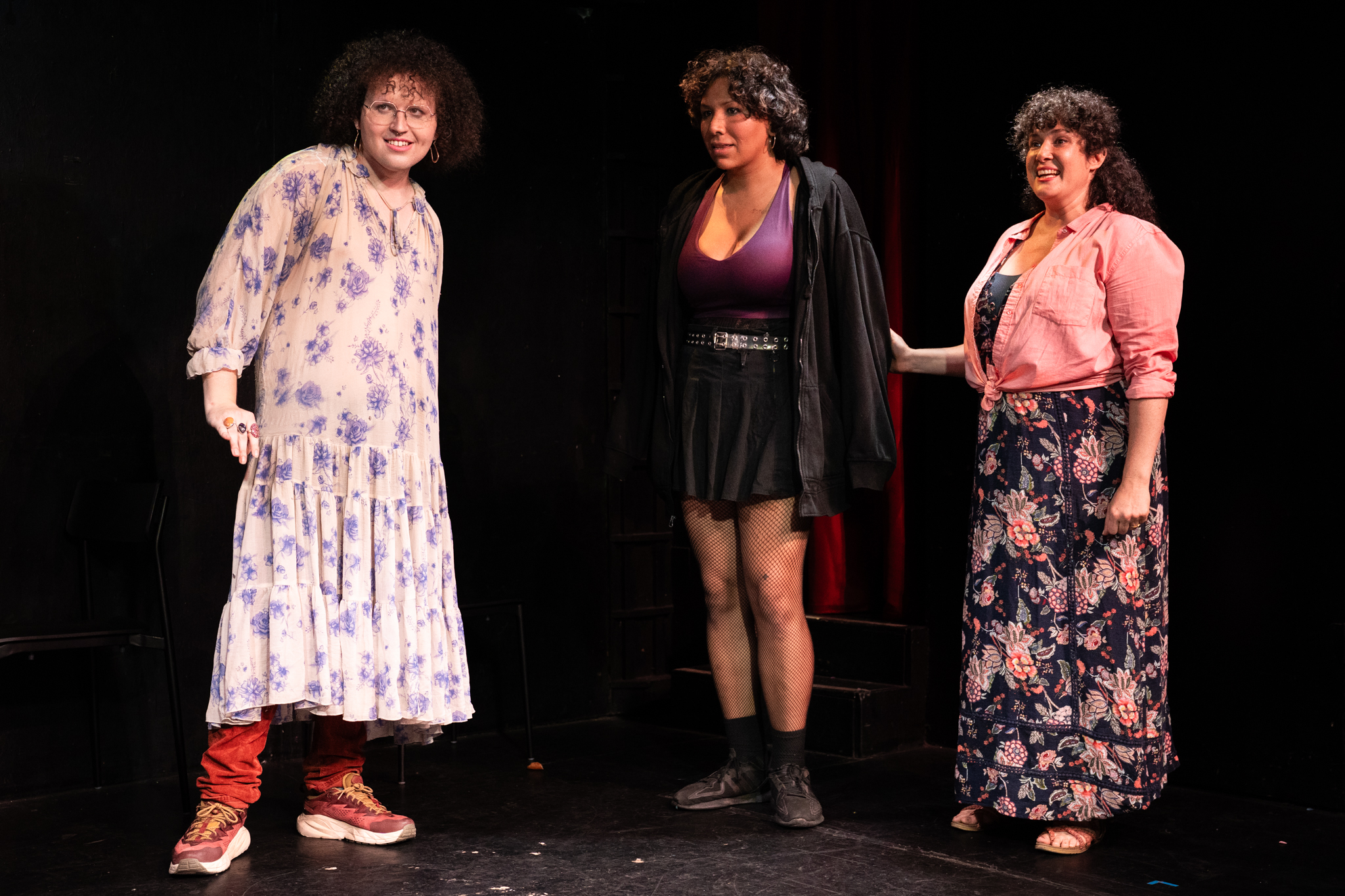
Last week, “Clay Mommy,” a play by the Ridgewood writer Aviva Pearl Creation, directed by Makenna Masenheimer, returned for a two-night run at Under St. Marks Theater as part of its annual “Queerly Festival.” Founded in 2014 by Erez Ziv and later curated by Kevin R. Free, the festival is now led by Jimmy Lovett who is currently prioritizing work by and featuring trans artists. The venue, a true black box tucked down a flight of stairs in the East Village, delivers on its name: it really is under St. Marks.
Clay Mommy follows Violet Abramowitz, a 24-year-old trans woman and former sex worker, as she returns to California after years in New York to reconnect with her estranged Orthodox Jewish mother. In this staging, Violet is portrayed by Flower Estefana Rios, with Maia Karo playing her mother and Clay Baker-Lerner returning as the golem animated in the image of Abramowitz’s late grandmother. As Violet searches for connection and purpose, she takes on a maternal role for a young trans girl, a family friend in the midst of her own awakening, played by Jackson Taitano.

First staged at Chez Bushwick last November, further performances of “Clay Mommy” has seen the play grown sharper and more layered in its evolution. “This past year the play underwent a very intense development period with seven different drafts in three months,” Creation told me. “There were times when actually putting the play up felt very distant, so I’m so happy and grateful to have been able to share this story again.”
One of the most affecting arcs in the play centers on Michal, Violet’s mother, whose inability to accept her daughter’s transition is complicated by her own unraveling. Battling addiction and clinging to a fractured identity as both daughter and mother, she spends much of the play reaching for connection with her dead mother. Her desire to nurture is constantly eclipsed by a deeper need to be herself nurtured, a portrait of how motherhood and longing can collapse into each other, and how cycles of abandonment shape the lives of women across generations.
“In the previous version of this play I think I wrote a much flatter and less sympathetic version of Michal,” Creation said. “In this draft I wanted to go deeper into her relationship with her own mother as well as her personal struggles that prevent her from doing the work to truly support her daughter.” Michal’s behavior is never excused, but her desperation to not lose Violet, however flawed, provides moments of emotional clarity. “At the end of the play though, no matter her motive, Michal is able to put in the work to understand Violet, and the two of them are able to work towards building a relationship,” said Creation.
The play blends magical realism, ritual, and dark comedy. “Whenever I’m in a desperate situation I feel much closer to the supernatural and I often turn to ritual as a way to move through whatever trouble I’ve landed myself in,” Creation said. “On the other hand, these situations are often incredibly comedic as they are usually absurd.” Creation says that many of her play’s most outlandish moments (which include a male puppet character delivering aggressively absurd pickup lines) are based on real things men have said to her.

Performing as part of the small Queerly festival offered some new opportunities for expanding the production. “We had a smaller and less raucous audience than [at] Chez Bushwick, but it was so wonderful seeing the play come to life with a full lighting and sound set up, which we didn’t have before,” she said. “The festival also helped with promotion, gave us the space to use, and even put photos from the play up in Times Square for a day, which was so cool!”


Creation hopes to bring “Clay Mommy” back to Under St. Marks later this year or early next, and is exploring further off-off-Broadway runs, as well as a production in Western Massachusetts.
“I hope the play makes people feel a little less alone and inspired to build family in healthy and mutually supportive ways,” she said. “At a time when trans rights are under such attack, we’re more likely than ever to find ourselves in desperate situations. Instead of spiraling, manipulating, and coercing people into helping us we must work to help ourselves and build solidarity and community connections to make ourselves less alone during this difficult time even when it feels impossible.”



Leave a Reply