
The Transplant Draft is an interview series with the newest team picks in the greater Bushwick, Ridgewood, and Williamsburg area. Read the last one here.
Aren’t we all better off disembodied but for a pair of thumbs, some coathangers, and a package room lockbox, all of it Bluetoothed to a credit card? That way, we’d function as true conduits of finance: no friction, nothing but circulation. The soul and body are just middlemen. We’ve come so far from gong farmers and woolgathering. Was it all worth it?
It’s hard not to feel lonely and stupid and broke in Bushwick. Everyone warned me, but it’s easy to think we’re above universals. I feel particularly alone when intricately dressed people don’t stop me on the street to ask how my night’s going. I can only seethe and project my average screentime so much onto others before the horrible happens: I start to look inward.
I feel like an ant, but a rarer kind of ant that makes everything more expensive. The developers quicken the infestation. I imagine they dream of turning all of Brooklyn and transit-accessible Queens into Infinite Williamsburg: a landscape of guys who do whatever “brand partnerships” is and girls who work atop desk treadmills and have perpetually wet hair. How do you move through a world that’s one big condo? Will you only need an elliptical?
I spoke with Alex over Google Meet, my Loom screen recorder plugged in. Alex and I have shaken hands enough already. We’re better off haunting each other in voice and image. So we appeared to each other as we should: as bobbleheads. But something wasn’t right: our shoulders were too big. They did in fact support our heads.
I was surprised by how normal her office looked in the background: frosted glass, stacked boxes, an ambient light that implied really old carpeting. I expected more glamour from the publishing industry: an aspirationally Scandinavian interior with Barcelona chairs and desks as low as Japanese dining tables. By the end of our conversation, I learned I have a problem with not knowing what I’m talking about.


Aaron Tomey: When navigating a crowded dive bar, are you a shoulder tapper, or a tackler?
Alex: I don’t know that I’m, like, tackling people, but I’m just making space for myself. I’m looking for the holes in the crowd and I’m moving very aggressively through them.
AT: Tell me what your hometown taught you about the game.
A: My hometown—Ledyard, Connecticut, which is important because it’s in eastern Connecticut, so it’s not New York Connecticut—taught me nothing about the game, because my hometown has no game, has never heard of The Game. Most people from my hometown—I think everybody’s hanging out at home. I learned that I knew nothing about the game very quickly. And that I was very unprepared.
AT: How do you feel about Cam Skattebo’s prospects when he returns from his injury?
A: I don’t know who that is. [I explain who Cam Skattebo is.] I think his prospects are probably short-lived. He should stay on the sidelines. Maybe retire.
AT: What’s your injury recovery plan usually look like?
A: Normally I complain for a really long time. I make everybody feel sorry for me. And I lay in bed. I’ve gotten really into, like, ibuprofen recently. I only take one, but that’s because one works. So why would I take more?

AT: How many Substacks are there in your friend roster?
A: I don’t like to read online. I would never read a Substack. I don’t need to read every thought that you have. If you’re my friend, just talk to me. And this might make me an elitist, but I’m okay with somebody curating the media that reaches me. I don’t necessarily feel like everybody needs a platform, and I don’t have the time or willpower to sort through and decide who I want to pay attention to. If I’m going to read something, it’s either going to be something that a friend has recommended, or something that 200 years of history has proven people still want to read.
AT: What’s your walk-on song? How often do you listen to it?
A: “Sports,” by Viagra Boys, but I pretty much never listen to music while walking in public. I actually don’t belong in Bushwick, and you should probably kick me out.
AT: How much of your workday is spent reviewing footage with your team?
A: Maybe like an hour a day. We have real life meetings. Well, even those meetings are half-virtual. There’re always those people on the screen.

AT: What’s your at-home/away game ratio?
A: 4 days a week in the office, then on Fridays I normally work at a coffee shop, or the library. I don’t have Wi-Fi at home. It’s easier to work in-office, too. And I like my work friends. I don’t mind the commute. And I’m a better employee there. Marginally, sometimes. Sort of.
AT: What’s a part of your gameday uniform?
A: [When working remotely] Normally, I just wear something that I think the people of Bushwick will think is cool. And a tote bag. [I posit backpacks.] I’m not a child. But with guys and tote bags, I guess it’s little, like—I wouldn’t say it’s a super masculine move. But, I mean, to each their own.
AT: How has the team developed since you arrived?
A: When I started out here, there was a lot less. Bushwick was still kind of COVID-y. A lot of things have come and gone. Now there’s a Chipotle on Knickerbocker. [I accuse Alex of being a coastal elite for criticizing Chipotle, which is beloved in the Heartland. She says she lived in Kansas for a year as a child.]
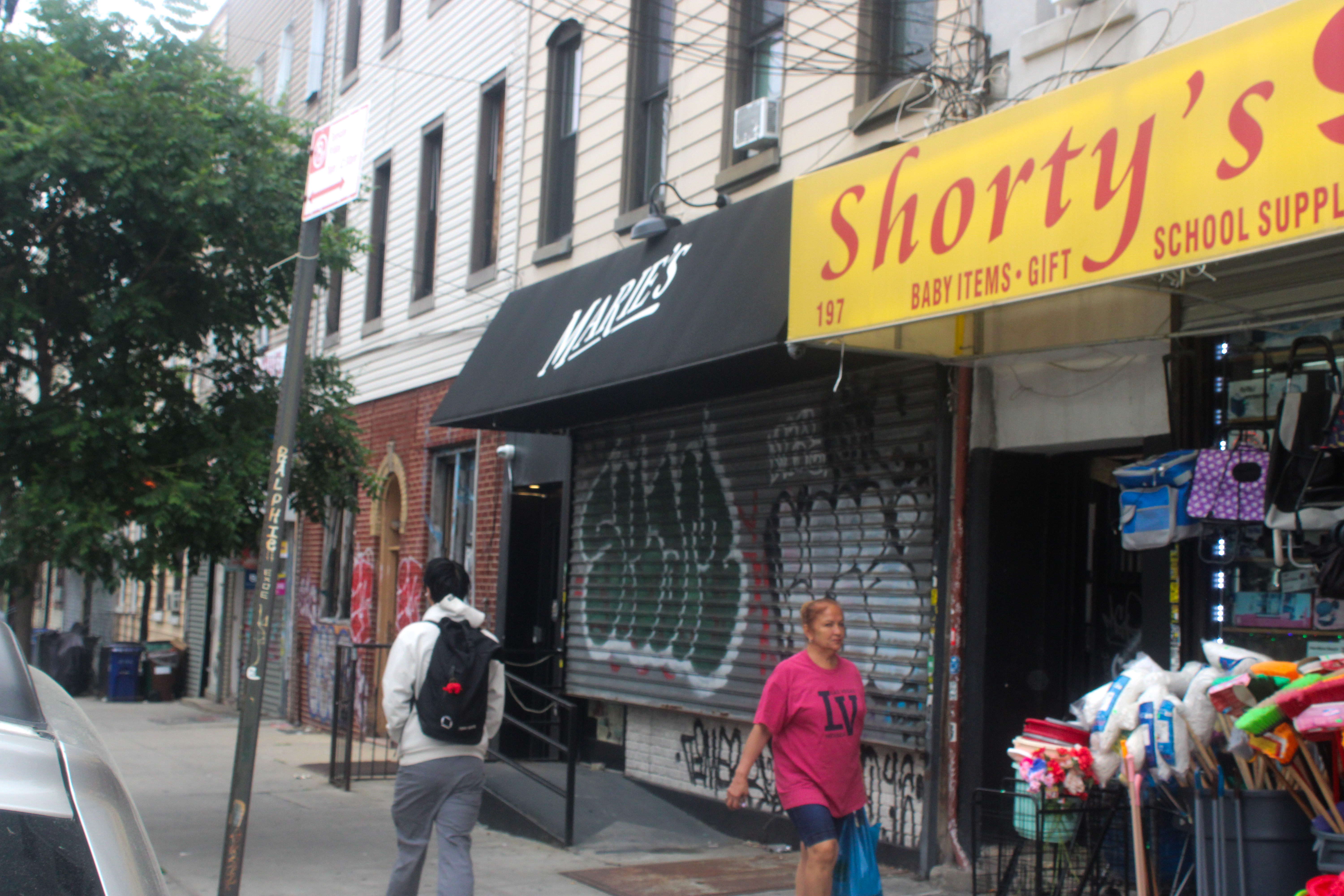
The apartments are annoying. I understand what they’re building them for, but I don’t understand who the target audience is. I assume that it’s not somebody I really want to hang out with. In the time I’ve lived here, the crowd has changed a little bit. It’s not overwhelming, though. I don’t feel like I run into people who are the techie Williamsburg type. But there are places like Carousel that cater to the Manhattan runoff crowd. So, yeah, I think Williamsburg is coming. It’ll just keep pushing east.
AT: How are you helping the team?
A: I work on a zine that rejects apathy for radical feeling in action. It’s called Bushwick Burner Phone [Pitchfork-approved!]. We solicit fiction, poetry, and essays, primarily from Bushwick and Ridgewood. [Disclosure: I have contributed to Burner Phone, as has Grime Square EIC Andrew Karpan (pinnacles of unbiased reporting)] The goal is to make an in-person artists’ space and connect with the people who are in the community who see the things that I see and share my experiences to a certain extent.
It’s about being able to be earnest, and care about things, and organically discover. You don’t have to always be online. You can walk up the street, see something interesting, and engage with it.
AT: Who else pulls their weight on the team?
A: Dykes and Dolls rounds up queer events and prints zines to distribute around the neighborhood. Zine Club is very Bushwick too. And because Burner Phone has a very offline mission, we’ve interacted a lot with August Lamm, who has a few different projects about getting offline and dumbing down. And [Lamm’s] friend Magdalen Kennedy just started a small press called Loose Tooth Press that publishes short fiction and little affordable books.
AT: What kind of contract would Fort Greene have to offer for you to accept a trade there?
A: A big loft that I could turn into my commune/zine office. Where we’re all living together in one big room. We’re getting hammocks. This is the dream.
AT: You ever done a 3 cone drill before?
A: No. I guess, maybe, like, as a child, in soccer?

OUTRO:
After the call, I am yet again in a body in a neighborhood where I feel like an ant. But no one gets mad at ants, even when they’re killing ants. They’re mad at their landlords for renting their whole family a 2 bed flex hovel.
Talking to Alex provided some light. At least some of the adults are alright. Some are aware of what a screen really means, of the consequences of a lifetime spent disassociating. So they make objects and experiences that are so actually tangible that they require a minimum of real life effort to discover. Friction can be a good thing.
Authenticity can’t address the built landscape, but it can teach us to find our peace in it. If I ever take a non-work call on Google Meet again, it’ll be in the next life. I just uninstalled Loom.
Aaron Tomey is from Georgia, lived in St. Louis, and now lives in Brooklyn. His essays have previously appeared in Hobart, Bushwick Burner Phone, and Apocalypse Confidential. He can also be found on Twitter: @ecstatic_donut.
Photos taken by Alex, edited by Aaron Tomey.


Leave a Reply