—accept them. That’s why we’re here: to see acceptance demonstrated. It’s the only worthwhile ritual. That’s why I sat in an East Williamsburg warehouse, looking at a stage framed away from painted ductwork by blue curtains (never drawn) accented by fluorescent strips.
I was there to see blue seal, blue sea (or, gay boy grieves death of gay-hating dad), directed by Clara Wiest, written by Dante Fuoco and which has made its way over to Makers’ Space on Grattan. In it, Fuoco plays F@gg’aught Flamé. (His character is actually and also named Dante, which is how I’ll be referring to him in this review, since I don’t have enough skin in the game to get away with that.) Dante is stuck in another world that’s actually his own head, imprisoned by the VCR cleaner he huffs like poppers. But how often do we meet each other at our peaks?
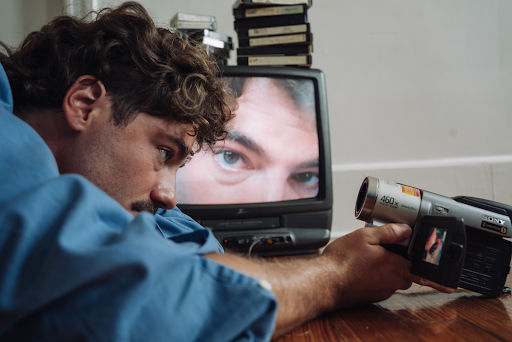
Dante forgot his name. He needs to be reconstituted. His parents—a skeleton (Dadá) and translucent mannequin (Mamá)—aren’t too helpful, but a guardian angel-doll (voiced by Amberine Huda) and velvet-gloved hands (stagehand Jimmy Guest) guide Dante through his past via a VCR installed into a large contraption called The Closet, which Dante has hidden in at times. The closet is the aperture through which the audience sees Dante’s past. He handles the VCR player with a mix of childlike surprise and muscle memory. He attempts to rediscover his name and life through his media relics.


Months ago, I had read Fuoco’s essay in Split Lip. There, he uses media spectacle—Abu Ghraib, Anna Nicole Smith—to frame a narrative through his childhood and teenage years. In it, we see the myth of Nicole Smith manifest in her reality TV show and media appearances.
Dante’s myths are music videos, TV shows, and home videos. He lip syncs to early 2000s hits while wearing a skirt and shirt made of pajama scraps and button-downs. When afraid, he lapses into performing as a cop, miming a gun with his hands. With no understanding of his past, he operates only in its extremes: joy and agony.
The play is a dirty pool of humor and cruelty. The humor doesn’t always land: it fluctuates between the obscene (i.e. gooning) and lighter drag antics. Sometimes we try, but life isn’t always funny. Mixed in is intergenerational trauma laid so bare and naked, in the way of memoirists, as to be cruel.
His father, per the title, was deeply homophobic, but also supported his son’s pursuit of musical theater at times. He was a man whose past didn’t deserve full forgiveness. Dante learns that he doesn’t have to forgive all of someone to move on, that parts of the worst among us might still be deserving of love. Some of our pieces will be remembered; others will never receive absolution. Half of us will be cast to hell. The remainders reappear in heaven: our living nostalgia.
There is levity, too. Young Date barks like a seal in an old home video taped by his father. A lot of the clothes are blue. There are beachside tapes of Dante in youth and adulthood. There is no conclusion, no tied bow, for this imagery, and there doesn’t have to be. Sometimes, these are just the details of a lifetime.
He relearns his name and dons a new costume: a tight dress with a belt from which a bouquet of plush dildos dangles. When confronting a video of his cop persona, Dante breaks an in-universe 4th wall to resolve the drag/cop dichotomy. Through the TV, he spits into the cop’s mouth and demands that the cop call him “Daddy.” He usurps masculine authority while negating the stranglehold the home videos have over him.
He discovers agency, ends in a tutu. The final video montage is more recent than the childhood videos. In these clips, Dante is with his mother. He has found the remaining familial lifeline. But there are only so many videos, so Dante takes up a camcorder to record the present, to immortalize what he’s become. He stands on pointe, then records a closeup of his face as he tells a final story about his father. There is artistic restraint here: the camera wasn’t pointed at the audience as a cheap gag. The story remains memoiresque, rightfully self-obsessed, though shows self-consciousness in the end: Dante addresses the audience in a tone reminiscent of a comedian who suddenly wants to have a heart-to-heart with 600 people.
The play’s faults are negated by its willingness to be vulnerable, to err. How often do we succeed? The beauty is in the attempt. I watched someone ask others if they could spare some understanding. I sat close enough to take to the stage and harangue Fuoco, but I didn’t: I listened. So I’ll keep watching, keep watching to see wreckage become building materials for the essential regeneration: the becoming of a stronger composite of one’s befores.
Catch Wiest‘s production of blue seal, blue sea (or, gay boy grieves death of gay-hating dad) until November 23rd at The Makers’ Space (13 Grattan Street, #408) Tickets ($28) can be purchased here.
Aaron Tomey is from Georgia, lived in St. Louis, and now lives in Brooklyn. His essays have previously appeared in Hobart, Bushwick Burner Phone, and Apocalypse Confidential. He can also be found on Twitter: @ecstatic_donut.
Photos courtesy of Clara Wiest.


Leave a Reply