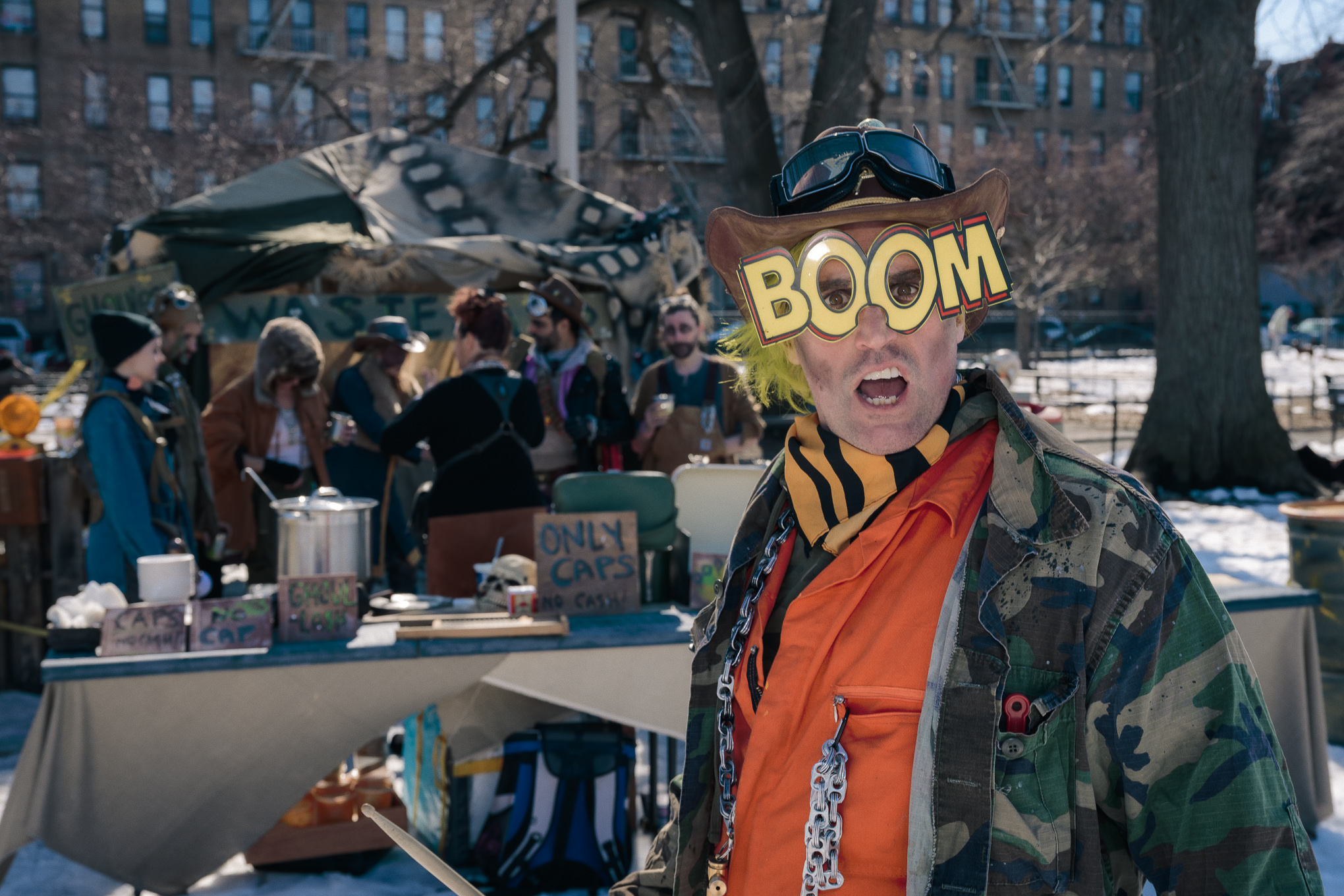
An alien made of five shopping carts launched an Eggo waffle at my head. A narrow miss. A pack of kids scrambled to rescue it from the melting slush of Herbert Von King Park. It wasn’t an attack. It was an invitation.
The year’s near-record winter was finally easing. The sun was out, jackets open: ideal weather for Competitive Winter Picnicking, organized by Shadow Traffic, a participatory arts collective that stages absurdist public gatherings. The group began in 2017 with a Burning Man Global Grant to create night market bazaars housed in box trucks in New York City and Philadelphia. They now host at least one recurring event in every season.
For this one, teams built themed picnic stations on the lawn of the Bed-Stuy park. There was the “Ramen Hood” station, where you could shoot arrows at cups of ramen; a star-chart-reading tent; two apocalypse stations (sign of the times); and many more. A coterie of immaculately made-up clown judges circulated with clipboards, inspecting each station and awarding the winner a spray-painted golden basket (bribes accepted).
“Winter is a hard time,” said Jaclyn Atkinson, one of Shadow Traffic’s co-founders. “Everyone’s been cooped up inside. It’s nice to have something to look forward to and build toward with friends.”


Jonah Levy, another co-founder, agreed. “We like to utilize public infrastructure,” he said. “We want to help people feel more at home in their city and in their public spaces.”
When I asked about the role of whimsy in the midst of a grim news cycle, Levy nodded. He said he has a two-year-old, and sometimes it helps him handle the weight of it all to dress like an English duke and shoot down a cup of noodles.
The event has roots in Burning Man culture, though he said the popular image often misses the point. “People hear Burning Man and imagine P. Diddy marching through the desert,” he said. “They don’t realize there are also a ton of day-to-day creative culture workers trying to cultivate joy.”
One source of joy among the competitive winter picnickers was a team worshipping the beet as a versatile ingredient. Their station featured homemade beet sweets, dips and chips. They wore all white, with beet prints staining their clothes. Each member had a streak of juice across their forehead—a beet blessing. They told me to return later and see how their station would evolve. “Come beet off with us,” an acolyte called.
The event threaded an unlikely needle, feeling both family-friendly and gleefully adult. As members of Shadow Traffic began having kids over the years, they simply brought the children along, the way whole families now attend Burning Man.
I ate some clown brains (Jell-O shots), and almost forgot about their invitation until I saw their ringleader, the Gowanus Adonis, standing in the center of the field, clutching a beet in his raised fist like a bloody heart. Juice ran down his arms, across his chest, his whole body splattered in beet blood.
“There’s a world before beets and a world after beets,” he told me. “Before beets, people were pale, struggling, anemic. Low iron. No energy, sleepy all the time—like that one person you know. And then there’s the world with beets. I’m flushed every day. Energized. The tang of nettle in the back of my throat. I have the mark inside of me.”
He leaned closer. “What’s more attractive than a little flush in your cheeks? Do you want someone gaunt and sad and pale and beetless?”
I said they might in Ridgewood.
“I’m from Ridgewood!” he said. 1 “That place doesn’t even know where it is. Used to be Queens. Now it’s Brooklyn.” He threw up his hands.
Near the edge of the circle, I spotted two white plastic chairs set up against a leafy backdrop. The station, called Bad Bunnies, handed me bunny ears and bunny snacks while they took my picture in honor of Benito, my forever crush. As the snow melted, the chairs were slowly becoming their own island.
Still hungry, I drifted toward an apocalypse station serving goulash and a spiked beverage called “ghoulgade.” But first I had to earn it in a game of capjack. A man in steampunk fatigues and busted prop teeth dealt me in. I had to offer something as a chip, so I handed over my used plastic shot glass.
The woman next to me offered a coupon for a free cocktail at a Union Square hotel, a much stronger bid. The dealer rummaged through drawers and rewarded her with a prize: someone’s expired State Farm insurance card.
I lost the hand, but still received a token for goulash. When I asked if I should throw away my shot glass, the dealer looked shocked. “Absolutely not,” he said. “That’s my winnings. It’s not that I want it, but I can’t not have it.”
Walking around with my bowl of soup, I realized I was happy. It’s easy to forget how much we need community, connection, plain old stupid fun. Doing something for no real reason except that your heart is still beating. Whenever I get too comfortable in my adult routines and start thinking this sort of thing is childish or lame, I know that’s exactly when I need it.
It really doesn’t take much. The potato camp ran sack races using burlap bags from SEY Coffee. One game challenged you to snatch a bottle cap out of the air after a clown bounced it off a drum. In another, I crawled inside a tiny clown tent and made a racket with noise makers while clowns listened in, reacting as if they’d just overheard something scandalous.
The character work was another joy. One judge wore a towering powdered wig and a cantankerous expression that made me laugh every time I saw them. They looked unimpressed when I dared to stammer through some nervous questions about what it took to win them over. They stepped closer. And closer. Soon we were locked in a stare-down that felt both terrifying and thrilling, like that capjack game, where I didn’t know the rules but had already been dealt in.
Later I noticed a couple hovering near the edge of the grass, watching cautiously. “Excuse me,” one of them said. “Can you tell us what this is?”
I explained the event to them and said anyone could join. They brightened immediately and headed toward the potato sack races.
Watching them go, I thought about how much of this culture revolves around permission. Permission to be silly in front of other adults. Permission to share food and games with strangers. Permission to show up with full, earnest energy in a city whose social currency often runs on outdated ironic detachment.
Lots of park visitors walked past and didn’t join in, including parents whose children were clearly itching to run over and grab waffles from the air too. All they needed was to know they were invited, I thought, and all this nonsense could be theirs. The only thing in their way was themselves.
About an hour later I ran into that couple again. They were clutching drinks and laughing, smears of brilliant magenta across their foreheads. They looked right at home.
Sam Ligeti (she/her) is a writer based in Brooklyn and an MFA candidate in fiction at The New School. She writes about art, spirituality, community, and why everything feels like a metaphor, especially when it isn’t.
Photos taken by Shamal Deare and Edwina Hay.
- After publication, Mr. Adonis clarified that that he wasn’t from Ridgewood, as previously misreported in the chaos at the park, and that he would not “have said that Ridgewood was once part of Queens and is now part of Brooklyn.” Grime Square had interpreted his statement—in whatever form—as cultural commentary, and not a debate on county lines.
↩︎



Leave a Reply