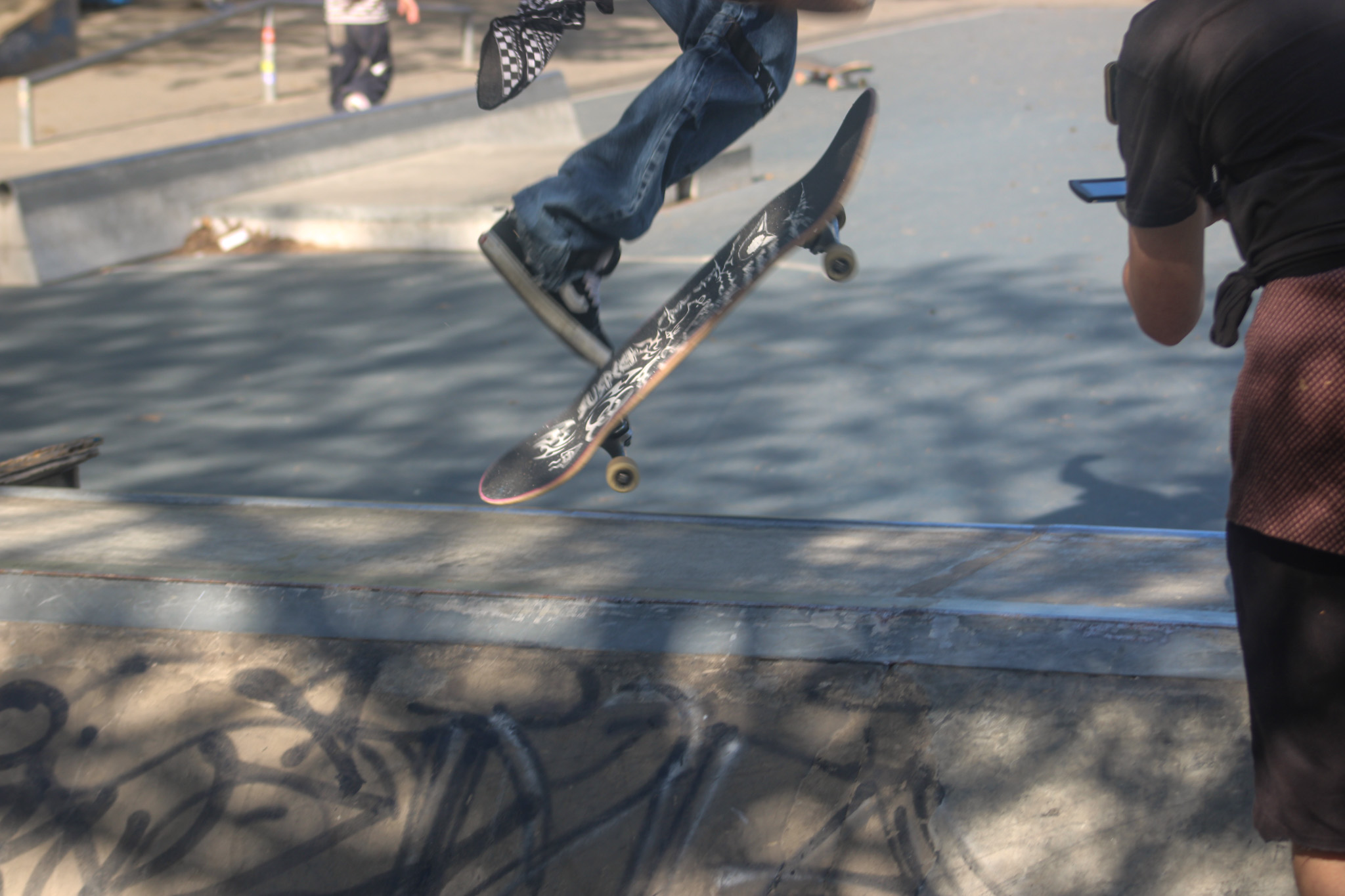
Most NYC cultural experiences involve sitting, standing, or some combination thereof, but either way spent ingesting something (food, media, et al.). Queer art/skate collective Spygrrrl succeeded in doing the opposite at their Gayest Trick Contest, hosted at East Williamsburg’s Blue Park (88 Stagg St.) on a mid-April Saturday.
Built around 2013, Jenkem-approved Blue Park is a basketball court surrounded with obstacles to conquer. Ramps, halfpipes, and ledges simulate the kinds of public spaces that skateboards have historically repurposed for sport. One skater named Chris said that property owners and the government “view it [skating] as a kind of destruction and not as something productive, despite it bringing a lot of people together.” The world often isn’t ready to become a high-speed playground.
The Spygrrrl collective, founded by NYU senior Bec Bender, have turned this sport into a happening, or at least a cultural moment. Anything beyond that is a gray area. Someone there hit a sick grind on a tailpipe.


After jazz and hot rods, skating might be one of the original American countercultures. But if it’s still a counterculture, then what culture does it counter? The internet merged and balkanized all cultures. Skater, goth, country throwback: all signal toward individual taste and persona, not an organized subculture that exists in opposition to a defined monoculture that is everything and nothing at once.
Per Spygrrrl member Pappa J: “Skateboarding originally was against everything. Everyone hated skateboarders. They weren’t allowed to be anywhere. There were no spaces made for them. And then we’re a group of people who are often othered and excluded.” How are skaters othered today? “Just like in existence.” The community-making of skaters repurposes environments that constantly reshape to antagonize them with disruptive studs drilled into benches and ledges.
Of the event’s inception, Bender said, “I just enjoy discovering material, learning how to work with it. I’m always looking at different things when I walk around and stuff like that. I was making a lot of ceramics… and once I started getting a little bit better at printmaking, I realized how I could use it to kind of build something. Spygrrrl was originally a zine, but then I put it on the shirt that my dad was wearing, actually.”


The contest coexisted beside a crew of beefy-wheeled bicyclists. The Gayest Trick attendees covered a range from queer to straight-presenting, from post-20s to elementary age. A space and happening can be unpolitical without being callow. “I mean, it’s people having fun, doing their thing.” Dan Bender (Bec’s father, in from Maryland to help with event logistics) told me as I snorted nasal spray (on account of the pollen brutality). He added, “Bec has found the will and the gumption to bring them all together.”
I wondered if Dan ever had a counterculture, back when he lived in D.C., where Bec was partially raised. I dropped lines about Dischord Records, if only to flex that I knew who Shudder to Think is, but Dan didn’t bite. Someone else hit a sick grind on a tailpipe. Everyone seemed overjoyed, either at that or by being together, but cheering either way. I wasn’t sure it was all performance art, though.
I don’t quite believe the Gayest Trick Contest was art: there were too many people moving of their volition and intent, too many hands in the pots. It’d be like Rauschenberg’s competing materials, all suddenly alive post-sequencing, having their own little ideas as to what their collage means. But whatever people want to call it is fine, so long as it creates a sense of togetherness that transcends the hot, empty air that comes with every abstracted mention of “community.”


This was a natural community, one of shared interest, where competition was a game, not sport. Skye, host of Queer Skate Brooklyn, said, “I don’t actually care to win anything.” Skye didn’t even know what the prize was. “I’m just here for a good time.” They skated off, presumably to hit a sick grind on a tailpipe.
Bec Bender also said, “I started thinking about street spots in skateboarding as sculptures, then the space being the art kind of just fit right into that. It wasn’t intentional at the beginning or anything. I wanted to bring everyone together, pretty much.” I remembered something Chris had said earlier, that the challenges they sign up for bring “skaters together, because then they’re all together looking for a spot to skateboard… They’re working together.” I left before Spygrrrl crowned the winner. No one seemed concerned about winning. They acted like they’d already won. And they had.
Aaron Tomey is from Georgia, lived in St. Louis, and now lives in Brooklyn. His essays have appeared in Hobart, Bushwick Burner Phone, and Apocalypse Confidential. He can also be found on Twitter: @ecstatic_donut.
Photos by Andrew Karpan. Drawings courtesy of artist and attendee Lily Edmiston.


Leave a Reply