Anyone who knows me knows that I love an argument that goes on forever. Maybe that’s why I’ve had a hard time wrapping my head around the controlled punk noisework that is YHWH Nailgun, true superstars of the Bushwick transplant punk scene, our very own Nirvana that dropped in from Philadelphia and quickly made it out of playing the second-floor of the Broadway and sets at TV Eye. They play festivals and tour Europe now. Their whole thing is brevity; their debut clocked at 21-minutes and their latest record, their first on the same London label that signed Pixies, runs at just about half that. Shorter, faster, you get it.
But if they’re leaving the world behind, they’re also still around. The night Magazine came out, the group could be found playing a free show in the grand ballroom of Gottscheer Hall (6-57 Fairview Ave.) the gottschee social club that made it into its latest century by turning into a hangout for the area’s curious newcomers.
The past was always malleable, something that could be switched in easily for something else. Some months ago, I caught the area’s nouveau locals packed in the same early 20th century ballroom, dressed like cowboys; now, they were here dressed like punks. “Future outcasts and they don’t last,” as the old song goes.


It may have been show #1 for the group’s world tour of their 11-minute album, but for everyone at the bar, it was Game Four of the NBA finals, a situation that had filled the room with a kind of nervous dread.
The Knicks had a kind of underdog authenticity that spoke to the area’s newcomers because they were currently in the process of winning. Their finals run had created a perfect storm of collective interest, which Magazine reworked into a document of the city’s temporary attention. Fittingly, in Ridgewood, most of the room’s energy was directed to the show’s furtive openers, Anastasia Coope and DORIS, the latter not a Spurs bar in Crown Heights, but a Brooklyn rapper with a well-received collection of “lo-fi sampledelia.” He trawled the stage, both rapping and making ambient noises, and I didn’t know what he was saying, but I liked the frank way he was saying it.
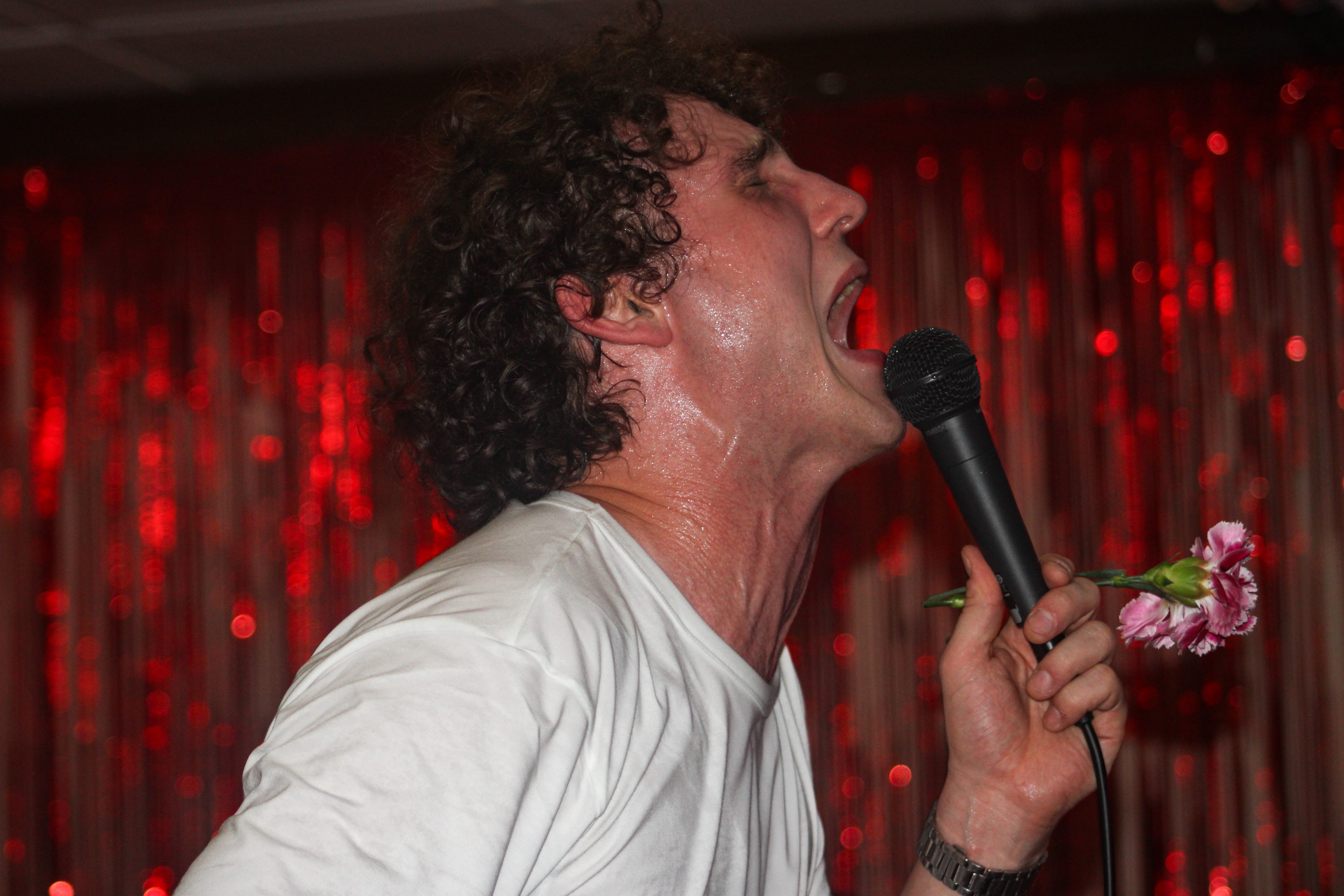
It was hard to make out much of what YHWH Nailgun singer Zack Borzone was saying either (recent song titles like “Stillness Blues” and “Innocent Sigh” and “Ghost of Love” give some idea), but fortunately the group did a photo op earlier at Gottscheer that landed in Interview magazine a few days later. “It’s called Magazine because of the many meetings and associations with that word,” he said with much insight. “Yeah, like a magazine in a gun. Or like pictures in a book. The Z just feels really good.”
It didn’t matter what he was saying, it was just the way he was saying it: that was the radical idea put forward by today’s punks. At the end of hardcore was a message of distilled nothing.
On stage, Borzone had an earnest theater kid energy that was moving to see applied to a formless version of Iggy Pop. He was only fifteen years too late to try out for Hamilton. Around his ears, instead, he was wearing a rose, like some kind of gladiator, and he would occasionally throw those out into the crowd too. The songs were all two-minute “images of doom,” as Greil Marcus would put it, and they took over Borzone, who sweated it out on stage with a kind of knowing charm. What made this work were the Remain in Light-adjacent riffs coming from the most talented member of the foursome, Saguiv Rosenstock, whose prickly guitar work gave all this a kind of danceable form. By the time the set ended, the Knicks were still down ten or seventeen and Jalen Brunson was still choking, while Borzone and his friends were ditching the stage, and the room faded into a kind of pointless disappointment that would itself be forgotten soon enough. They would be in London a few days later, playing another free show. The ball would tip in. It didn’t matter what anyone was saying.


Photos by Andrew Karpan.


Leave a Reply