
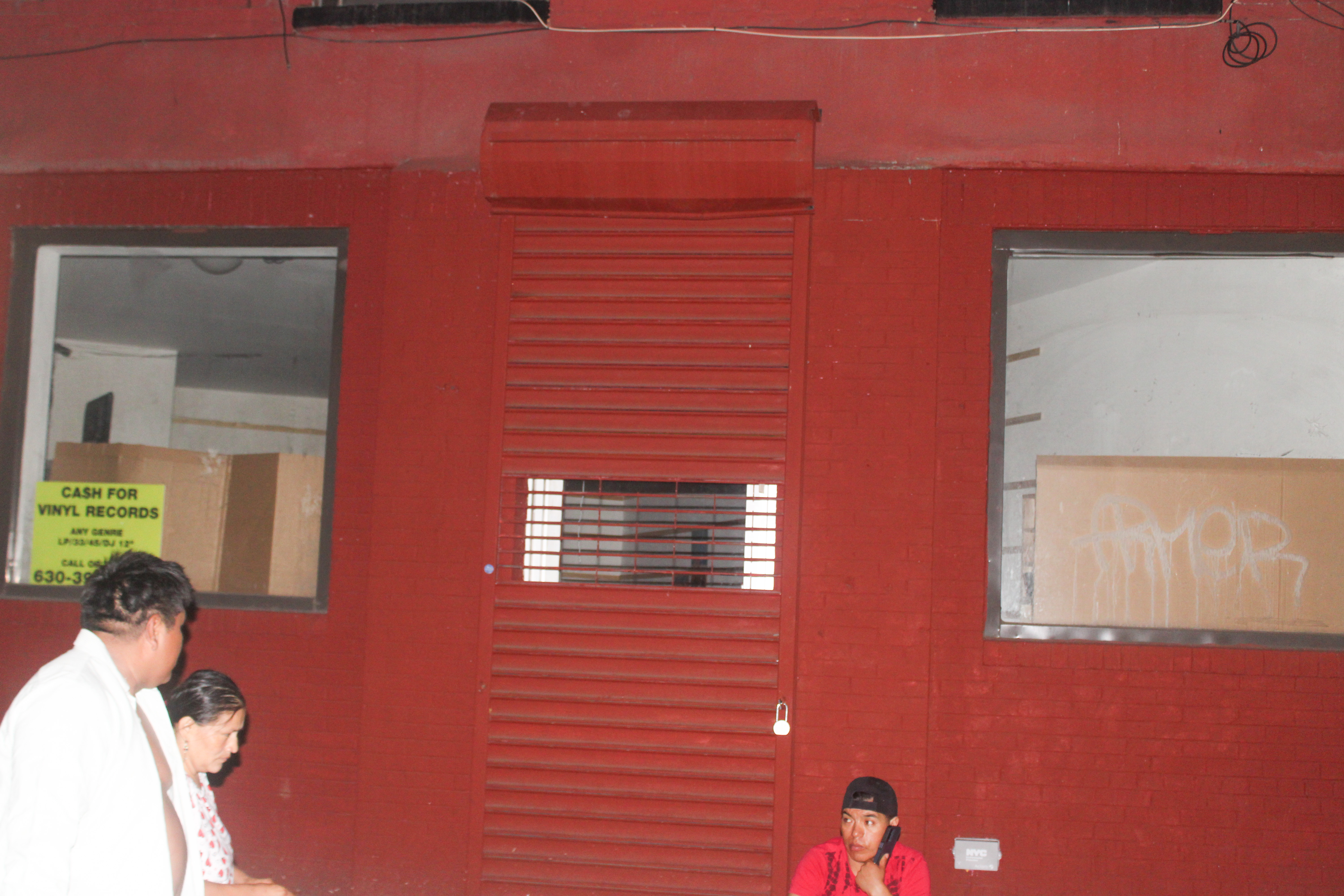
The owners of the Bushwick Abbey (176 St. Nicholas Ave.) are selling the property to developers for $4 million, and are kicking out Mayday Space, a local community group that has been renting the space out for over a decade.
“The church has put the building up for sale,” said Finn Baum, a fourth-generation New Yorker and longtime Mayday member, during a virtual town hall last night that included Mayday regulars and users of the space. Some ran music production workshops (“Liberation Sounds”) out of the upstairs space in the church, while others ran teach-ins aimed at “Divorcing Google.”
“They did not tell us they were doing this. We found out from a community member who sent us a post saying, ‘Hey, is this Mayday? It seems like you guys. Your building is being sold,’ said Baum. It hasn’t been a great month for churches.
“Actually, it’s been really hard communicating with the church. They have not been forthcoming with timelines and [willing] to work with us on making sure that we can continue in our space,” Baum added.
Speculation was simmering about the move from the church, an Episcopal congregation that operates out of the Iglesia Santa Cruz church building. Details weren’t known about the developer; there had been two competing bids for the space, Baum said, and it appeared momentum was centering around one of them.
The congregation operates the Bushwick Abbey, “a queer-friendly Christian community” that’s home to Reverend Vince Anderson, a popular underground folkie, subject of the recent documentary “The Reverend.” Representatives for the Abbey did not respond to my attempts to call, email or message them about this, and Anderson hasn’t responded to an email either.
“And the developer, of course, will be tearing down the building to build residential housing, you know, tall condos, surely as tall as the zoning allows for,” said Baum.
“Word on the street is that it’s going to be a luxury residential property,” I was told by P, another Mayday organizer and a career prison abolitionist who moved to the area from DC over a decade ago.
Eviction has been a threat to the group for the last few years, P told me. “Last year, they told us that it was going to be in six months. At the beginning of the year, we found out we had at least one year.”


“We have to be given at least two months’ notice,” said Baum during the meeting. “The church kind of said we have until the end of the year. And it sounds like that’s kind of when the deal will be finalized.”
“Staying in this neighborhood is crucially important for the organizing that happens in this neighborhood,” P told me.
The group’s origins inside the backrooms of the Iglesia Santa Cruz date to 2015, when the Mayday was celebrated by the Indypendent’s John Tarleton as “a space that is a hub not only for social justice organizing but socializing and hanging out and creating the human relationships that build community.”
Back then, Tarleton writes, it was a place where, on any given day, you could find “a panel discussion by climate change activists, a build-out of large, colorful banners and props in support of living wage protesters, a meeting for local residents fighting gentrification and displacement, a training on how to secure your laptop from government spying, a Halloween costume party or a ceremony in honor of Indigenous People’s Resistance Day.”
Outside the church, P tells me that little has changed.
“We have an incredible range of response networks to respond to ICE. We have mutual aid for communities. We usually source our food from local vendors. We throw ramp parties for folks who are being displaced from housing. It is a place that is safe for multiple kinds of organizing,” says P. “Having a space like this that is multifunctional and can be responsive to the community is really crucial to organizing, especially in the moment when we’re increasingly surveilled.”
As development has transformed the neighborhood from family oriented to “the home of New York’s young and reckless,” per the Guardian (characteristically a decade late), Mayday was an early signpost created by the area’s newcomers to both live out their earnest political aspirations and work among the populations they were displacing. Its early organizers had collective memories of the Occupy Wall Street movement and chose to settle in Bushwick with the idea of creating something more permanent than the tents of 2012.
“I’ve been involved in Mayday as a volunteer since 2018,” said Brian, one of the volunteers at the town hall. “And I really owe a lot of my political education and just a lot of my closest relationships [to] Mayday.” It was, for its newer members, as one put it, an “active space against gentrification.”
“It’s not Zuccotti Park. It’s not the open, ‘anybody do something’ model,” one of the space’s founders, now-City Council Member Sandy Nurse, would tell Tarleton in its early days.


Nurse moved to the area in 2009 and dispatched herself to Zuccotti Park on the very first day of the protests, where she quickly rose in the ranks of the anarchist protest’s powerful Direct Action Working Group before taking those ideas back to Bushwick.
Nurse would later tell Tarleton: “I see Mayday as like Zuccotti Park in a building.”
Crucial to the group’s identity straddling the line between the area’s otherwise competing demographics, Nurse told him that she emphasized placing “people who were born and raised in Bushwick and people of color in general on the group’s Planning Committee.”
At Mayday, Nurse and other ex-Occupy protestors had also discovered a different way of occupying space: paying rent. According to a presentation in the town hall, the group currently pays $3,200 a month to rent out the floors above the church. But if that was a way of making capitalism work for radical ends, it could only last as much as the market could allow.
According to Streeteasy, the median base rent for a single apartment in the area is $3,495. It was hard not to see the 2,700-square-foot room as the future site of a web of apartments.
“I think that it is also a lot about standing ground and saying that everything is not for sale,” P told me. It was the group’s second location, after opening where Starr Bar (214 Starr St.) now operates (“[Starr Bar is] a sister group,” says P, “but we don’t share finances or anything.”). Even after some permitting issues, everything had worked, at least for a while.
Outside of Mayday, Nurse would eventually advance into City Council, with her base of Sunrise Movement volunteers finally besting Democratic Party warhorse Darma Diaz in a series of contentious elections early in the pandemic.
P tells me that the group has been back in contact with Nurse, who has been made aware of the sale.
“We’re trying to get her back involved, depending on her capacity,” says P.
At the moment, the group is debating and deliberating their options, publicly and with numerous introductions, in the spirit of Occupy. Everyone was being listened to. A New Space Research committee has been formed. They are looking into community land trusts and rental lofts above Bushwick Avenue.
They are doubtful they can match the church’s $4 million price tag, sold in a deal where “the developer will make a space for the church,” says Baum, a deal that does include not a new area for the Mayday community space. Those would be where the apartments are going to be.
If you can give them anything at all, please do, says P.
Photos by Andrew Karpan.




Leave a Reply