Someone in the crowd said they’d seen Jersey City’s Rye Coalition back in 2003. “Now that you’ve gotten older, son / And all that fun’s but dead and gone,” Ralph Cuseglio sings. By that third song, he had already sweat through his shirt. In front of me, a man in his 40s fold his friend about his small bladder and trunk-or-treat plans. The past is no one’s home.
Coalition’s riffs sounded intentionally bland, like jukebox filler. Guitarist Jon Gonnelli skanked, duckwalked, flipped the bird. Cuseglio only belted, locked in a vocal default. Their rhythm section—bassist Dave Leto and drummer Gregg Leto—looked like security metronomes protecting time. Rye Coalition is a classic rock band covering itself.


They were opening for Les Savy Fav, a band that operated on the edges of late ’90s and early 2000s indie rock. I’d been waiting over half my life to see them, and they were set to play one of the last shows at Music Hall of Williamsburg (66 N 6th St.). Per Variety, they’re to close at the end of this year. What a lovely loft it could’ve been. What a Gucci it’ll be.
While waiting for Les Savy Fav, I was enamored by a white woman with dreadlocks, her bangs pulled back and pinned into a bump (post-goth romantasy author up front, IDF vet in the back). Her partner looked like he was 40% Black Rifle Coffee by volume, and he hit a vape that glowed like a rainbow seen only by Rick and Morty fans. You can only get away with these things if you’re 42 and live somewhere in Westchester. America would never be ready for a real struggle session.

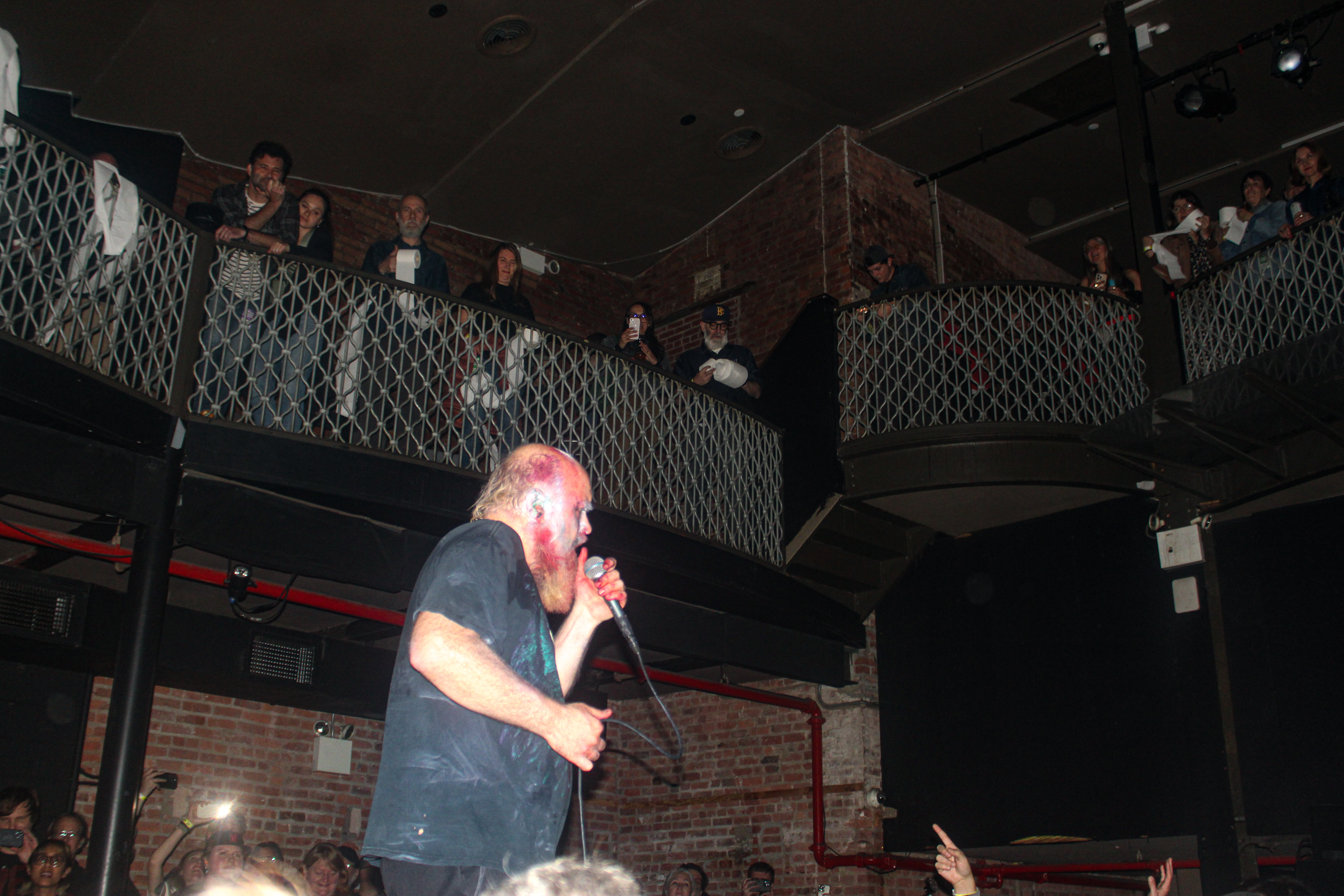
Finally, Les Savy Fav arrived, dressed as police, with frontman Tim Harrington zombified and losing clothes with every minute. The crowd was sedated for their first song (from their newest album OUI, LSF), but “The Equestrian” created a churn. My brother—in town for the first time—and I assaulted people in the pit.
Harrington, already known for his antics, splattered himself in fake blood and sprayed some extra into the crowd. He spent most of his time among them. I pushed him in the pit and I told him I loved him. He didn’t hear and I didn’t need him to. Later, he tightroped the baluster, which shook under him.


It was a room full of elders. It’s important to know your future, like perusing jail cells on Google Images. Lock in, go gray, get fucked. Near the pit, I shared my Juul with a woman. She said “Shabbat shalom” in thanks (it was a Friday), and I said, “Type shit” before joining the churn brought on by “Yawn, Yawn, Yawn.” I, that day, was still 31 years old.
The band had hidden rolls of toilet paper in the balconies, and concertgoers threw them into the crowd. By the end, the floor looked like a spitball firing squad had killed it twice.
Harrington recounted how, years ago, they played a show for nearly nobody here. “The pangs of nostalgia for a neighborhood’s previous incarnation are part of living in New York, but you can’t always go home again,” Michael Calderone writes in a Curbed retrospective on the club’s coming closure. The only Williamsburg I’ve known serves gourmet McDonald’s at Lighthouse (145 Borinquen Pl.), and I’ve never wanted to go home. I’m too old to not know these feelings are coming. I’m not even escaping the feeling anymore.


From Les Savy Fav came every name: Pixies and Gang of Four and Jesus Lizard, Brainiac, then Archers of Loaf, Polvo; and every other name I name to better clarify my indie positionality that’s waned over the years until now, when I’m all lost trying to find out the aboutness of cumbia.
I was doing a very bad job. My stubble had been growing out for a week. It was just thick enough to leave a disgusting rash on my skin. When they played “Hold On to Your Genre,” I looked to my older brother, and, for the first time that week he was here, I realized yes, we’ve lived this long to end up here together (“Now I’m haunted by dreams of the things I’ve found hid there,” Harrington sings). We were long past standing in line at Atlanta’s Masquerade for Fang Island and Danny Brown, when we sought pauses from a childhood that should’ve been something else (“All the rabbits you’ve vanished / All the cards that you’ve killed”). The years, the years after.


I tried to hold his hand. His hands were tougher than mine, and he twisted my fingers until I pull away. He black-eyed me once, years ago. There’s but no other brother to love. We returned to the pit for guitarist Seth Jabour’s work1 in “Dirty Knails.” I can’t remember us ever frolicking as children.
Harrington returned for the encore in pink underwear. Les Savy Fav ended with “Let’s Get Out of Here.” Let’s stop thinking for a moment; my back ached. Exit at midnight, into Halloween revelry. The regular noise in someone else’s Williamsburg. Night comes early now. The holidays are here.
Photos by Andrew Karpan.
- A common refrain in music journalism is to refer to guitar work like that of Jabour and Andrew Reuland as sounding like a “screech,” as Brent DiCrescenzo writes in his review of The Cat and the Cobra. It is exactly that, but there’s little understanding circulating as to why it is that. A screech is an interruptive sound. Les Savy Fav’s guitar work operationalizes noise, though less brutish than Big Black and less virtuosic than Jesus Lizard’s Duane Denison. “Bringing Us Down” normalizes that interruption, but doesn’t dwell on it. We’ve conditioned ourselves toward numbness against overstimulation.
The riffs are “angular,” as Matt LeMay writes in his review of Let’s Stay Friends (Best New Music). While it’s a cliché modifier, here it’s telling: Les Savy Fav’s guitar work illustrates the late-20th-century soundscape—dial-up internet, the last of the truly loud cars, hardcore that hadn’t forgotten why it was so mad—which carried over into the early 2000s (Friends was released in 2007). The angular guitar represents the normalization of noise.
↩︎


Leave a Reply