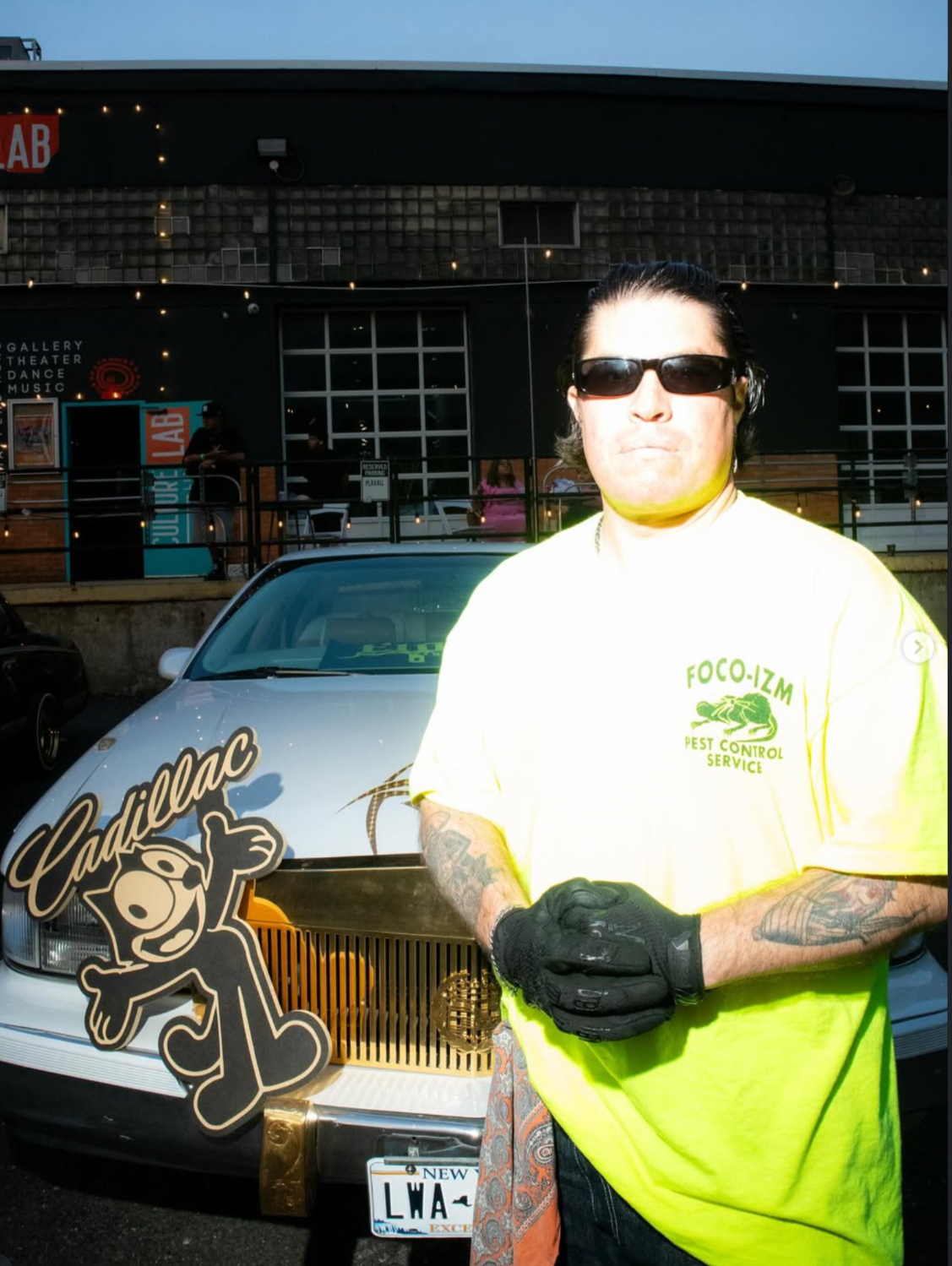
I recently wrote on Substack about some of my personal qualms with people who could qualify as fake punks, or twentysomethings LARPing being alternative. They dine on fruits of the labor from bullied and beaten “weird kids” and queer people past, and make sure everyone on their Instagram knows they’re super sick and went to the annual NYE Tunnel show.
My complaints about the social problems in the DIY scene fell upon perhaps not deaf ears, but were heard only selectively. It does not seem they liked what I had to say. So rather than continue to complain, I thought that I should talk to someone who embodies the opposite of my frustrations.
In 2022, I met Nachi at a dimly lit AA basement meeting. The browning carpet smelled of mothballs and cigarette butts. I was 21, newly sober, and fresh to Brooklyn. Myself, along with most other vaguely artistically inclined transplants, had just been priced out of our slumlord COVID deal apartments in Manhattan.
We became friends, and over the years have had similar feelings about the alternative scene. Nachi moved to Bushwick in 2014 and helped me better understand the history of the area, and what problems the community was facing in regard to displacement due to increasing rent prices and the closing of local businesses. At the time, he was playing in a dark thrash-metal band called JUNTA. Today, he is the frontman of FOCO(IZM), an “Anti-Colonial Hardcore” project.
I point to him as an example of someone who stands ten toes down. He practices what he preaches, and shows up for his community. His music is political, the conversations he has are political, and the work he does with NYC Migrant Solidarity and fundraising through DIY shows make an impact.
Contributing to your community looks different for everyone. I think using whatever set of skills you have is always better than throwing your hands up and doing nothing. Over the years, Nachi has been someone I’ve reached out to, to throw my hat in the ring. Nothing major: shooting band merch, poster design for toy drives, things of that nature. I only mention this to drive home the point that, doing even a little bit, does a lot. Ask, and you shall receive. We all scream online about wanting community: show up and show out!
This interview has been condensed for clarity.
Q: What is your creative background?
A: Growing up, what got me engaged was my hometown radio station. I did a community radio station from 7th grade up until high school. Getting engaged with that aspect of the music inspired me to get involved with booking DIY shows in my hometown as well.
Seeing the community of the radio station was pretty formative, the town had gotten together to build the radio station out. I mean, it literally started in a half-abandoned barn on the edge of town in a little loft factory pretty much. The collective capacity to just go do the thing, and make it happen is definitely something that stuck with me in the sense of musical background.
When did you start making music?
2013. I was in college at Sarah Lawrence. I had a good friend of mine that’s now an ambient composer in Los Angeles. He taught me about the Ventura hardcore punk scene and we started a band my junior year. We did other fun little bands my senior year.
When I moved to New York, I lived in a DIY venue for a while; that gave me the opportunity to meet a lot of musicians in the community, and get a perspective on DIY in New York and Bushwick. That friend I mentioned earlier from college—I remember around 2016 when I started forming JUNTA—they were, like, “Just go and do it.”

Can you tell me a bit about FOCO(IZM)?
There is that tagline in our Instagram that says “nu metal,” but I like to keep it open-ended. I would say that I tend to try and center and give a lot of credit to the people I work with. The current lineup working on new material for FOCO is Eyram, Itsy, and D.
The reality is, I don’t play instruments. I try to be hands-off with the people I’ve elected to work with. In terms of what I want to make, a friend of mine described it to me as “the best effect you can have on people as a musician is a feeling of ‘I don’t know what this is but I can’t look away.’” I want to make music people can hear for the first time at a DIY venue.
Most of the time you go to a DIY venue, you’re there to hang out with friends. I feel like it’s about the community and the social scene. [I want to] play some stuff that people think, “Oh, this doesn’t sound like everything else on the bill, what is this? I gotta find out what this is.” And you feel welcome to step into the space as well… I don’t want people to feel like they have to be part of a certain subculture in order to be welcome.
With [FOCO], I would like to see folks feeling confident in themselves and confident to engage with their own forms of resistance.
Across the board, white supremacist capitalism is targeting people in our community. Causing harm and violence, in one way or another, toward everyone. Systemic violence that contradicts human life.
Every person, everyone reading this, regardless of background has a part to play in liberation. I want people to hear this music and think, “Wow, I need to reflect,” and feel a part of that struggle.
The way culture flows—and the way we’re told to think about things is an “either, or” mindset—it’s [culture is] a neat little box, it’s a product you have to be a part of. I really want to be, like, “Hey, this [the culture] can look like resistance. Liberation can look like many different things for many different folks, but it’s welcome and it’s valid here, included and appreciated here… getting involved with something.”
How did your relationship with community organizing/volunteer work in Brooklyn start?
Due to the community I grew up in, [organizing] is an inherent part of my identity. What it means to live freely and have my autonomy is to engage with community defense, collective action and mutual aid.
Going back to the radio station, that was a platform for bringing the community together and mutual aid. I always interacted with music as a platform to keep people together. You can convey messages and stories that are passed down from our communities that have been marginalized by the system.
I feel interactive with the culture. Interactive in the sense that this is inherently a part and parcel of continuing the struggle and keeping our people together. Doing shows and events throughout my time in high school and college, and as soon as I got to New York—this has all been on my mind.
When I moved here I made the decision to live in a DIY venue because I thought as a transplant I have to be accountable to the community that I’m moving into. If there’s anyone that’s going to live in a windowless loft in order to create space for people to gather and feel community – I’ll take that L. I did an internship at Make the Road New York, and worked mostly in Bushwick.
I used music to do benefit shows—not only to work towards mutual aid and trying to help in material ways—but also trying to provoke dialogue around the ways we talk about collective action and mutual aid.
How would you explain the Bushwick “scene” at large, to someone that knows nothing about it?
I don’t feel like I would just describe it as a scene at large. The thing about New York is, people come into these spaces, and think that the first 30 people they meet can be the end-all, be-all—the highlight of the world. But the reality is, it’s not. There’s a million different people to work with and spaces to engage with, you know?
I want to emphasize to people that you can engage with this as well, you can be a leader, you can cultivate community. In a lot of ways I find it stifling that, you know, people get into a small rut in terms of, “okay, I’m back here, same show, same venue, every weekend.”
We can help people in our community. Community doesn’t have to look like one white way down the middle of the road. There can be conflict. People can not see eye-to-eye immediately, but hey, we’re trying to see.
I feel like in order to maintain healthier communities it’s healthy we branch out and get out of it [subculture]. One thing that’s been really refreshing for me, is if I’m going into a bar that doesn’t usually have hardcore punk shows, I actually have to explain: What’s the point? What’s the goal? I have to stand on the principle of values and make sure that I practice integrity. I can’t just bullshit my way off of clout or anything like that.
People are moving in a way where there is a clear directive. We got a backline, the drums—we all did a little part to make this happen. We’re gonna make it happen for each other. There’s the goal and the values and principles that we’re centering. I think a lot of people can feel… constantly inundated—patriarchy tells us to feel insecure and afraid about ourselves and the world around us. I can understand why it’s difficult for people to get out of their bubbles.
I’m trying to demonstrate with the work I’m doing, particularly with FOCO, that people can have a good time together. They like music that can actually resonate with them. If you feel uncomfortable with the way things are going in a certain scene or community, you can go do your own thing and there will be people that gravitate towards that, and have your back.
There’s a million ways we can go about this and create, you know? Within the spectrum of social media, we’re incessantly presented with “this is what it has to look like.” The subculture, the scene, what music is—it all “has” to look a certain way.
I feel like people are more insecure in taking that leap of faith and trying something different. Everything has been presented to them a million times over, and everything they do, every mistake that’s made can be immediately looked at, critiqued, and discouraged.
I’m really trying to empower that feeling that you can take a chance on things. Maybe this show’s not gonna be the most packed out, it will be a lot of time and effort, but still try and fight. You can, and there will be people that have your back.
Zooming out, when you look at the DIY music/art scene in Brooklyn, what do you see?
I think a challenge in New York is the violent cost of living. The people that get their artwork on DIY platforms tend to be those who have the time to fight for their reputation and have resources to make art. I choose to decenter that and not engage with it. Even if it costs me a platform or immaterial resources.
DIY doesn’t have to look like a certain genre or method. When I hear “do it yourself” I think about the street vendors I work with. I think of the plazas that are set up by other members of the community to create space and bring people together. I’ll occasionally go to a hardcore punk show, but most of the time on weekends I’ll go check out a dance group or local music festival.
That is DIY. People hitting up their neighbors and their families: “okay we can rent out a space, we can cook and sell some food in order to make rent.” That’s the DIY I’m in alignment with and looking at. There’s definitely stuff that does get a platform and circulated within New York, but I really choose to be like, I’m okay. Do you guys do this and think that this is really cool and important to you? I am doing something else, we’re gonna make our own time.
DIY is a large umbrella, but what are some of the things you think Brooklyn DIY is getting right?
The quantity. There’s a lot of different bands. I’m going to go back to critique though, like, there’s a lot of bands, and a lot of platform that comes out of that. With that being said, I’m gonna keep it a stack: I think there needs to be more of a collective mindset about the fact that you play music, you have this platform, you have a room of 50 people paying attention to what you’re saying. Say some real shit, do some real shit for the people that need it.
The amount of art and music going on is great, but again, behind what purpose and intention? What are you saying with this? You could be getting a lot done directly to challenge and improve people’s material conditions. I think that there’s a lot of eyes on the DIY scene, direct people towards something real. Something geared towards expansion, something provocative.
Alternatively, what is the scene at large getting wrong?
This answer is colored by the reality that the background of hardcore punk is inherently about creating a challenge. I’ve been thinking about that. And y’know what, to me, there’s a lot of just kind of unnecessary cliquiness. People try to act like shit is hunky-dory. With hardcore punk and several other musical aspects I interact with are about creating a challenge; creating something out of nothing. I feel like that has to happen. A lot of what gets platformed aligns itself with white supremacist patriarchy. That’s what ends up getting popular.
I think the politics need to be more challenging towards white supremacist patriarchy. Just because I have an anarchy badge doesn’t mean that I don’t have to interrogate my relationship to white supremacy, or my interactions and how I treat people.
I feel like people could be interacting with shows, not just lining up like they’re going to church every weekend. It could be something more like, “I’m going here to feel a certain connection and affirmation, and to change my viewpoint on things” to continue cultivating community. Like I keep saying, white supremacy and patriarchy is about reducing people to the individual, atomizing things. The nuclear family.
That’s where I see a lot of people spinning their wheels, operating like they are individuals when there’s a larger movement to be accountable to. There’s a larger movement that we could be a part of and directly coordinate. I think the important thing is that people think in terms of “with all the people here we could be really creating something a whole lot bigger.”
What does punk mean to you?
It is a folk music, it is something that was born out of individuals and communities that were being targeted by white supremacist capitalism. Targeted harm… seeing their communities ripped apart, but saying, “I’m gonna have an answer.” I’m gonna have a next week, I’m gonna have a next show, we’re going to have something.
We’re gonna have culture, you know? We’re gonna go make it happen. Despite, almost in a quixotic sense, this sense of, “I’m not necessarily here for a guaranteed finite end product and agenda. I’m just going to go do the damn thing, I’m not expecting a return on investment from this.” People are told that the right way to think about things is transactional, there has to be a singular purpose.
There’s also the capacity to let things be open ended. We did this benefit, we haven’t saved the world but we’re gonna keep on fighting next week, and we’re going to keep making things happen. We’re still going to be here. We can keep on going and keep on that smoke.
How can we bridge the gap, and get people out to volunteer & show up in collective action?
I don’t think it’s a question of pushing people. In reality, nobody likes to be told what to do. I hope I don’t come off as I’m telling people what they need to do. The golden rule of history, nobody likes to feel like they are being told what to do. It all comes down to poco a poco, little by little.
Going to support spaces that are actually trying to create a more holistic approach to community is a good step. I do a lot of shows where we are doing benefits for people directly in the neighborhood, and going out to spaces that wouldn’t traditionally have hardcore punk shows.
I’m also directly inviting folks from the neighborhood. A lot of the time we do these shows with street vendors. We have a common ground and common agreement to work on here, and work together. With FOCO, it’s also been about creating intergenerational space. There’s a lot of shows we play where people bring their kids, or older folks are there.
I think a discussion people in hardcore punk don’t want to have is aging. Everything is meant to be centered around this idealized youth subculture, AKA, the time when you’re the most physically able to offer your labor to capitalism. No one is having that conversation about what getting older or having different generations in the space means.
Speaking from my own experience, [bridging that gap] is the process of realizing I’m not the same person I was 10 years ago… four years ago, or even last week. I’m willing to grow and be humbled with that. And also being there and being accountable for people in the community. I feel like it’s especially important for the folks that have been around to be present, especially for the younger folks in the scene. To help people navigate conflicts, or when they need to book a show or check out a new band or space.
The roots of alternative culture often stem from black and brown communities. In your opinion, how does this history play out in the modern day?
Back to your other question of what I think is going well, I’m seeing a lot more black and brown bands that are playing, doing shows, and organizing. It’s definitely something that’s positive and gives me hope. I get to also work with a lot of these artists, and I’m seeing that the community is emerging, and building a larger platform, becoming more of a force in New York.
I’m grateful to play shows with a lot of these bands, and be a part of that. Bands like Boil, No Weapon, No Values, Lake Lanier. The list can go on, these are just a few that come to top of mind.
I’m getting the opportunity to talk on my art, but it comes out of a collective struggle and community. I have the opportunity to platform things and speak out. But the credit, honestly, at the end of the day goes to the community, mostly black and brown artists and people born and raised here, who have made space for me to be a creative and work with me. The majority of people I work, and interact with, are that community. They have my back and care about me.
So what I’m doing is really built off of their collective insight and experience, their artistry as well. I aim to be accountable to that. I’ll always put on for the people that care about me and have my back, you know, I’ll show up in the same way.
People reading this should definitely check up any bookings that come from Hood Park Presents, New York Under the Sun, Nate’s Showbooking. Anything from those groups is great, keep an eye open.
In terms of the transplant conversation—everything is a spectrum—what is your overall view of Bushwick/Ridgewood transplant culture?
I think it’s a question of people remembering to be accountable to the community. We are told that success, that the ideal, is to be the person that discovers, arrives, plants the flag. The person that comes out with the newest idea and best product—that nothing else has come before. I think that [mindset] is the core of it.
There’s the other aspect of people thinking “be responsible towards your block, towards your community, live in New York, live in the neighborhood—the whole world is here.” Be here with each other, be humble to that.
I feel like there’s a lot of people that pull up here on ego stuff, because they don’t have to be accountable. That also comes with class privilege, and the resources to ignore what’s going on.
Shut up and listen. See what people around you say, where they’re meeting, what can help—what needs to happen. Don’t make yourself the center of attention around it, but show up when people are telling you they need you to show up. Be there when the harm is there.
Use the resources that you have in order to create those spaces for people to listen and be heard.
Can you shout out some orgs that you think people should put their time into?
NYC Migrant Solidarity is the organization I’ve had the opportunity to work with for the past couple years. Our primary project right now is “Mercado Caracol,” a monthly market organized with street vendors in the neighborhood. The next one is November 21st at Ridgewood Commons. There are DJs, live cultural acts, political education, and a fundraising raffle for local families that have been separated by ICE. That goes back to what I was saying earlier about creating space. Asking people what would make them feel empowered and safe. You just open up space, and people create from there.
You can find FOCO(IZM)’s most recent music video here: “The Conquest of Apocalypse.”
Annabelle Abel is a writer and painter who moved to New York in 2019. She is originally from Austin, Texas and now works out of Brooklyn. A version of this essay originally appeared on her Substack, which you can find here, her paintings here, and her Instagram here.
Lead photo by @longlivechrist2


Leave a Reply