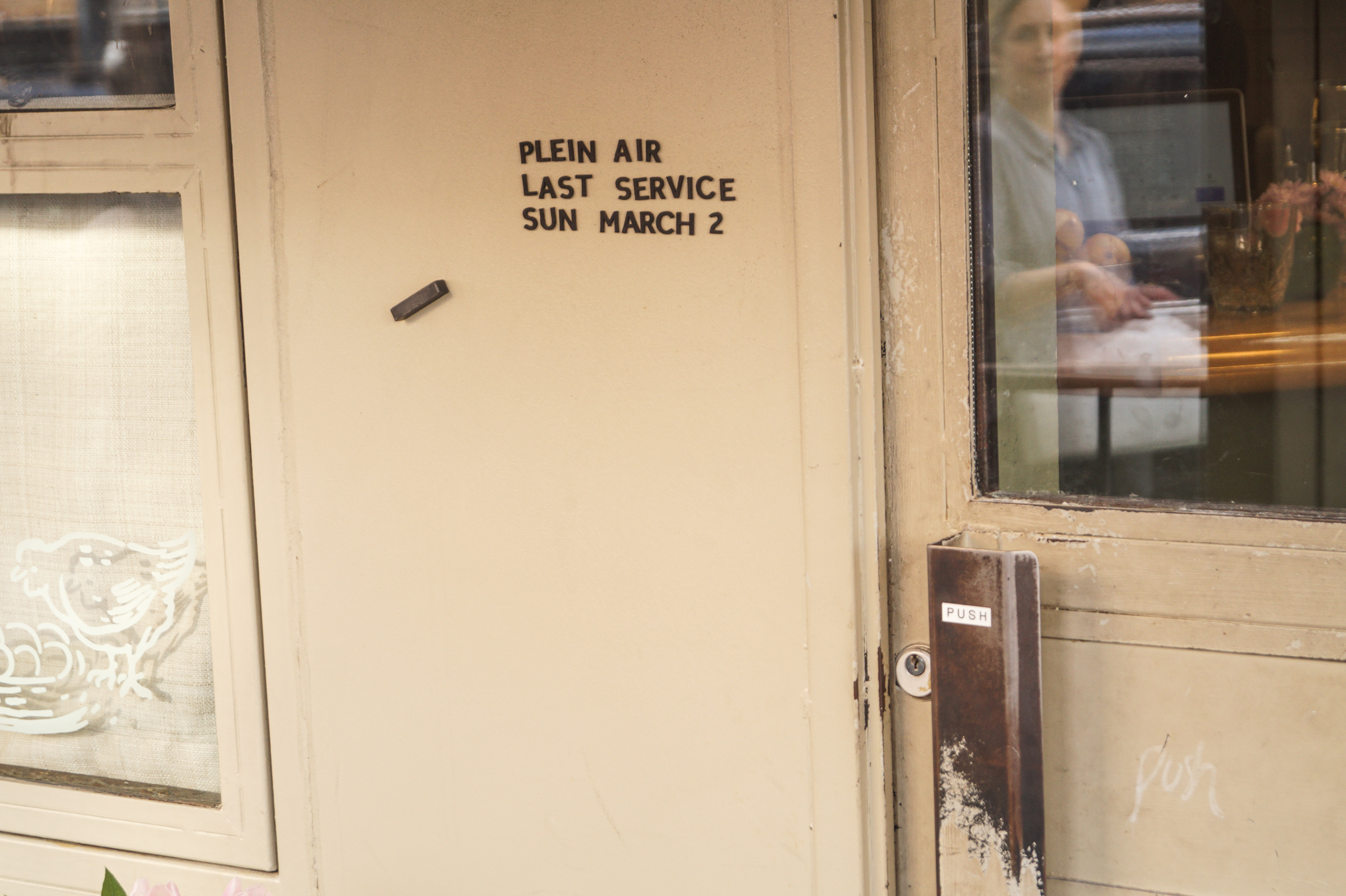
I hadn’t been to Cafe Plein Air for years by the time I heard that the conspicuously small, conspicuously French cafe on Forest Avenue was closing its doors suddenly, and for good. Restaurants come and go, spaces appear and then reappear, but the departure of Plein Air felt conspicuous. “The lease is up and we are choosing not to renew so we can have a rest,” Jackie Gorzelnik wrote me in an email about her decision to abandon the cafe she has been managing with her husband Jeff since around the start of the pandemic, where where it has led a brief and curious life as a signifier of neighborhood change, during its years of serving pastries bussed in from Brooklyn and sourdough sandwiches filled with aioli and thick stalks of celery.
“I think that Ridgewood attracted us because we could take the risk. Here, things were blossoming,” says Gorzelnik, as visibly quoted in a Daily Beast trend piece, some years ago, on the neighborhood, which has remained a persistent fascination for the various people who write about that kind of thing. The same week Plein Air marked its final week of croissant-related services, no less than the New York Times declared “Ridgewood is a Restaurant Neighborhood.”


The Gorzelniks had arrived when the pandemic began, a Southern France-style cafe concept that took the place of a departing Southern Spanish cafe concept called Cafe Essencia, whose departure I had personally mourned, some years ago in a since-defunct blog. “The sourdough churros that [Andrés] Castelló regularly baked were among the most remarkable in the neighborhood, and possibly the city,” I wrote at the time. I sounded so innocent. Could the Gorzelnik’s dollar-coin shaped upscale bodega sandwiches and plates of east coast oysters quite reach such exaggeratedly superlative heights?
If polled, most in this corner of the neighborhood would probably say no (I asked, like, three of them) but this does not diminish what the Gorzelniks did accomplish. They took up valuable, if perhaps tiny, real estate. “A restaurant so petite, onions are stored beneath the coat rack,” reads a notice in a New York City-themed substack that recommended it as an alternative to nearby New American hot spot Rolo’s. Before the Castellós had taken over the place, it had been a neighborhood hair salon and the thin corridor is still shaped as if three enormous salon chairs should be sitting where four wobbly tables and a formica bench are installed instead.
Admittedly, as is often the case with these so-called “second generation” of new businesses, the long-gone Essentia folks did most of the work of converting the place into something safely pseudo-European. (It’s not the only place on the same block to have quickly changed hands in this way, in the last few years. The Rolo’s people opened Hellbender inside what some fondly remember, around the corner, as Colleen and Ian Bock’s brunch place Acre. Down the street, a group of Bolognisians did the same inside the hastily converted remains of Porcelain, whose operator Mike Stamatelos had fled “before his [lease] was over,” Lorenzo Pizzoli told me the other month.) The Gorzelniks had arrived and maintained a modest, if largely unobserved, presence, attracting attention not from food blogs but in further neighborhood trend pieces, like in a notice in yet another New York Times story on the subject, published three years ago. (“Kermit Westergaard, a developer who once lived in the neighborhood, has had a hand in the opening of several, including the Mediterranean-inspired Cafe Plein Air on Forest Avenue…).
In that way, like so many places in the changing landscape of the neighborhood, the Gorzelnik’s little hole in the wall succeeded most in its very earnest ambition of simply being there, existing very firmly as a place that looked and acted like a cafe. There were windows filled with potted plants. The menu was a page long. There were lattes and they would be made, always, with a decorative swirl. ‘Lentils and Mushrooms.’ Sure. The ‘celery root sandwiches.’ Everything tasted and smelled like sunlight and went well with red wine. We’d miss them when they were gone.
The Gorzelnik’s cafe had its most notable presence online; I had avidly followed its travails on the neighborhood’s local Reddit community board, where a purported former employee called Jackie and Jeff “simply, truly, monstrous people” and went on, at length, about their mismanagement of the cafe. This would be one thing, and perhaps not worth commenting on at all, if not for further comments along the lines of “also a former plein air employee” and “i worked there and i can absolutely attest to this statement,” and further Reddit posts titled “CAFE PLEIN AIR / ANOTHER EX EMPLOYEE.” In one of these, a comment from a deleted account that purports to be Jackie Gorzelnik herself, reads: “we understand several of you feel mistreated by us. We acknowledge your feelings and understand. Thank you for bringing this to our attention. We own that we could have been gentler and that we may have lost our cool at times. Small business is tougher than we ever imagined. We own that we had a lot to learn about hiring and managing employees. But we do not own that anyone has been criticized for anything other than our perception of their work (regardless of age, race, gender identity, or anything else.) In fact our goal was to always make it so everyone on the team was working equally as hard and getting paid equally.”
If real, these dispatches from a post-covid labor battle between the Gorzelnik’s aspirationally pretentious cafe and the neighborhood’s roving gangs of overly online artist-cum-baristas feel like something out of the well-observed b-plot of a Spike Lee movie, if Spike Lee woke up suddenly interested in the work of MJ Lenderman. Like the cafe itself, it was hard not to feel like its departure meant something, even if the subject was as elusive as the thick foam of a matcha latte, or maybe an address from our former president. It was the end of an era. And now, as if following the end of some dramatic, undocumented denouncement, Cafe Plein Air was gone now too.
Cafe Plein Air had been located at 68-38 Forest Avenue.
Photos taken by Andrew Karpan.



Leave a Reply