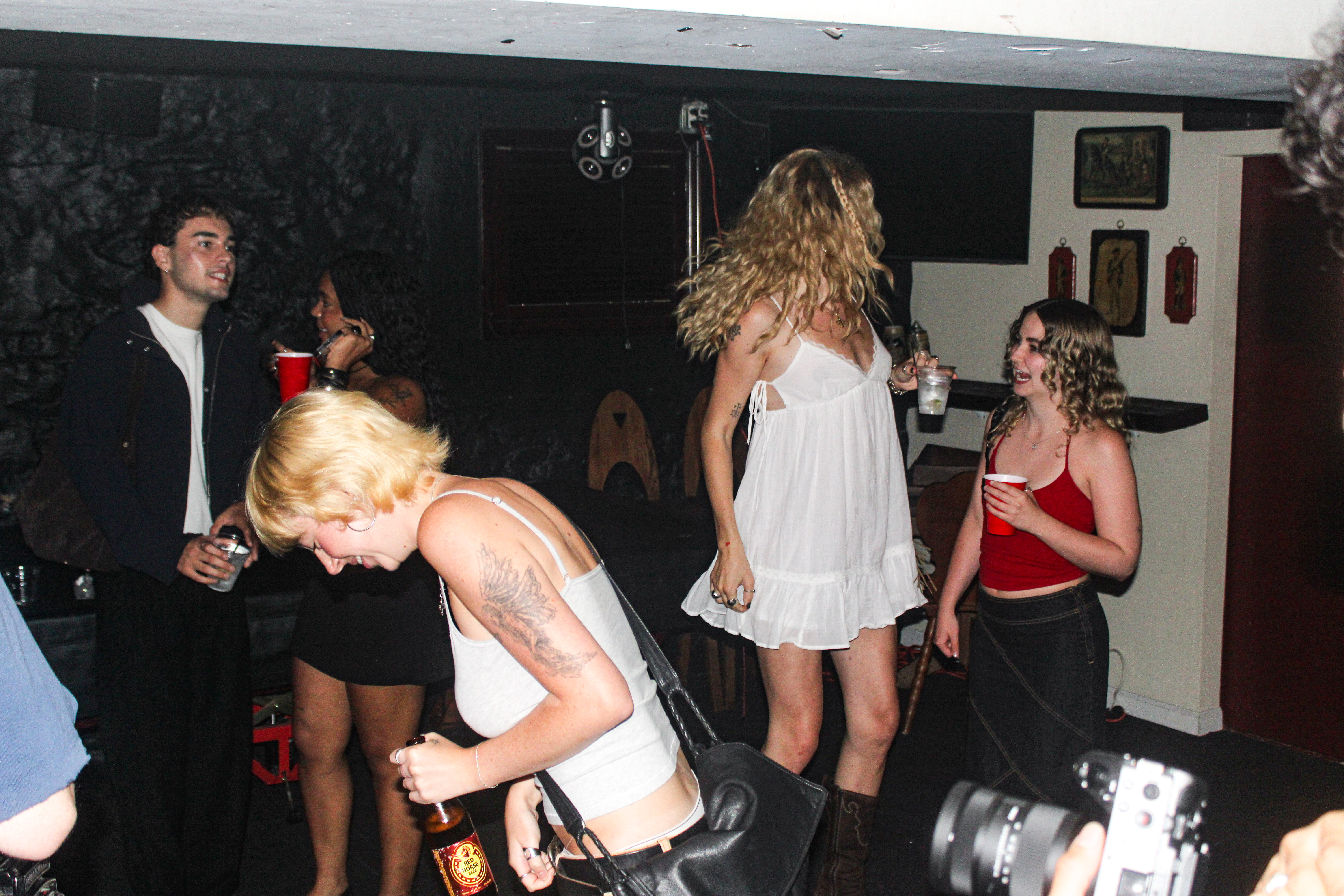
On a Saturday night at Amma (68-64 Forest Ave.), the midnight crowd spilled into the street, occupying an entire potential parking spot, probably in anticipation of Open Streets Ridgewood. Women in Adidas shorts and leather boots, men in t-shirts that say things, all here to learn how this bit of Albania is “young, beautiful, small in area and population but with big achievements,” per a 1975 issue of Albania Today, a Hoxhaist propaganda publication. They didn’t even know they were among the true Illyrians.
Between sets, the crowd expanded like a lung out of an open chest cavity, taking in the cool night air and expanding before contracting back into the basement, where bands and DJs worked through their sets. Without windows or clocks, the basement operated like a casino, where you “end up forgetting all about the world and the human race,” as the Albanian novelist Ismail Kadare writes in Palace of Dreams. Amid the Solo cups, collegiate party culture is alive and well in Ridgewood, and still has the intensity of an explosion that’s only halfway done.

That night was only the beginning, and a regular occurrence at Amma, where business has only picked up in “the past year and a half,” the owners tell me, after opening in 2017. Its recent growth is by design, though not in a groveling way.
“To be completely honest, it happened by chance, mostly,” says co-owner Marli, who handles bookings and marketing for the bar. I interviewed him in the main room, both of us seated in delicate chairs that reminded me of bedroom recreations in museums. The techno in the background made the interview hard to transcribe (“You’ve got to have Balkan, loud music,” he said.) He’s younger than me, and everybody already likes him more. I overheard at least two people tell him, “We should collab.”


A mix of Americana and double-headed eagles dot the wall. “It’s a very authentic space. When you come in here, you look at every single thing on the walls, and think, ‘Wow, there’s so many antiques.’” He said. “My dad handpicked every single item on the wall.”
His father is Amma founder Artan, aka Tony, who moved from Tirana to New York City on September 11th, 2000. After opening Amma nine years ago, he leased the adjoining space (fka Forest Windows) in 2021. During renovations, they ran into issues with Community Board 5, as both buildings are part of the Central Ridgewood Historic District, landmarked nationally in 1983 (and locally in 2014) after advocacy from Ridgewood Restoration, a group that spends most days erasing graffiti.

Eventually, Artan and Marli connected both spaces, and put up a community board outside, and opened up the basement for shows. While they began advertising sets on Instagram in March, Marli said, “The main marketing here really is word of mouth, people telling people, ‘Hey, you should come to Amma.’ Or, ‘Hey, there’s an event at Amma. Have you been to Amma?’”
“Right place, right time,” he said. “This place has been here for a while, but it only catered to the Albanian community here, especially older Albanian men, but things have changed.” Within the crowd outside watching the World Cup, a few older men spoke to each other in Albanian.
On the regulars, Marli added, “They’re actually so upset that this place isn’t as quiet as it used to be before. They wanted a place to themselves. They really gatekept this spot. But then shows getting booked here, a lot of the influx of people: they were like, ‘Shit.’ I wish it was still the same, but they’re still very happy with us.”
It’s an alliance tolerated by locals, and enjoyed for its exoticism by newer residents. “Because of the younger generation and the crowds that are coming here, they just found that the kind of aesthetic attracted them. It’s a hole-in-the-wall kind of space, so they were like, ‘Let’s make this place our own.’” He said. “We even have people coming from the Lower East Side, Manhattan.”
In the second room, I sat on a church pew with Jesse Weiss1, a mixed martial artist and Heritage New Yorker living in Washington Heights, who told me he liked Amma for its “size, and the different vibes. It’s really cool that they have so many different rooms, and it’s a little unexpected.” Žižek is his favorite philosopher, and he criticized me for being a tankie. He asked me if I was self-deprecating, and I said it’s hard to do that when you’ve never been wrong.


Mia, of Orlando, who returned to Ridgewood two weeks ago after a 2021-2023 stint, said she first came to Amma last week. “They gave us free moonshine [rakia, presumably]. The beer: we had to pay.” Amma always meets you halfway.
“I like it because [of] the maze. You walk in, it’s a cafe,” she continued. “You come here [the secondary room]—oh! And then you go downstairs—what, what!” She added: “A girl tonight, she was walking around, waving her little spoon, waving her little bag in the air, not sharing… because she was rich.”

Amma is a reprieve from daytime in Ridgewood, which is conquered by bustling patios and the tyranny of couples taking up unlittered sidewalks, while on the street there goes another Uber whose EV engine hums like the background of every Chanel Beads song. Under the sun, Ridgewood is Fort Greene for people with half-sleeves.
Down in Amma, you can forget how far north of Bushwick you are, away from its beauty and three whole trees, the J and M as loud as guns that drown out so many benevolent Dominican interactions. Amma provides nightlife far from every other night.
The historian Koço Bihiku, in A History of Albanian Literature, writes that the 20th century poet Migjeni expresses “the spirit of discontent and revolt of the Albanian progressive youth against the social order of the time, its aspirations for the regeneration of the life of the country on free and just basis.” Ridgewood was once bucolic (“countries of the dead,” per Kadare), but is now being un-suburbanized. Loud pauses now interrupt Forest Avenue’s once quiet geography. “The sleeplessness of a whole nation must be very different from that of an individual,” Kadare writes. We all feel the lacuna of a good time.
But Amma is only one piece of the bustle. Nearby is Hellbender (68-22 Forest Ave.), Cassette (68-38 Forest Ave.), and Il Gigante (8-80 Woodward Ave.). But proximity, or Marli and Artan’s work, doesn’t explain Amma’s success. The natural next step after Hellbender or Rolo’s (8-53 Onderdonk Ave.) is home, Williamsburg, or The City. There’s only so much of an audience there to capture.
In “The Significance of the Frontier in American History,” Frederick Jackson Turner writes that the Atlantic coast of the US illustrated “the evolution of institutions in a limited area,” more comparable to Europe than America’s frontier. By 1893, population densities had un-wilded the west, and now you can move to Tempe or Ogden and settle into a life of driving across parking lots to enjoy increasingly Mormon experiences inside James Hardie boxes optimized for private equity deed transfers. It’s a culture against which Ridgewood, in its heritage and transplant forms, acts as opposition and alternative. So here, people move inward, to previously claimed lands, at such a rate as to produce distortions.
In a screed against Ridgewood transplants published in Unherd, local writer Stiven Peter writes, “The Ridgewood transplants are forming an adult campus, their own ecosystem to mimic the liberal college experience.” Childhood will be practiced by actual children—Forever Young (8-01 Woodward Ave.)—or in adulthood, either at the related gift shop Stay Forever (8-18 Woodward Ave.), a retro arcade safe space, or a dive bar LARP. It’s all a genuine attempt to make a community of one’s own. It just so happens that a community was already here. Some of it will be curated to remain.

Amma is the townie bar in this farthest flung2, post-collegiate outpost. The rebrand as a venue turns it into a tulpa of the idea that one can buy acceptance into the body they’ve transplanted themselves into. It is the terminus of the new. Within it remains an authenticity in hot transplant demand.
With the lack of ethnic information about these bars, they’re all just nebulously Balkan, a sort of spicy whiteness that’s not so exotic as to be alienating. It’s a much more approachable mystery than, say, Bed-Stuy, where white people on Malcolm X mean well (“Don’t get me wrong, [they’re] nice guy[s], I like [them] just fine”), and it’s not that they’re racist—I mean, I think they mean to mean well—but they simply don’t know what to do with black people. Despite all our eighth grade history classes, some of them private, it remains such a mystery.
Amma’s pivot presents a reconciliation with gentrification. You can’t beat them, but you can access the same thirty-six dollars traded between the many hands of the same scene.
After decades of decline, what brought Gottscheer Hall (6-57 Fairview Ave.) back to life was a “sampling of the mid-twenties, M-train art set,” as H. C. Wilentz writes in the New Yorker. It now hosts noise acts and monthly honky tonks, “bringing in the kind of business that evades most small corner bars that fade into the collective memory of old New York,” as Grime Square editor-in-chief Andrew Karpan once wrote in B******k D***y. Amma is replicating a tested formula, and they’re not the only ones.
On the same night, Relax Lounge (68-17 Forest Ave.) hosted a DJ set organized by LA label One Hundred Percent Music and Crushed Magazine. Everyone there dressed like extras from The OC (nonderogatory). More Balkan techno played up front, clashing with the industrial techno coming from the backroom. Here, the same crowd as Amma manifests in a space that in no way caters to them. It is approachable, thus easily co-opted.


Farther north, just under the M Train, there was no party or Solo cups at IO Cafe (7-93 Fairview Ave.), but it did have gaudy lighting, half a dozen locals, and white-on-white violence (Argentina besting Switzerland in the battle between guys with questionable Italian-German lineages). While there have been accusations that it’s owned by Serbs, or that it’s Yugoslav, as a friend of a friend claimed, I confirmed with the bartender that it’s run by a Romanian man who left the moment I asked about his origins.
Constant in all three bars is an early 2000s maximalism: an eagle declaring patriotism behind the bar at IO; and at Relax, prints of Marilyn Monroe and Queen on canvas in red, white, and blue. A general sense of what you might call tacky if they didn’t let you smoke inside, congregate on the street without permitting, and treat max occupancies as verbal guidance given by scolds to the deaf.

For such effete, progressive people to patronize naked patriotism mirrors what Jackson Turner writes of the west: “The frontier is the outer edge of the wave, the meeting point between savagery and civilization.” Glendale is a half-mile away, and no one’s got any clue what goes on there.
Adopting Turner’s language to discuss gentrification, the geographer Neil Smith, in the New Urban Frontier, describes the kind of people who go to Amma as working to “scout out the flanks of gentrifying neighborhoods, check the landscape for profitable reinvestment, and, at the same time, to report home about how friendly the natives were.” Heritage New Yorkers, as Smith writes, are seen as “a natural element of their physical surroundings,” in the way of townhomes, or shrubs.

So, pioneers in Queens co-opt preexisting spaces. Back in Albania Today, Stefanaq Pollo, when commenting on foreign depictions of Albania’s liberation, writes, “Although they claim to know the Albanian reality profoundly and be objective, a class and political bias can be seen in them… [with an] earnest desire to inflate their own importance, to make themselves almost a pivotal factor in events.” Amma becomes both a signal that one is in-the-know, and also curates the futures of culturally lazy but more moneyed incomers.
Smith writes that “in the most extreme scenario, the new urban pioneers were expected to do for the flagging national spirit what the old ones did: to lead the nation into a new world where the problems of the old world are left behind.” Ridgewood hybridizes Albania and all of America in New York City, a place full of people who rightfully want nothing to do with the country as a whole.

The suburbs are either a failure, or taking on hideous functions, but new urban arrivals are not depicted by anyone but developers as offering any sense of renewal.
In Ridgewood, they’ve found city and suburb at once, at turns urbanizing and sanitizing it. Amma is a beneficiary of the transplant urge to select what is allowed to remain in the face of change. Others might never be so lucky. We’re all interloping among one another’s ruins. Every day, Ridgewood wakes up into its second life. Dichotomies are so plentiful because we can’t count past two. We’re having a great time, and some of us are making money, and it’s all inevitable.
P.S. And after it all, at a deli, I ordered the ultimate baby food sandwich: a chicken parm. It’s soft and doesn’t have, as with a chopped cheese, any slimy tomatoes and confetti lettuce that slip out and force you to eat the sandwich from the back. While waiting, a mouse scurried from the kitchen to the dry goods shelf, and the bodega cat fat-assed its way in the wrong direction. Before leaving, I told the owner that, just between us, his cat needs to work harder to earn his keep around here.
Photos by Andrew Karpan.
- Jesse also asked that I include a footnoted bio, as he’s read Infinite Jest more than once: He went to Wesleyan University, and the University of South Florida. His blue belt descends from the Marcelo Garcia lineage, and he currently trains at the West Village’s Unity Jiu Jitsu while competing in Chronic Kombat, which hosted his official amateur debut, where he lost by submission in the last 30 seconds of the last round. He is also the founder of Loki’s Valhalla (“All Dawgs Go To Heaven”), an apparel brand launching in August, with samples imported from Pakistan. ↩︎
- The Forest M (a five minute walk from Amma) is the fifth stop after Myrtle-Broadway. If development had instead continued straight along Broadway, we’d all be hanging somewhere east of Broadway Junction right about now. ↩︎



Leave a Reply