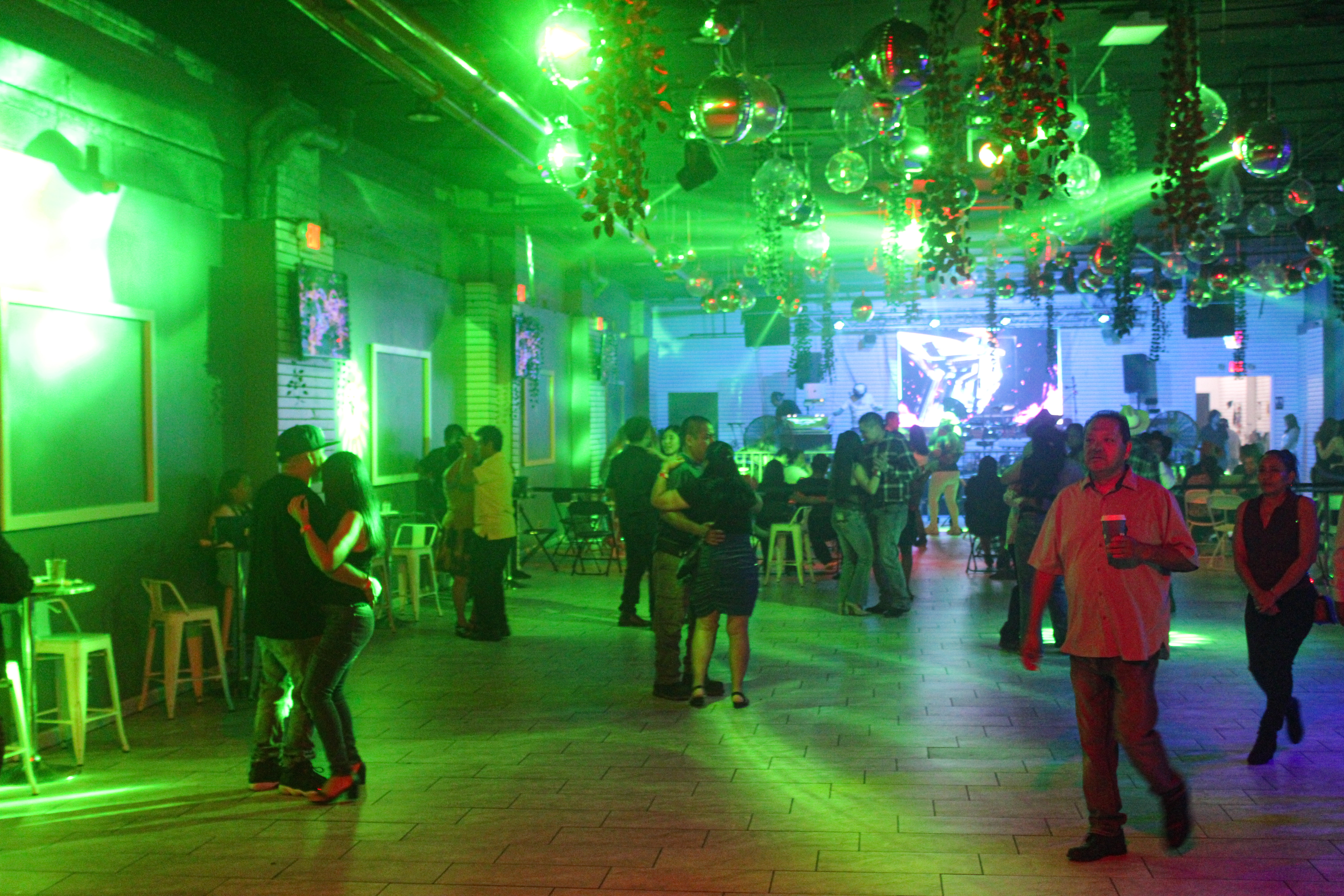
Located in “The Upper East Side of Ridgewood,” Lottus Event Center (63-01 Fresh Pond Rd.) should’ve been busy. Famously, the Ecuadorian club has always been busy since Hector Gomez Najera opened it in 2024: multiple Queens-based newspapers and the Post have covered alleged noise violations and public crowding outside the event space.
On one Friday in July, it was quiet, despite the night being Lottus’ second anniversary, per an Instagram post. There was no crowd outside, only a security guard ushering in a single group during the ten minutes I stood across the street in the way that losers do: alone and having been disappointed. It seemed to’ve finally become what it says on the tin: a humble event center.

Days prior, the area’s Councilman Phil Wong vagueposted on Instagram about “an illegal club in Ridgewood,” then asked Mayor Mamdani (without tagging him), “Does the Office of Nightlife still exist? Is there even a director anymore?”
Wong’s office declined to confirm if the “illegal club in Ridgewood” was in fact Lottus. But, Wong’s predecessor, Bob Holden, waged an explicit war against the club, and promised local papers that Wong would do the same.
“It is jarring to have clubs next to quiet residential zoning,” said local UnHerd columnist Stiven Peter, in reference to the block’s M1 zoning area, which per the city should act as a buffer between commercial and residential areas. “Wong is representing the constituency that voted for him,” said the young Gen Z homeowner. The block itself is wedged between multiple areas zoned for residential. This is all happening on the border with Maspeth, where even a chic neighborhood like Ridgewood begins to look like Middle America, and act like it, too.
Lottus did not respond to multiple requests for comment through staff, Lottus’ Instagram account, or by texts and calls.
“It’s completely destroyed my quality of life. When it ends at like 5 a.m., then the whole next day, I’m like a zombie,” one local resident said. “This stretch of Fresh Pond was so quiet before.” He moved a block away from Lottus more than 9 years ago after previously living in Bed-Stuy. “At least once a month, there’s a party that’s so loud it can be heard a block away.”
After the noise began, the resident made contact with the owner, who said in email, “I apologize. I’m trying to be a good neighbor.” He has regularly complained to Ridgewood’s Community Board 5 and recalls having submitted multiple 311 complaints, which result in police temporarily shutting down events that resume soon after they leave.
“I’ve done it all: the white noise machine—I had a custom $2,000 acoustic insert put into my bedroom window, and that sort of helps,” he said. “The other weekend, I took a pillow and a blanket into my bathtub, because it was like the farthest away from the windows. It’s just crazy.”
On solutions, the resident said, “I don’t think they need to shut down. It’s just about finding a compromise between the volume and the duration of these events.”
So, I returned to Fresh Pond again on yet another Friday. The vestibule, where security and ticketing are, appeared to have been now partially soundproofed, as a manager had promised the Queens Chronicle.

It was past midnight, but inside there weren’t many people. To Lottus’ credit, you could hardly hear the outside, but the sound system was punishingly loud (5 more noise complaints in August). Seating didn’t appear over max occupancy. I had sat at a table, but was then told that table service cost an additional $50 on top of the $70 cover (which, out of pride, I had haggled down to $60).
A few people danced to norteño. Most clung to the walls. It was past midnight, and opening DJs Estereo Nova Ny and Piwi Sound had only just taken the stage.

After I left, someone who worked there saw me taking photos followed me for two blocks while recording me with his phone. Based on what he yelled, he had assumed that I was there to target Lottus. An hour earlier, he had offered me allegedly discounted tickets outside, which I ignored. I was sad to have missed the headliner, Jalisco’s own Banda Maguey.
The response to Lottus is Ridgewood yet again resisting a perceived urbanization that has already come to pass. Phil Wong previously took to Instagram, barely anonymizing me in a reply I sent to Newtown Historical Society president Christina Wilkinson after requesting her comment about Lottus. Wong said, “We can’t always fix every problem as quickly as we’d like, but you can count on us to work as hard as we can.”

Lottus should’ve been shuttered long ago, with its long history of citations from multiple city departments, including for operating overcapacity (caught with seating arranged for nearly three times its max occupancy, per QNS). But Ridgewood isn’t as quiet as some claim it to be. “Newspapers from 100 years ago detail problems with noise emanating from local halls and beer gardens,” Wilkinson ended up telling me.
The neighborhood has always been dense and connected to mass transit. 45 minutes on the M separates Ridgewood from Midtown. The area has always been part of the city’s urban fabric, but has maintained its suburban brand through zoning, historical preservation, and a kind of idiosyncratic conservative advocacy (Wong describes himself as a “conservative Democrat”). But a city is still a city, and cities produce noise. Lottus is not the only source of noise in Ridgewood today.

In a review of 311 data from the last year, Lottus received 162 noise complaints, while Jones Bar (64-02 68th Ave.) and Willows Tavern (64-18 Fresh Pond Rd.)—both longtime community bedrocks (opened 2022 and 2024, respectively)—received similar volumes of complaints (over 130 for both Jones and Willows), and both operate on suburban blocks (Willows is just two blocks from Lottus). While Lottus has allegedly operated as an illegal club, formally distinct from more standard bars, the quality of life concerns from these businesses are the same.
What most distinguishes them from Lottus is their demographics: Jones Bar plays country music, while Willows hosts kimchi eating contests and drag shows hosted by Nicky O: the kind of programming that caters to a newer, whiter crowd which, despite neighborhood complaints, has found a home in Ridgewood.
Two train stops south, Bar Freda (801 Seneca Ave.) had an approximate number of complaints, as did Hungry Burrito (811 Seneca Ave.) and El Manaba (341 St. Nicholas Ave.). Based on the time complaints were filed, Hungry Burrito and El Manaba—both restaurants with hours of closure listed as midnight—appear to operate as illegal clubs. These bars’ 311 histories at least match Lottus’ volume of complaints (Bar Freda, at 165; Jones at 177), or far exceed it (El Manaba at over 200). None have received the same pressure that Lottus has received.
But location is important here: Hungry Burrito, El Manaba, and Freda all operate around the Seneca M, which—much like the area surrounding the Jefferson L in Bushwick—functions as a zone that’s sacrificed to nightlife. It’s a compromise many neighborhoods make to prosper off of the consumptive lifestyles of the young and recent. The city is more than capable of closing businesses (officials shut down St. Vitus mid-show in 2024). Geography, in Ridgewood, appears to override the tendency to prioritize white noise. Inaction is itself a policy decision.
Willows, only two blocks from Lottus, has not received the same pressure from local politicians, press, or social media posts. Nor has Jones Bar, despite its location in a heavily residential area.
When asked about their 311 history, the person who runs their Instagram page wrote to me, “That’s so funny[,] because we really haven’t had a lot of noise complaints in a while” (three complaints filed in July). “We are also a small bar and don’t make much noise at all[,] so when the cops do come over a 311 call we are very surprised,” they added (177 complaints filed since August 2024).

They also cautioned against the veracity of 311 complaints: “I actually didn’t know we had so many. I’m not exactly sure who or why. Sometimes when you have to 86 someone[,] they get mad and just like to try and mess with the business. People are silly & petty.”
(Neither Jones Bar—where you might find a “former-friend-turned-opp,” per Mike Crumplar—Freda, Hungry Burrito, nor El Manaba responded to requests for comment.)
All things being equal, Lottus appears to be a more acceptable target from political figures because it serves a more precarious demographic. “Today it’s just a different kind of noise by a different demographic,” said Wilkinson. This is not to say Willows or Jones Bar are somehow racist. They’re simply the beneficiaries of policy choices. In that sense, suburbia has won in Ridgewood: the noise of some (POCs) has been deemed a nuisance, while the noise of others is left unabated.
When asked about nightlife in Ridgewood, one Halsey L Westchester native asked, “What’s the difference between Bushwick and Ridgewood again?” On noise, he said, “People who move here shouldn’t complain.” It’s an endemic, typical “It’s New York: get over it” response, as if everyone here—heritage, immigrant, or transplant—should’ve been born with the capacity to sleep through Dresden.
Newer residents’ tastes and habits alter the urban imaginary. A place is not only its buildings, roads, and trains: it’s also composed of how people speak of it, which alters what people expect from it. One day, you live near two Albanian bars. The next, a new crowd remakes the space around you.

Xochitl Gonzalez once correlated increasing neighborhood wealth with silence and aversion to public gatherings. The vibrancy of historically Black neighborhoods like Fort Greene was muted by a WASP attitude impressed upon them by newer, whiter residents. In Ridgewood, it’s inverted: the heritage New Yorkers enforce the silence, as if quiet were a concept that’s physically present and entitled to a vote. Ridgewood, as a place with a character defined by its population, never asked for urgency and volume (noise is energy, is vibrating air) until nightlife, perceived ahistorically as essential to the character of North Brooklyn, was exported to Ridgewood.
Demographic shifts in Ridgewood have heightened the contradiction—an allegedly quiet neighborhood now accepts certain white noises—and make clear the question is not, “Why is there noise?” but “Whose noise is acceptable?”
But for how long can the noise be curated here? Members of the City Council are curtailed by pseudo-term limits (they have to take a four-year break after two terms). Wong’s district may feel conservative, but the times may change there, too. How long does suburbia have Wong, and how long can suburbia win? The uneven peace and quiet may not be around forever.
Photos by Andrew Karpan.




Leave a Reply