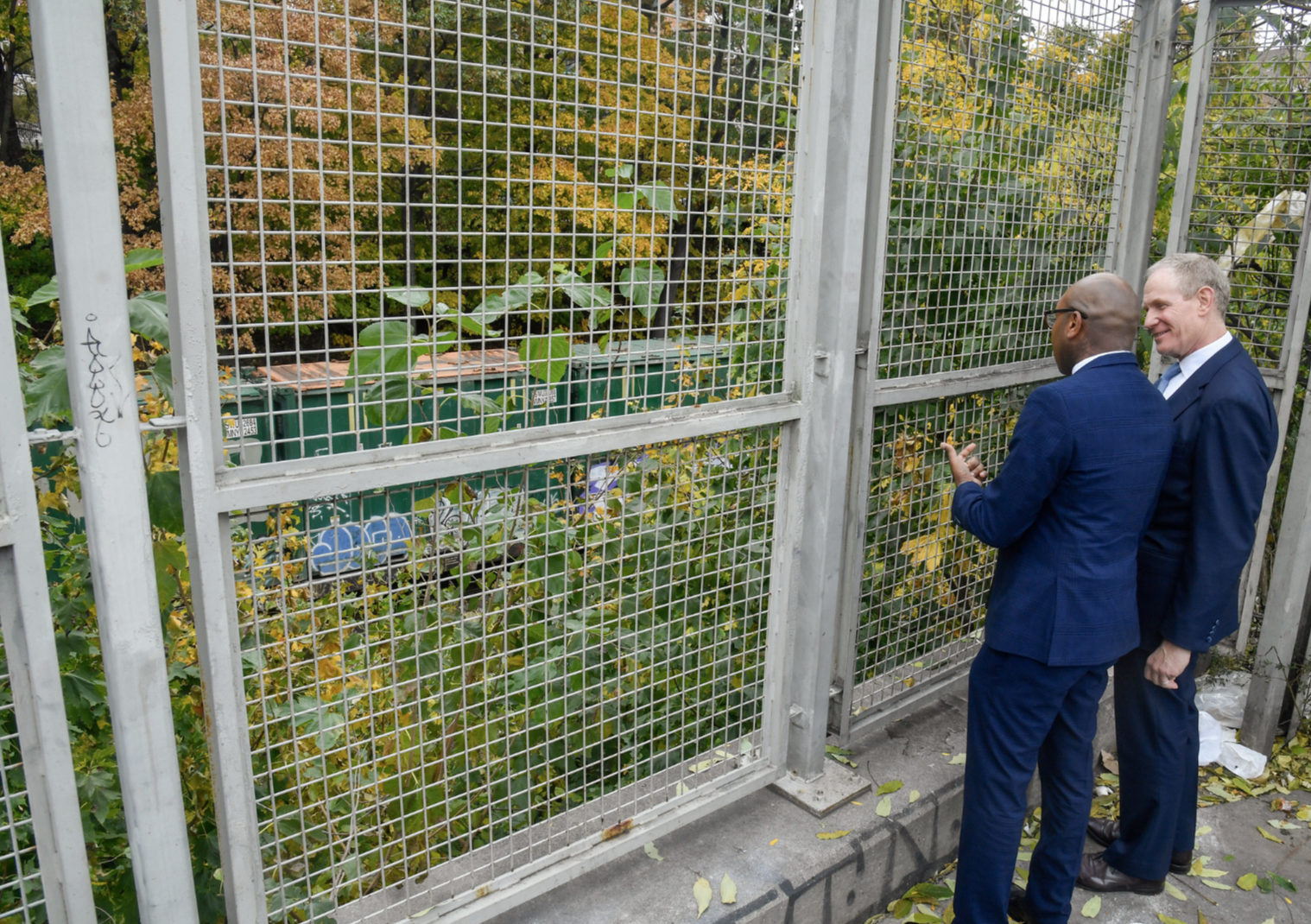
Above: Queens Borough President Donovan Richards and MTA chief Janno Lieber at a future IBX terminal site (Marc A. Hermann / MTA)
Back in September, Christina Wilkinson hit the front page of The Juniper Berry with “The IBX: A Boondoggle Overdevelopment Scheme.” Beyond the dramatics of her headline, her article was an expansive collection of misinformation and baseless allegations. One would think that the president of the Newtown Historical Society would be updated on local affairs, but Wilkinson claims that city and state planners “don’t seem to know where Middle Village and Maspeth are,” even though there was a meeting on November 6 in a Middle Village high school auditorium dedicated to taking comments on the light rail line. (There will also be an open house later this week, on November 19 at Trinity Lutheran Church too, but we can ignore that to feed into her delusion.) Besides that catchy but untrue fun fact, though, there are a few “unaddressed concerns” that are listed in her Juniper Berry story.
Wilkinson first attempts to address claims of union busting with the bold claim that light rail was selected as the transportation mode for the IBX primarily because of contract loopholes that would render union regulations inapplicable. A “published analysis” is referenced to support her argument here, which turns out to be a substack article that she doesn’t even provide the link to. After some digging, I have concluded that the article in question is likely “A Non-Technical Reason Suggests Light Rail for the Interborough Express,” by a John B. Pegram, who runs the substack BQ Rail as an independent blog since 2022, although (at least from my research) he seems to have little formal credibility on the topic. Given this and his apparent strong bias against light rail as a form of transit, I will be taking his article with a grain of salt, and Wilkinson’s interpretation with the whole shaker.
While I agree that the MTA has a history of ulterior motives, I could not find any evidence suggesting that the MTA has decided on a lack of union coverage for the IBX. There is some reasonable concern, but it is a little odd that Wilkinson frames this point of her argument as fact. Nothing has been proven regarding union contracts yet, so this allegation reads as finger pointing and fear mongering.
While bringing up modes of transportation in the context of the IBX, and why light rail was chosen, it’s appropriate to discuss why bus routes are ineffective for the community, considering that Wilkinson thinks that these connections are “more efficient for many.” Any Queens resident who takes public transit would know that the borough’s bus system is a patchwork design meant to fill the void left by an incomplete subway network, resulting in transit deserts—like Maspeth and Middle Village (and no, having a subway station named after the latter does not count.)
Bus routes might be the least disruptive form of transportation, but Wilkinson’s fear mongering over concerns of “disruption” and “the neighborhood character” is exactly the problem: a good transit project needs to be disruptive in order to be effective and change the community. A good transit project prioritizes connectivity for its residents; it doesn’t ignore certain communities to maintain the status quo.
Maximizing effectiveness while minimizing construction costs is exactly why light rail was chosen over the other five modes that the MTA considered for the project. Heavy rail would require high construction costs, which would undermine the major reason why the IBX is so heavily endorsed in the first place, being its theoretically low construction cost due to existing right of way, or ROW. Diesel multiple unit rail was eliminated for many of the same reasons, and passenger rail was also screened out due to high costs associated with track upgrades. Automated guideway transit is more forgiving in these aspects, but would likely not meet long-term demand that is estimated for the rail corridor. Bus rapid transit, as previously discussed, is much the same, with the added drawbacks of less efficient use of existing ROWs and traffic. Thus, light rail is the logical option for a mix of capacity and cost concerns.
Additionally, why does Wilkinson make so much of a three block walk-transfer? Walking transfers are commonplace: the walk from Broadway station on the G line to Lorimer Street or Hewes Street on the J/M line, the walk from Livonia avenue on the L to Junius street on the 3, or the walk from Lexington Avenue-59th street station to the Lexington Avenue-63rd Street station on the F/Q, and others. So what’s the difference between those transfers and the one proposed by the IBX? People who are “reliant upon public transit” are likely walking anyway, so how much of an inconvenience will this really be?
Wilkinson also mentions the eight block walk from the northern terminus station of the IBX to the Woodside station on the LIRR. The walk from Broadway Junction to the East New York LIRR station in Brooklyn is a four minute walk, yet no one says anything about that transfer. So is the walk from Forest Hills-71 Avenue station on the E/F/M/R and the Forest Hills LIRR station.

Below: a map of the planned IBX route.

So what is her issue with another walking transfer, especially over something as trivial as a three or eight block walk? No one in the real world is being that dramatic about a four minute walk. People will, in fact, be doing that: they do it all the time already.
Maspeth and Middle Village are both typically conservative neighborhoods, not known for being open to any change that doesn’t involve maintaining the delusion that their communities are somehow suburban in New York City. It’s unsurprising that “preserving the character of the neighborhood” is used as an argument against much needed connectivity in the outer boroughs, considering that said rebuttal usually translates to something along the lines of we don’t want minorities in our neighborhood. The arguments Wilkinson makes are NIMBYism at its finest and most unabashedly exclusionary, especially when considering the hypothetical ridership of the line. Even if “only 6% of subway users from [the] area are traveling to Brooklyn,” this is negated by the fact that Middle Village and Maspeth are, in fact, not the center of the universe, and are not the only people who would use the IBX.
What about all the people who live in Brooklyn and work in Queens, or vice versa? What about people from Middle Village, Maspeth or surrounding neighborhoods who go to college in Brooklyn? What about those in southern Brooklyn who will use the IBX to connect to subway lines, a job that would likely otherwise be done by a string of buses?
This is likely where at least a part of questions about the high ridership statistic emerge from: the fact that people will use the IBX instead of these ineffective bus lines. There are a few other reasons why this number is increasing, including reduction of estimated ride time from 39 to 32 minutes and improved spacing of stations since earlier proposals. All of these reasons mainly prove that the project is evolving constantly, especially in this phase where no ground has been broken yet (we are just moving into the environmental review process now). So given the project’s constant improvements in this speculatory phase, no, one would not think that ridership estimates would go down.
It is true that there will be some property loss as a result of the project, like any infrastructure improvement. However, I believe that Wilkinson overdramatizes the extent to which eminent domain will take effect. Of course, nobody knows what goes on behind the scenes with the MTA, but based on the information that we can actually access, there is some reasonable interpretation we can engage in. However, this is not what is going on in Wilkinson’s claims. She’s given an inch and seems to take it miles beyond where the evidence goes. She claims that the MTA “won’t specify where” the process will need to be done, yet claims in the same sentence that the Ridgewood Historic District will be specifically targeted. The 2025 IBX report, for example, has no mention of this. What I did find, however, was evidence to suggest that the MTA at least has a rough idea of what they are doing with the areas surrounding the line. The report in question outlines a comprehensive guide to which neighborhoods are prioritized for rezoning, putting emphasis on low density neighborhoods (relative to the rest of the city) along the line, like Maspeth and Middle Village. These neighborhoods are not being targeted because the MTA hates residential areas, or wants to purposefully target the people who live there, or whatever reason Wilkinson believes in that justifies her opposition to new infrastructure. The MTA is putting focus on these neighborhoods because there is the most potential for new housing units there, new housing that will be affordable for New Yorkers and will help mitigate the affordable housing crisis Wilkinson partially touches on.
I do agree with Wilkinson that there is an affordable housing crisis. The numbers support her claim, as one-bedroom listings in Middle Village have increased from $1725 three years ago to $2350 in October 2025. However, I disagree on the solution she proposes, or lack thereof. What Wilkinson seems to place emphasis on is the rezoning of the neighborhood, and how it will “cast shadows” on many of the neighborhood’s landmarks and existing properties. She claims there is an affordable housing problem, yet she and associates with the Juniper Civic Association oppose any construction that would allow for more affordable housing.
Of course, she and others in this NIMBY bubble were against Adams’ City of Yes proposals, which would actually build more housing near transit hubs. Last year, Queens Community Board 5, which includes Maspeth and Middle Village, voted “overwhelmingly in opposition” to the proposed changes. These same council members, mainly Joann Ariola and Robert Holden, called the project “City of B.S.,” which would be funny if the reforms were a set of silly suggestions rather than policies that could better people’s lives. So, which one is it? You can’t have an affordability problem and then complain about solutions to said problem. What does Wilkinson propose as a solution to this problem instead? There is no clear answer given, much like she does not give clear answers to many of the problems she complains about in her article, and the solutions she does give do not work in the real world. This is, once again, NIMBY posturing from Wilkinson and like-minded residents of central Queens, finding the opportunity to complain about anything that was not specifically tailored to them.
If living in these neighborhoods my entire life has taught me anything, Middle Village and Maspeth residents like Wilkinson only complain about a construction project when it benefits anybody besides them. Nobody complained in October 2018 when a local construction site caused smoke to be dispersed throughout elementary/middle school P.S./I.S. 128, requiring the evacuation of all students. Nobody complained from 2017 to 2020 when the extension of the aforementioned school was built, expanding the capacity for precedented population growth. Nobody complained when Maspeth Park was built in 2023, a project that I’m sure some people in the neighborhood didn’t even know about because not all construction is large-scale and massively disruptive. Nobody complained about the pipe upgrades in the Maspeth and Middle Village area last year, modernizing the area’s drainage capabilities. The two neighborhoods are not immune to change or quality of life improvements—and what is the IBX if not a quality of life improvement? To say that central Queens will not be able to handle the influx of population and foot traffic is simply untrue, especially as these projects are consistently being undertaken. It seems that residents who are opposed to the IBX, like Wilkinson, either don’t realize or don’t find reason to be outraged that development is happening when it is being done in their best interest. In fact, “real estate professionals forecast an increase in property values” in the neighborhood, per amNewYork’s IBX Stop by Stop series. The issue seems to lie with the IBX being useful infrastructure for people other than ourselves, because nothing is worse than better infrastructure for minorities and the lower class.
The project is being framed as “transit equity” because that is what it is first and foremost. The line will make the lives of many New Yorkers much easier, reducing commute times and giving opportunities to those who have been previously underserved by the city. It seems that Wilkinson is just opposed to anyone who threatens her NIMBYism and suburban fantasy, even when the added density would ultimately benefit her and others in the city — and their property values. The last line of her article is very concerning in this regard: “[I]f it seems like ‘they’ are coming after our neighborhoods, that’s because they are.” Who is she referring to with “they?” Supporters of the IBX, Democrats, others with opposing ideologies, minorities, the lower class? This is typical Us vs. Them rhetoric, seeking to separate Middle Village and Maspeth from the rest of the city instead of promoting a sense of unity, seeking to start pointless infighting that will lead to losses for everyone involved. This is, once again, NIMBY language at its core, further establishing the superiority complex that these two neighborhoods in particular seem to have over the rest of the city.
And even if we have lived without rapid transit our whole lives, why does that matter? Why should we live with less than adequate service when there is an opportunity for change quite literally in our own backyards? It’s time that people in our neighborhood stop being upset over inevitable change. Bushwick has been gentrified for years and Ridgewood is basically an extension of that Brooklyn gentrification. Forest Hills has already started its partial redesign; of course Middle Village is next. People can fight the IBX all they want, they can fight the (much needed) Metro Mall improvements, they can fight the rezoning of the neighborhood and all the density that will come with it. But the future is coming, and it’s coming whether the NIMBYs like it or not.
Ashley Kelly was born and raised in Middle Village and is currently an undergraduate at Hunter College. She is a lifelong advocate for improved public transit in Brooklyn and Queens.
Grime Square is committed to publishing a diversity of local voices. Do you have something to say? Email grimesquare@gmail.com.


Leave a Reply