At Life World, waiting for Yael Horowitz’s production of The Trial of Modicut (written by producer Luca Evans), my neighbor was a big green palmetto in a chair no one would sit in. Everyone around scratched their head at it. I asked a lady behind me what it was and she said it was a pomelo, a citrus with a really thick pith. I guessed it was probably very bitter. She corrected me: they taste really good if you can get to the fruit. I asked around for a knife and the lady said she had one, which I think’s a crime in Brooklyn, but then the music starts.
The only thing I like about Europe is the deference paid there to accordionists. On trains and in public squares, they play with dignity. Not as losers, but as artists deserving of romance. House musician and Cabaret alum Ira Khonen Temple—acompanied by cellist Raffi Boden—leverage the klezmer from an American enclave that, from the outside, appear so exotic and of the Old World, where accordionists are still capable of getting laid.
I knew I couldn’t even hit water if I fell out of a boat. I was just a humble gentile who can’t stand musicals. My most coherent thoughts there were about the sex lives of accordionists. So I mostly stayed quiet, ate my sufganiyah, and didn’t ask how it was any different from a jelly donut.


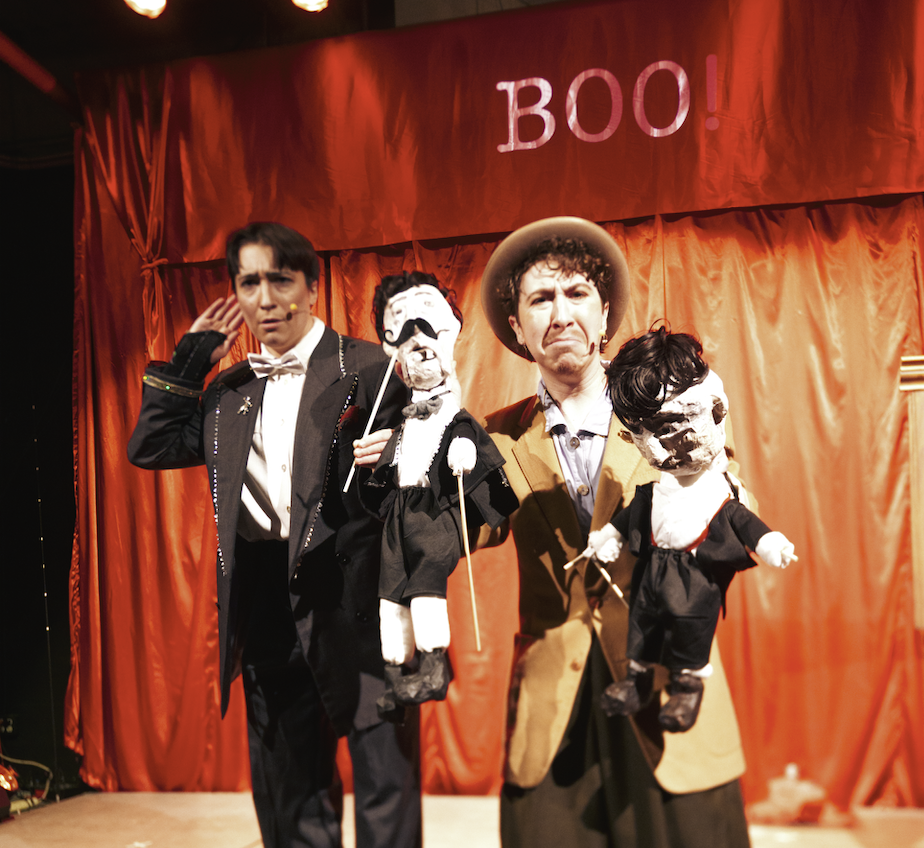
In Modicut, Yiddish puppeteers Yosl Cutler (Evans) and Zuni Maud (Ozzy Irving Gold-Shapiro) have a falling out with their old puppeteer boss Maurice, so they strike out to open their own puppet theater in early 20th century New York City. This lands them in court on a technicality: violating zoning restrictions on the warehouse they rent from their landlord, depicted as a hat and moustache brought to life by El Lang, who talks through a kazoo.
It’s a standoff between the little guys, who can only afford to be represented by their two puppets, against a judge presiding over them and the interests of capital. The judge presides highly: he’s about ten feet tall and operated by three puppeteers (including Landry Levine). His head was adorned with a wig of toilet paper rolls, his jaw hinged with rope. He is a bully whose gavel-baring hand is often stopped from hitting an imaginary sounding block by Cutler and Maud, bracing his massive hand in an Atlas pose.
Cutler and Maud respond to audience suggestions (“cover yourself in schmaltz,” one lady offered as a solution to a problem, which I assume was a non-sequitur). They say early on that a hallmark of Yiddish theater relies on involved audiences.
I figured too soon that the bar of knowledge (songbooks, Yiddish jokes) would be set too high. It turned out knowing nothing wasn’t just acceptable, but preferable, since you can just clap and boo and hiss through the whole thing. It was a story most can get behind, one about how your landlord’s better off on the other side of a firing line, or piled high like a potato sack with the rest of the dead weight in a gulag parking lot. The landlord incites the loudest jeers. I bark like a dog and don’t feel so left out.
The puppets depict the struggle against capital as mythical in scope. The story hints at the then-conditions of city garment factories. Cutler and Maud ask the audience to cheer if they’ve been a part of a tenants union or strike. All of this happens in Life Wold, another warehouse/factory in North Brooklyn that, like most of the rest, was decommissioned and vacated of its workers to make room for another playground for the urbane. Somewhere nearby, there must be a canyon of cardboard shards, the guts of imported boxes piled so high they block the views of the city across the East River.
Modicut lapses into the pedantic, but that’s fine when I agree with it. Cutler and Maud yet again motion for the audience to cheer and again I bark like a dog and the audience’s jeers aren’t against me, but the landlord still. No one’ll hassle the ignorant when the wretched are around.
Despite a witness (Julius Nicoy), bribed by the landlord, almost swaying the judge, Cutler and Maud receive leniency. They don’t necessarily conquer the ruling class; they get lucky by being allowed to sell one-off memberships, in lieu of tickets, so they can technically abide by local zoning laws.
The play ends with a dance line, led by the actors inviting the audience, including me. I thought the dance capped off the play, so I took my time in the bathroom, blasting my Juul in front of the mirror before hearing what was actually the final song. I stepped on at least two toes on the way back to my seat, where I learned that, years later, Cutler and Maud grow to hate each other, and both die tragically (Iowa car crash for the former, heartbreak over the Night of the Murdered Poets for the latter). I don’t mourn Cutler and Maud (I hardly knew them): most lives lived barely have one win, but the two succeed fantastically before us.
Nothing happened with that pomelo. We weren’t asked to throw it, nor did Maud and Cutler come to find a bite deep inside of it. It was forgotten among the polka in Phrygian, the upset against the landlord, the comradery and effort of a humble duo: a story openly for anyone. It’s sometimes enough to know just enough to get by.
‘The Trial of Modicut’ was produced by Luca Evans and played December 18-20 at Life World, 563 Johnson Avenue. Follow writer/producer Luca Evans and Life World for further updates.

Aaron Tomey is from Georgia, lived in St. Louis, and now lives in Brooklyn. His essays have previously appeared in Hobart, Bushwick Burner Phone, and Apocalypse Confidential. He can also be found on Twitter: @ecstatic_donut.
Photos taken by Alexey Kim.




Leave a Reply