In “The Anti-Chamber,” the anonymous anarchist baedan writes “that the development of civilization… has drastically increased the portion of a person’s life during which he goes about with his sphincters contracted.” We’re so tense and wound up, “searching for the nearest portal to the municipal sewerage or else postponing until such time as he is obliged to seek it out with urgency.” Ready to blow at any moment, like a bomb, like a loaded spring that goes boi-oi-oi-oing. We can only hope we’re in the right place that’s outfitted to handle our messes.
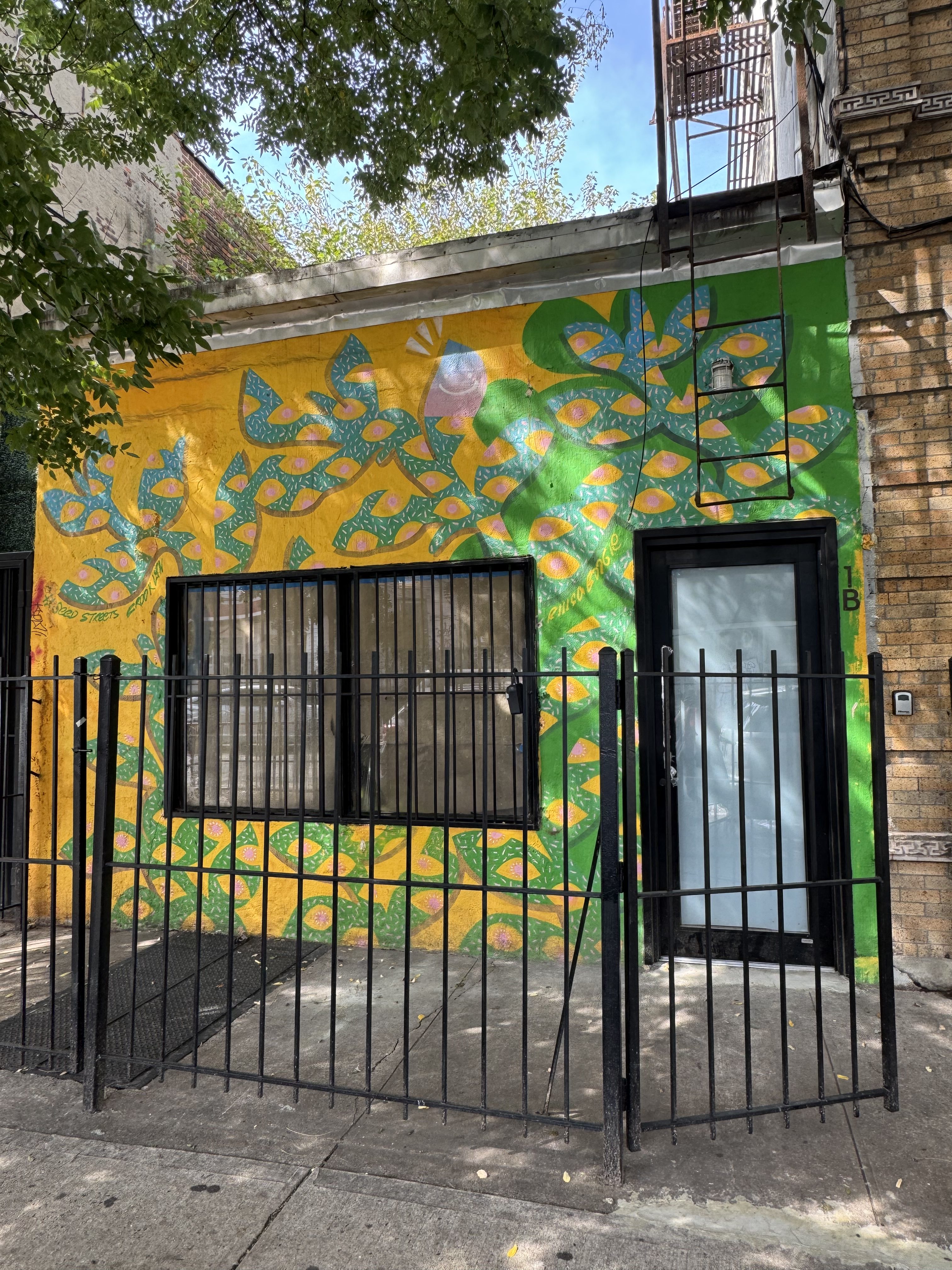
Life World (563 Johnson Avenue)—I’m back—in East Williamsburg, west of White-Koff Heights, was just that place to see Suz Murray/KACHONK and Pompom performing some of the best clown work I’ve ever seen, and some of the best theater staged in north Brooklyn this year so far.


#1: KACHONK (Suz Murray)
KACHONK and I go way back. I’ve written ‘KACHONK’ so many times that I consistently typo it out as LECHONK, who I imagine is their French counterpart, who, coincidentally, probably doesn’t smoke, which KACHONK is now obsessed with, ripping rubber cigs that wag like flagpoles and whistle like kazoos.
I was ecstatic to see them again. I missed their emotive eyes—enlarged by whiteout makeup—the eyebrow flutters that require advanced forehead exercises and their high-volume suitcase. This time, there were wardrobe changes (a merkin, even), along with the hideous scraping of chair and barrel on concrete. It’s a story of noise, capitulation, and relief.
Commute, work, sleep, repeat: that’s the story of KACHONK, as it is for most of us, propelled forward by a stimulant addiction (cigarettes and coffee-coffee-coffee): not because things are unbearable, but because there’s a constant need to be locked into a 24/7 lifestyle, which is, as Jonathan Crary writes, “a reprimand for and a depreciation of the weakness and inadequacy of human time, with its blurred, meandering textures.” KACHONK is flattened and made gray; they’re an attempted automaton, but one that’s (thankfully) failed in their becoming.
KACHONK’s teal rubber boots with hot red socks underneath declare modernity’s inherent failure to beat sameness into people. I imagine a whole world of KACHONKS, each with their small personal effect—ascot, whacky handbag, stud in right ear—cogs in the capital apparatus, demeaned just by being there. KACHONK’s job isn’t made specific—they have to take out the trash (an ordeal), but they also type at one point. Any work without dignity—without individuality or empathy—drains life of its color.
In Minima Moralia, Theodor Adorno says that tact “demanded the reconciliation—actually impossible—between the unauthorized claims of convention and the unruly ones of the individual.” Never ourselves: repression is the name of the game. It’s in the impossible reconciliation where we suffer the most: pleases and thank-yous to managerial demands, smiles in the face of deliverables and of course we’re all happy to be on this afterhours async video call with the Singapore team. Constant effort and the worship of one’s capacity to give attention to tasks are paramount.
Adorno continues: “The human consisted… in a self-limitation… when the bourgeois individual rid himself of absolutist compulsion.” KACHONK represents the inability to wear the mask of work, of inhumanely polite society, of cringing through everything and pouring 95% of your waking thought into trying and failing not being a fucking bother to anyone.
They’re eager to go home to live the life they define in opposition to work, but their only entertainment there is audio of David Attenborough mourning the Hawaiian Kauaʻi ʻōʻō bird. Even entertainment elicits suffering.
KACHONK is the failure to adhere to Adorno’s notion of tact. Unable to reconcile themselves, they toss and turn in bed, smear their makeup on a striped yellow pillow. Their insomnia can be interpreted, per Jonathan Crary, as “a way of imagining the extreme difficulty of individual responsibility in the face of the catastrophes of our era.” There’s no one but yourself to witness the death of birds, the death of each day.
I thought of Crary’s “blurred, meandering textures” during a dream sequence, where KACHONK swims or flies, or both, and encounters the spirit of a dead relative, still smoking in the afterlife. In the dream, they reexperience familial connection after an indefinite amount of time spent in lonely, economically mediated exchanges with their boss.
It invigorates them: they’re not quite ready to quit, but they do it anyway, so nervous they spit up blood (probably resultant of a coffee-abetted stress ulcer). A Tide pen, handled by an audience member, doesn’t do much to clean them up. With great effort, they become the rebellion against Adorno’s notion of tact. There’s a way out of work, a way to become something closer to what’s inside.


#2: The Shit Show (Pompom)
The adage that “You are what you eat” is an old one. A more immediate version would be “You are what you shit,” that which is urgently at the door. Pompom’s The Shit Show—a piece in development for over a year now—dramatizes that urgency, its history and shame, in a freely associative structure. It explores the parts of us that are so obviously human because we’re so universally ashamed of them.
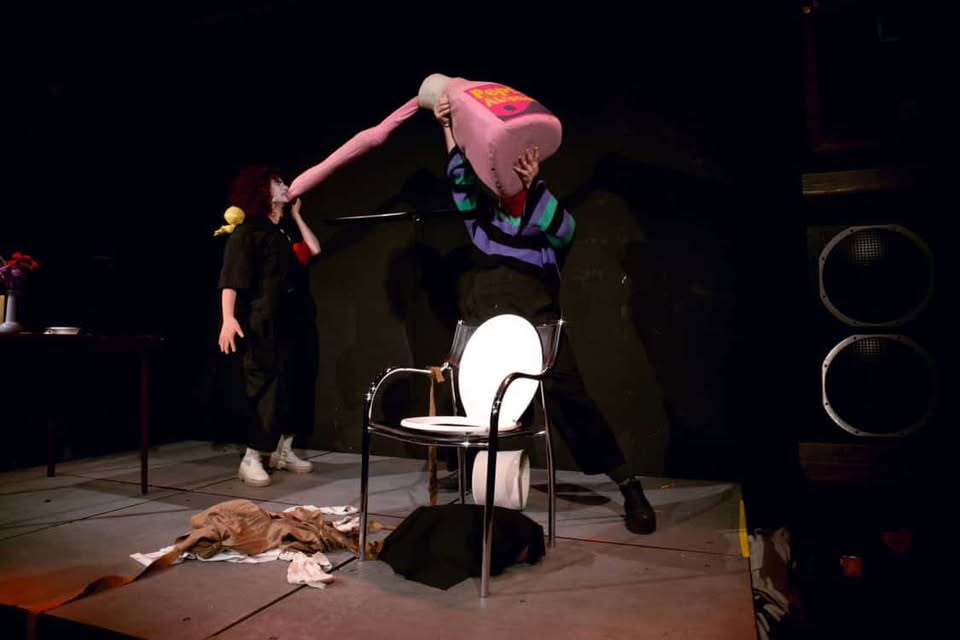
Pompom is pedantic to the point of annoyance, repeatedly asking the audience if they completed their homework: reading baedan’s “The Anti-Chamber” (of course I did). Initially in a decadent Restoration dress, a stagehand rips it off to reveal black overalls and a twisted, lumpy body underneath. Pompom shambles around, lumpy like a pillow thrown in the wash, a Cronenbergian figure twisted up by a bubble gut full of gas and the things that gas will propel out onto the stage.
Pompom finds many releases—memory, defecation—whose public airing brings them a sense of great shame. All of that release has one valve: a gigantic jutting ass, reminiscent of a post-hemorrhoid surgery butt pillow, out from which comes a corded telephone and the American flag; a ribbonous mass of shit, and assorted turds; toilet paper scrolls that declare the show title and end of the show; among other things. It’s managed by a false arm that belies Pompom’s real arm, under their overalls, shoving shit out of their ass, an inverted fisting.
That ass also prolapses and maybe had anal beads, too, as one audience member claimed (though Pompom later confirmed this wasn’t the case). It is an ordeal to watch, but it’s a reminder that all shit has its history: Pompom’s comes from a family fixation on the scatological (IBS—or what baedan calls “the effects of bourgeois diet and stress upon sphincter tension”— has the runs in Pompom’s family for at least three generations), which manifests in a paranoia about something called The Movement, a paranoia that’s realized by a shat-out bacterium puppet that talks. The waste we produce has opinions, wants vengeance for its tormented creation.
As noted in “The Anti-Chamber,” there is “a documented inability of many persons to release their bowels in public restrooms.” At first, Pompom experiences great shame in shitting out puppets in front of the audience. As the show goes on, there’s a playfulness. The inverted fisting reverses: Pompom digs into their own ass to unearth new treasures. They find liberation in the grossest byproducts of the body.
Unburdened, the waste they produce comes to care for them. It helps reproduce memory (a wig, lipstick tube, and gigantic cigarette so Pompom can recall their mother). More sympathetic puppets express heartbreak via unrolling scrolls of tears.
Pompom resolves our collective shit contradiction: they come to accept all parts of themself to unlock new tendernesses. Pompom dwells on more recent aspects of life, like their knowing of Tortuguita, the Stop Cop City activist who died in my native Georgia. The mention of him cuts like a knife: it showed how, behind the humor, there is a body politic at work, that our agonies are not states we consent to, and that—at least individually—relief is possible.
There is so much more to life, and it’s all inside of us, waiting for us to dump it out and excavate something meaningful from it, as in the end, when digging in a plush turd, Pompom finds a plant bud that blooms and speaks upward.


Outro:
In the appreciation of shit, and the refusal to work, we see our greatest failures recast as learning experiences, ergo victories. Clown is a human universal because the human experience requires constantly responding to failure. The phrase “I was so embarrassed I could’ve died” comes to mind, though our failures are often non-fatal. Failure, reified in the past, feels like death because the thought of moving on—growing, learning—is daunting.
We’re supposed to be perfect; we imagine ourselves as optimized, zero-waste and hyperefficient. Shitting, and our rituals around it, are what make us particularly human. Shitting, quitting, and clown are all affirmations of humanity.
As famously normal guy Antonin Artaud writes, man “chose to shit / as he would have chosen to live / instead of consenting to live dead.” Pompom is a direct dramatization of that, while KACHONK presents work and life (leisure, spiritual seeking) in a similar binary; by Artaud’s logic, we choose to work as we have chosen to live. We didn’t decide to have these needs (to eat food bought with wages; to shit it out, hopefully on company time). It’s the space we’ve come to occupy by hidden threat: don’t shit where you live, and, while we’re at it, carve out 40-60 hours of your week so you won’t even be there, but rather somewhere else that will never be home.
I can only feel gratitude to’ve seen them put on some good theater in north Brooklyn. Of work: Glory to the workers who labored on Behalf of KACHONK, from Erin English on sound to the puppetry of Cornbeard Jimmy Sweet to (whatever a) Chair Supplier (is) Andy J. Waldron. Of shit: Glory to toilets. Glory to what’s been sprayed onto stage by some of us to remind others of the possibility of a life less burdened, to demonstrate that reality is something made, something we consent to.
Pompom & Suz Murray performed at Life World on the 4th and 5th of March. Follow Life World for more theater in East Williamsburg.
Aaron Tomey is from Georgia, lived in St. Louis, and now lives in Brooklyn. His essays have previously appeared in Hobart, Bushwick Burner Phone, and Apocalypse Confidential. He can also be found on Twitter: @ecstatic_donut.
Photos taken by Carson Stachura.



Leave a Reply