There is no limit to what I can critically witness.
I was an hour late to “Fool Around the Block,” a clown show that was happening at Starr Bar. I walked in as a clown (Funmi Adejobi) tried to flirt with the audience. A clown is not a loser. A loser is someone you bet on. They have wagers on their name. I’d never bet a dollar on this lady getting laid in-character. A clown never disappoints because disappointment is assumed.
At the door, a guy in a propeller cap shook me down for $20. He wasn’t acting like a clown. I could’ve ignored a clown, could’ve said, “press coverage.” He (Leon Masin) then went on stage and played with what I thought was a BuzzBall, but turned out to be a magic 8 ball. It didn’t help him. He couldn’t even tie a balloon. The audience groaned for him. A clown tells the story: “We’ve All Been There.”
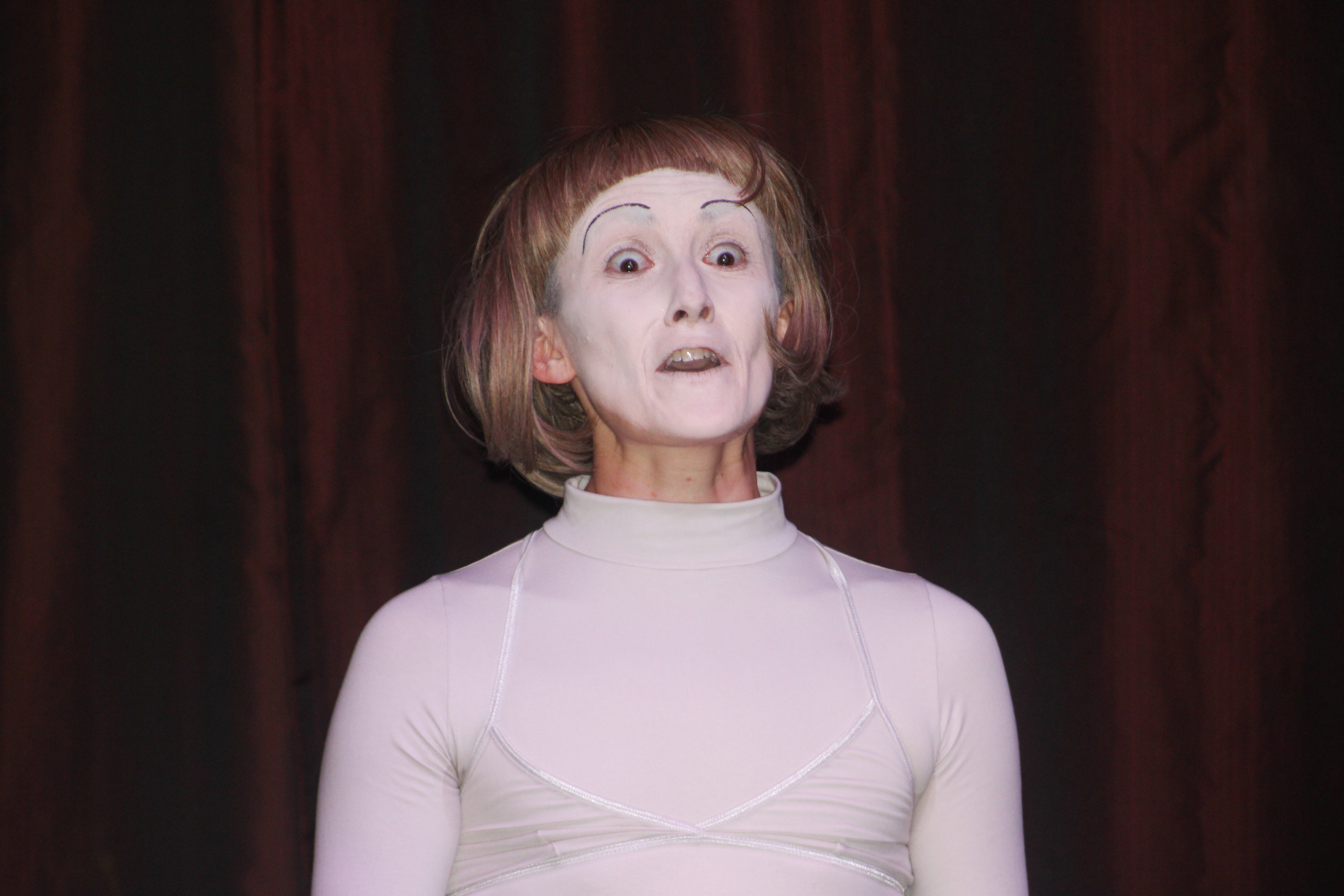
Suz Murray Sadler then performed their act “KACHONK.” I wasn’t sure what they were. At first, they seemed like an automaton in grayout makeup. They took uncertain steps, adjusted their posture very rigidly. They could’ve been an alien, too, but they were too familiar with life on Earth: waking up, commuting, working, hating your boss, wanting to kill your boss, commuting again (all made worse by the burden of carrying a suitcase full of cutlery that was louder than nine high-powered blenders). I empathized with that suitcase: I often feel infantilized when commuting to work in a backpack, though a tote bag would be even worse: emasculating.
They were a homunculus: just human enough for the audience to recognize something there. Haven’t we all felt less than the humans we are, born to be fools, beaten and worn down by the day?
What followed “KACHONK” included a mentalist (Michael Thomas Kennedy), a would-be namaste cult leader who went by ‘Tiger’ (Kiki Milner), a mime (Ish Fofana), and a bumbling spy duo (billed as “Ethan & Gigi”). These were stories of people who wanted to win, but were unable to impress their will on the world. They either lost, or won through circumstances outside of their control. They persisted, but couldn’t cope with their problems. They escalated into the ridiculous.
If there’s a solution in reach, what you’re actually looking at is a challenge. A problem is something that as-of-yet can’t be solved. A clown is someone neck-deep in unknowns, barely treading water, but they keep swimming anyway, probably because they’re thirsty.


Two years ago, I had a problem in Naples: I made the mistake of arriving at Casa Guarattelle, a puppet theater, ten minutes early. No one was there except a hundred puppets. I was in the right place for the closest available analog to commedia dell’arte I could find: a puppet show starring Pulcinella, the city’s official stock character. The puppets didn’t come alive to rip me apart. The worst was that I hadn’t considered Mediterranean non-perceptions of timeliness.
The owner, Bruno Leone, came out. He was happy to show off his many Pulcinellas (including Neil Armstrong Pulcinella) to an American yokel who thought every foreign day was as enriching as tearing through five Lonely Planet guides.
I’m sort of a commedia expert: I’ve seen the Glorious Ones and lived with three actors. Still, I couldn’t differentiate Pulcinella from any other commedia archetype. Fat or slim, either way they’re handsy. Eventually, a crowd of families joined me, and we all watched Pulcinella grab ass on some other puppets. It was Italy: what else did I expect?
I didn’t find commedia there, nor at “Fool Around the Block.” I’ll keep looking. I need newer, bigger glasses.The variety show ended with a monologue from Riley Soloner. He recounted summers spent at a children’s circus camp. There, a girl wouldn’t stop crying, even after she ran out of things to cry about. The other children grew uncomfortable around her, then hostile, until Riley gave her a red clown nose. The girl put on the clown nose and the other children realized what the exercise in crying was: that—I can’t exactly remember what the moral was, but I remember being affected by it.


After the show, I spoke to Ethan Lindhout—an alum of Brooklyn Comedy Collective and Spymonkey—who’s hosted “Fool Around the Block” in Bushwick venues since 2024. He said that everyone has a clown in them; it’s most obvious when someone trips in public and looks around. They’re worried about having been seen in a moment of failure.
I tell him that, whenever I trip, I dance it off, but don’t look around. I acknowledge the trip in a way that obfuscates self-consciousness. We weren’t sure I really got his gist.
I wasn’t a clown, but a joke. A clown doesn’t tame instinct. They don’t censor what’s most human: to fail and still persist; to be determined, despite it all, to take part in things working out down the line.
Follow “Fool Around the Block” on Instagram for updates on their next show.
Aaron Tomey is from Georgia, lived in St. Louis, and now lives in Brooklyn. His essays have previously appeared in Hobart, Bushwick Burner Phone, and Apocalypse Confidential. He can also be found on Twitter: @ecstatic_donut.
Photos taken by Andrew Karpan.





Leave a Reply