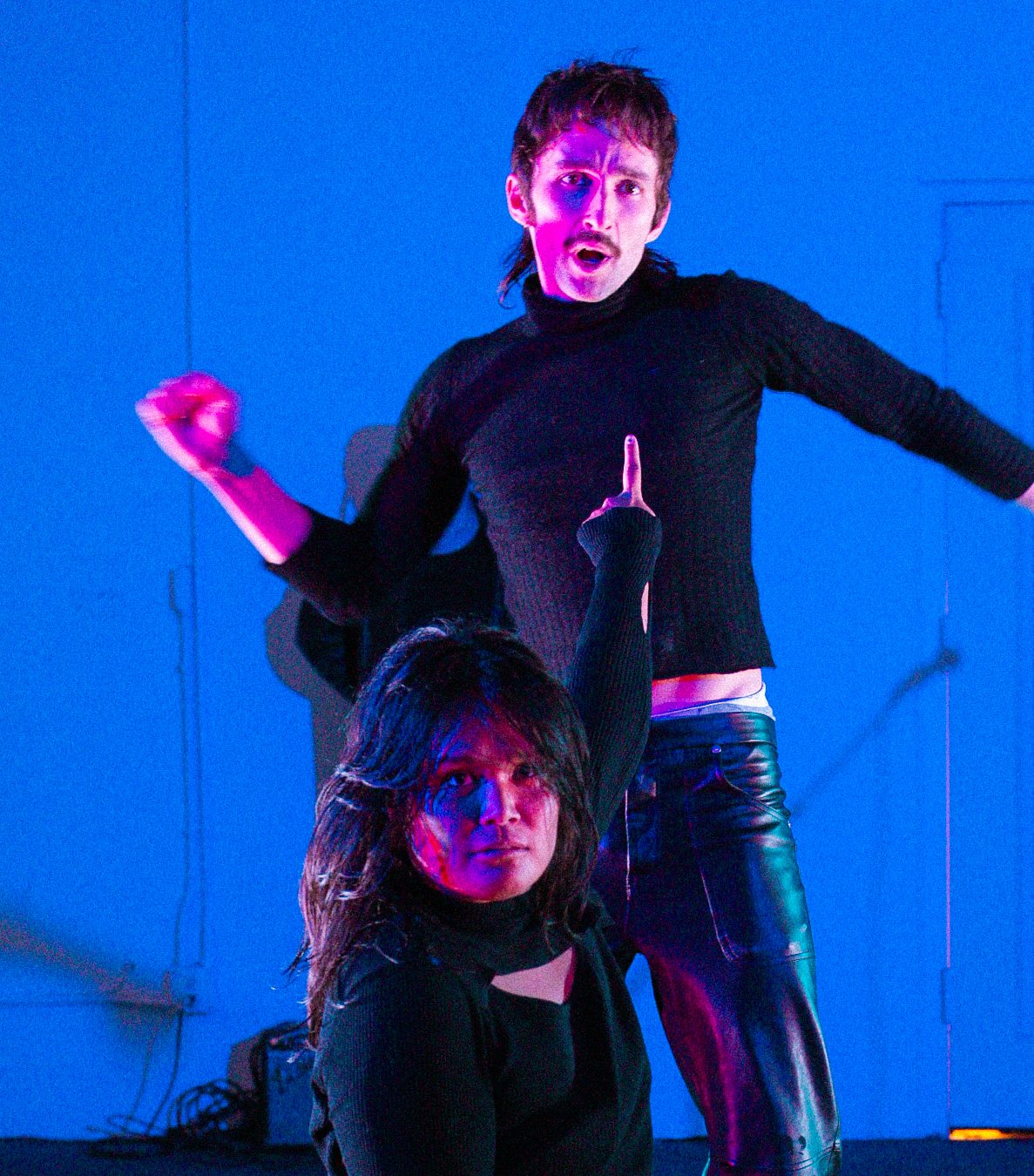
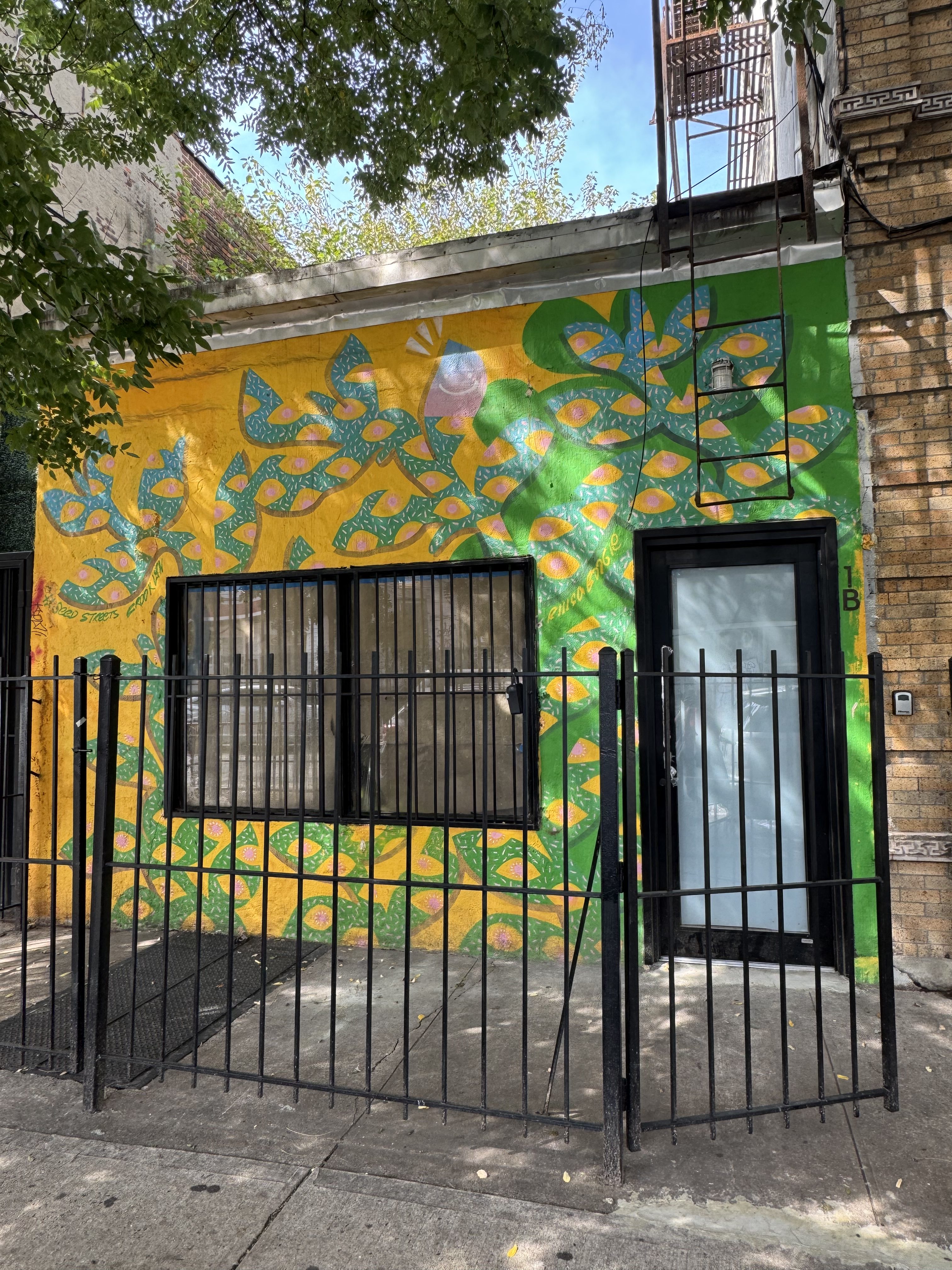
We’re at a secret location, Ethan Lindhout and Gigi Del Rosario told the audience. They asked people for codephrases, made sure we weren’t followed by agents. But they didn’t check me for wires, so I can report that we were at Makers’ Space (281 N 7th Street) in nearby Williamsburg. It helps that Ethan & Gigi are old acquaintances, and Williamsburg is an apt place for any showcase against the elites (Hitler particles off the charts).
It was a whole lot of secrecy for two clowns who were begging to get arrested: their show began with a video conflating themselves with Assata Shakur and Thomas Sankara before pleading directly to the FBI, who had snubbed them from their Most Wanted List.
It reminds me of what Inspector Pissani says in Dario Fo’s The Accidental Death of an Anarchist: “So many perfectly ordinary, bored people suddenly dress themselves up as anarchists and revolutionaries—they are completely innocent, they just want to get themselves arrested so they can have a fucking good laugh for once in their lives.”We’re all dejected from the feeling of being American, or at least being in America, which found parity long ago with the shame of Britishness before morphing into something worse.
Long-term dejection renders down into dysthymia, eventually into boredom. Ethan and Gigi knew this, and so they kept the us involved, drafting us as radicals in their mission: to bomb the Vessel at Hudson Yards and redistribute the nation’s wealth into their play’s budget, so the FBI would finally hunt them down. Clowns break down the barrier between audience and actor all the time, and there can’t be any boredom in front of so much well-timed failure.
There were agonizing call-and-response countdowns whose arcane rules reset the clock multiple times. They gave out radical codenames (Marsha P., Malcolm, Mao), and sorted us into groups into Teams Ho, Chi, and Minh. There were Hamilton parodies, dance numbers about Dick Cheney, a sometimes beautiful cover by Lindhout of a song half in Tagalog. An alleged time traveler gets gunned down, then Osama Bin Laden guitar-solos over Green Day. They retool the post-9/11 landscape into something fun, something bearable. At one point, I think they claimed George W. Bush was the first Asian president. “The only way to get rid of the past,” Möbius says in Dürrenmatt’s The Physicists, “is to behave like a madman.”
Even the faraway past is treated with madness. Ethan and Gigi retell Adam and Eve in a tender and very naked scene. That is what they’re fighting for: the luxury of making personal errors in peacetime, of obtaining forbidden knowledge, of sticking together because who else is there around to stick to?
I was worried it’d be a cynical play, that the creation myth would be subverted, and I’d be left with the theatrical equivalent to something gutless like current Oscar favorite One Battle After Another (seen in theaters with known anti-revolutionary and Grime Square “benevolent supreme leader” Andrew Karpan). But it was never cynical. Ethan and Gigi win. They blow up the Vessel. Wealth is redistributed, probably to them, but they fought for something, maybe us, so we trust them to dictate benevolently.
Catharsis is reached. They hold up a faceless dummy for sacrifice. They asked the crowd what or who they wanted it to be. People said, “Billionaires” and “Israel.” I offered, “Germany.” Lindhout asked for clarification: did I mean the Germany of the past? I said yes, and the present Germany, too: the only thing worse than the Great Satan is its father demoted to groveling accomplice.
All of the objects of audience hate in one single voodoo doll, torn apart by members of the front row, its flesh eaten like roast beef (I assume the prop was actual roast beef) by Lindhout, red strings like veins and strips of flesh passed through us and held up like holiday lights. The clown show ends with the crowd on stage, taking group photos with Ethan and Gigi, a moment to consider what’s happened, here and outside, and to finally be a part of something, however small and simulated.


The play was a relief from the day. On the L Train to the play, I listened to This Heat’s “Cenotaph” to mourn of the Ayatollah, and thought of Alejo Carpentier’s The Kingdom of This World: “This unending return of chains… proof of the uselessness of any sort of revolt.” I felt despondent: there’s one less enemy who can bring all of this—this country, its entire history—down. Tomorrow or after, the complicit among us will wonder why there’re so many more Persian restaurants, just as they wondered about so many Venezuelan and then Ecuadorian restaurants, because global politics are understood by folks in the way they understand restaurant economics: they don’t. How syncretic, our New York: the wretched refuse must’ve come here because they so badly wanted to, because Brooklyn is so woooow despite its capacity to literally eat people. I’ll end up eating beside them all, trying to invent a new communism that ends with—now, hear me out—all of us dying.
As far as I know, Ethan and Gigi didn’t know the Ayatollah, didn’t know he would die: it was a show vaguely set around 9/11 that had premiered the Friday night before. Khamenei died some time in the Eastern Standard afternoon. “I was like, ‘holy shit,’” Lindhout said afterward. “The American empire needs to die.”
I don’t mean to paint Lindhout as some die-hard third worldist. I’m not a personal fan of Khamenei, but he stood against this country and called it by its real name: the Great Satan. People are afraid of that name, how cringe it feels when said stateside, but it’s not wrong to describe a nation of dirt that way, its states fastened together with dried sinew harvested from brown bodies and adhered with glue rendered from all the really pretty horses. A vintage closet-full of death brought back into a parody of life: a hideous, churning machine that spits out B2B SaaS products, formerly fat people, and baby-seeking missiles.
That’s the same Great Satan that lets people convert their hours spent in front of spreadsheets into condos. In effete south Brooklyn circles, they’ll decry Iran’s treatment of women because their definition of progressivism is having transpeople bomb children from fighter jets whose paintjobs memorialize Kwame Ture. For them, as Dürrenmatt says, “The climate is murderous, but the air-conditioning is excellent.” These same people coo to their children at night, like Mrs Ramsay to her son in Virginia Woolf’s To the Lighthouse: “Perhaps you will wake up and find the sun shining and the birds singing… Perhaps it will be fine tomorrow,” because they’re all sad about Colbert leaving late night, because in his absence, they’re beginning to imagine a world that’s not being strangled, topped, deepfaked and spat on and tortured in their name so they can fly away on vacay to gain actionable insights at Iguaçu and Chiang Mai massage parlors. It’s easier to imagine the end of the world than a world free from the burden of us.
It’ll all be fine tomorrow or any other day, and I’ll—also from The Physicists—“thank you for leaving the world this faint chance of survival,” if my great reformist ideas are heeded: seize the assets of Greenpoint and Williamsburg creatives and give them to the West Indian grandmothers who they’ve reduced to a nanny caste. Send their children to reeducation camps. Put the parents up against a wall. Or so I imagine. It’s so easy to imagine in restaurants beside them. It’s so easy and it hurts, too. Just another non-accomplice here reporting for critical duty.
“Over the sill and into the void,” Fo’s Maniac says in Accidental Death. If the revolution really comes here, and Karpan and I aren’t lined up against a wall with all of North Brooklyn’s elder millennials, know it didn’t go far enough. “But now no one is following in our footsteps; we have encountered a void,” Dürrenmatt’s Möbius says. “Our knowledge has become a frightening burden.” Know it’ll need to be done again, done worse and harder: “Night of the heights… the fire below,” Carpentier says.
Ethan & Gigi’s ‘THE MOVEMENT’ premiered last 9/11 at the SoHo Playhouse, and ran at Makers’ Space from February 27th to March 1st. It will continue where all great things should: Edinburgh Fringe. Follow Ethan & Gigi for more updates.
Aaron Tomey is from Georgia, lived in St. Louis, and now lives in Brooklyn. His essays have previously appeared in Hobart, Bushwick Burner Phone, and Apocalypse Confidential. He can also be found on Twitter: @ecstatic_donut.
Photos taken by Peter Lofland.



Leave a Reply