The internet has gotten substantially worse in the last ten years, and every day it makes me grateful. Not only worse in its content, but its functionality, too: Javascript overloads every website, and every social media app seems to’ve lost that magic touch that knew us better than our mothers. At 30, I’ve spent more time completing two-factor authentication and CAPTCHA tests than your average 18th century dad spent rearing his children. How far we’ve come: this is the progress we were promised. My screentime’s barely four hours a day, so I can’t be insane.
Playwright and actor Alina Jacobs’ CAPTCHA Analysis at Sunview Acropolis1 (257 Nassau Ave.) proves that last part to be wishful thinking. My eyes and brain always burn like they’ve been battered and deep fried. Technology interfaces with thought to interpret and corrupt the mind. It doesn’t extend communication; it’s fundamentally a limiter.
The non-plot begins with Jacobs—her eyes covered in gauze, hiding her sight of the audience to force a sense of uncensorship—recounting a man being stabbed. The easiest lesson to take home is that the art of avoiding a stabbing is found in never leaving your bedroom. Even then, that stabbing is mentioned after the fact, and maybe hypothetical. Nothing is actually happening except a brain at work. The lessons beyond that are more abstruse.

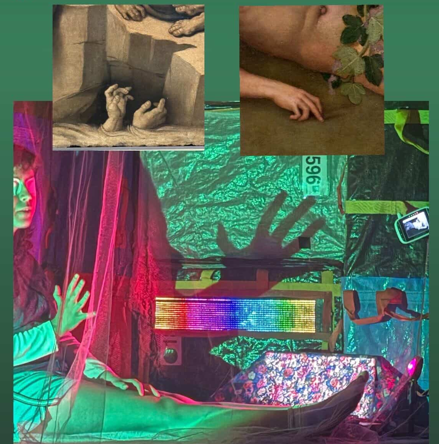
The obsession with the changing CAPTCHA—from numbers to words to images—illustrates an increasing difficulty for the same result: to get past gatekeepers and onto something else we can’t understand. In the process, one teaches machines to pretend to see and talk, torturing us while teaching machines to better torture us. The set reflects this obsession with technology: VHS tapes, a thick non-Mac laptop through which Jacobs delivers a slideshow, and a live video feed of the show on a camera connected to a fat-backed TV. Most of the audience had the opportunity to view the play through that TV, but a new aperture won’t help locate the answer.
Besides recorded conversations and some ending narration from director Blake Robbins, the play is a marathon monologue and humanization of the endless interior thought-streams often denied in common discourse to dehumanize others as anendophasic cattle. We all have a right to our infinite, unedited thoughts.
The show began with the curtain being pulled to reveal another curtain, a mosquito net on which light disperses into a rainbow, another barrier between audience and actor. The mosquito net indicates a second, impassable interiority: this story occurs (almost) entirely in her head. There, language registers—formal, vernacular—combine (“Calqued out bus bitches and so much more the like,” “Migrainiac bitch wife”), and an obsession with assonance (“decoy-people,” “cognitive salt”) shows the prosody in even the most opaque critical theory. It’s a play that challenges while pushing an audience to their limits in tracking language. Humor exists in it, but is never deployed in a way to relieve one of the effort in being its spectator. Language is a game, not just that which explains solipsisms.
Jacobs finally removes the gauze from her eyes, as if something will be learned, but how much can one learn from only themselves? CAPTCHA Analysis is meant to drain language of its ability to interface with the world; or, it’s designed to be a challenging play, in which case, I might’ve failed.
Another actor (Madeline Freeman) arrives to break through Jacobs’ mosquito net shielding and hypercirculating thoughts. Jacobs then introduces God, not to thank Him, but to praise Him. Thought and language-as-symbol aren’t curses, but gifts. We’re trapped to harness the only thing we have.
Images provided by Blake Robbins.
Alina Jacobs’ CAPTCHA Analysis played on April 17th2 & 18th at the Sunview Acropolis. Follow Jacobs for more updates.



Leave a Reply