Part two of a two-part retrospective on how the police fought New York’s last socialist mayor. Read part one here.
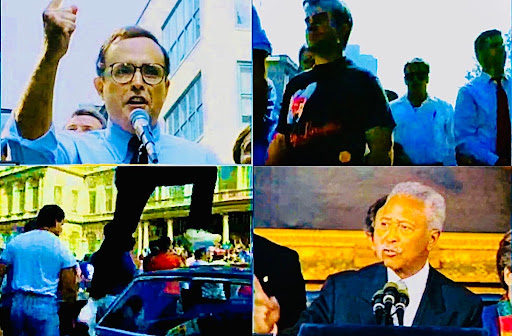
By around 10:50 AM on September 16th, 1992, all hell had broken loose outside City Hall.
As Rudy Giuliani and the PBA continued their rally on Murray Street, the overflowing crowd of thousands of drunken off-duty NYPD officers had begun to charge City Hall, trampling and smashing cars, harassing passersby, and generally wreaking havoc on the surrounding streets. (Jonathan Mahler, in his new book Gods of New York, claims that thousands of officers entered the building and made their way towards Dinkins’ office, though most accounts of the day don’t feature this detail. At any rate, Dinkins was uptown attending a funeral at the time.)
It was categorically a riot, with an ugly racist edge; politically it had implications of a putsch. For future mayor Eric Adams, present that day, it resembled something else: “Right out of the 1950s: a drunk, racist lynch mob storming City Hall and coming in here to get themselves a [n*****].”
Council member Una Clark, also Black, was blocked from crossing the street by a beer-drinking, off-duty police officer, who was heard saying: “This [n*****] says she’s a member of the city council.”
The racialized fury was even directed at Black police chief David Scott when he attempted to calm things down and was heckled with chants of “Retire! Retire!”
Jimmy Breslin, reporting for Newsday, recalled hearing: “Now you got a [n*****] right inside City Hall. How do you like that? A [n*****] mayor.”
Reinforcements were called in, but most on-duty cops showed no interest in wrangling their peers. A line of cops on horseback watched the action stoically. At one point, a lone officer on a scooter showed up and doubled back when confronted with the size of the crowd.
As the massive crowd was repelled by the barred doors to City Hall were barred shut. away from their attempt to take City Hall, they surged in the opposite direction—the Brooklyn Bridge.
Michael O’Keefe, the cop who was acquitted for shooting Jose Garcia and who had spoken at the rally, later wondered why they had taken the bridge. “They basically took the bridge, which was hysterical because we were so critical of Al Sharpton and all these people who took the bridge whenever they had a stubbed toe,” he would tell New York decades later.
With bridge traffic stalled in both directions, the crowd trampled and rocked cars, including that of Mary Pinkett, the city’s first Black New York City Councilwoman, and her elderly black passengers. At its frenzied peak, the crowd beat and harassed journalists trying to document the action and mocked drivers stuck on the bridge, including one frantic woman trying to drive her son to chemotherapy.

After a while, as the alcohol and mob psychology wore off, the crowd dispersed, leaving the bridge and City Hall area strewn with broken bottles and uneasy bureaucrats. On their way home, a group of off duty officers got into a subway scuffle that ended with them breaking a man’s jaw.
“They had beer and they wore guns and they all thought it was great to be young and drunk and ignorant.” Breslin wrote. It was a fitting epitaph for the chaotic morning—but the long term implications of the PBA riot were only beginning.
Dinkins, furious the next day, called Giuliani “clearly, clearly an opportunist… seizing upon a fragile circumstance in our city for his own personal gain.” Black papers such as The Amsterdam News called the rioters “fascists, stormtroopers, criminals, miscreants and worse,” and bluntly assessed Giuliani as a fascist, which he, perhaps smirkingly, characterized as an ‘anti-Italian slur.’
But more importantly, he employed a strategy that would become crucial to the right wing playbook in the coming decades: never apologize and always accuse your enemies of your own tactics. According to Giuliani, it was Dinkins and his allies who were race baiting, actually— by focusing on the “minor occurrence of racial epithets, if they occurred at all.”
For his part, PBA President Caruso told Guillermo Linares, a Dominican city council member representing Washington Heights: “You are responsible for what happened yesterday and so is the mayor.”
Characterizing the riot as “emotionalism” meant to “convey a message clearly and graphically,” Caruso put things in terms of a mob extortion in a conversation with Norm Steisel, one of Dinkins’ deputy mayors: “If you don’t respect them, you’ll never have a safe city again.”
It was the kind of blunt threat that a liberal media could only rationalize away. As the controversy wore on, a New York Times editorial soon called for “a break from the tensions” and “lowering the voices on all sides.” Dinkins was eventually praised for being a good sport and not making too big a stink about things: “Mayor Dinkins’s more conciliatory approach to the Police Department is most welcome,” the Times said.
After multiple inquiries, 42 NYPD officers were penalized for their actions the morning of the riot. Only 2 were suspended.
But Giuliani’s new campaign was only beginning. As his Election Day fight with Dinkins approached, Giuliani deployed a battery of what he would later refer to as “dirty tricks,” sending immigration agents, off-duty cops, corrections officers, and FDNY to Black and Hispanic districts to monitor for supposed election fraud. Ray Kelley dispatched 3500 officers to polls.
In one case, a polling site in Bed-Stuy was “disrupted’ by ‘about 10 men who appeared to be homeless,” one of whom admitted to being paid for the act.
Most notable was a scheme where posters hung up warning voters at Latino polling sites that they would be monitored by immigration agents. “Nowadays they [would] probably prosecute you for it,” Giuliani chuckled on a podcast appearance in 2023. In case anyone thought America’s Mayor would stop short of admitting to blatant voter suppression on air, he went on to clarify to the shocked host: “That’s the way we kept down the Hispanic vote… [Keep down] the Hispanic illegal vote, which takes away the Hispanic legal vote.”
He scored a narrow victory.
Though the tactics, which Dinkins called “an outrageous campaign of voter intimidation and dirty tricks,” spawned an investigation by the Clinton-era Justice Department, the mayor—who had once reminded Rudy that “a Marine doesn’t start a fight but we sure know how to finish one”—made a quietly emotional concession.
However dignified he was, American culture couldn’t tolerate a loser, and a one-termer was a loser. Like Jimmy Carter, Dinkins was characterized as a wellmeaning but hapless flounderer. He even lost the Phife Dog endorsement: by the late 90s, the Gen X rapper took to replacing his shout out with “Dinkins was a fucked up mayor” during live Tribe Called Quest shows.
Dinkins carried on as a teacher and activist, protesting Giuliani’s NYPD scandals more than once. Ironically, for the self-described socialist, many of his lasting legacies—leasing Times Square to Disney and other companies, consolidating Fashion Week and the construction of the Arthur Ashe Tennis Center in Queens, home to the US Open—are now staples of the city’s modern tourist-centric capitalism.
Meanwhile, Giuliani’s terms as mayor offered a preview of what politics would eventually turn into under Trump—starting with Giuliani’s sneering, combative handling of the media.
“At 2 PM every day, Rudy would just whip his dick out and go yell at people,” Rick Wilson, his media consultant, reminisced to Vanity Fair years later. “We had a strategy that we were going to commit news every day.”
Despite campaigning against patronage, he made sure to shove loyalists and unqualified lackeys into city government positions, while dramatically slashing city staff across the board. A Giuliani commissioner described this pre-millennium DOGE-ification of the city in Andrew Kirtzman’s Emperor of the City:
“These guys came in with this sort of disdain for government… their approach to hiring was, ‘What the hell difference does it make? We’re going to run everything from City Hall. We can have a chimp as commissioner.’”
When it came to the police, however, he micromanaged the department down to its individual promotions and began a pre-9/11 militarization of City Hall, complete with rooftop snipers, as if in paranoid anticipation of the kind of riot he himself instigated. By the end of his term, the NYPD Street Crimes unit were known to wear shirts emblazoned with an Ernest Hemingway quote glorifying the “the hunting of men,” and scenes such as a union leader being escorted out of a meeting by armed men at a town hall were normalized to being barely a blip on the radar.
The sheer proto-fascist animus seemed to overwhelm a feeble Democratic imagination. “Rudy is a ruthless control freak who governs by imposing a state of terror on his own administration and claiming credit for accomplishments he has nothing to do with,” former mayor Ed Koch wrote in the Daily News, before admitting he would still vote for the man.
The chaotic good fortunes of the 1990s were in effect. Crime plummeted, though it had already been going down under Dinkins. Times Square was cleaned up, which Giuliani was happy to take credit for, thanks to a confidentiality agreement that Disney CEO Michael Eisner insisted on with Dinkins officials preventing them from announcing the deal until Giuliani took office, in order to curry favor with the incoming mayor and which made sure there would be no mention of the Dinkins and Koch administrations that had worked for years to make it happen.
But Giuliani’s grasp on power was as unwieldy as it was fierce. Once his second term came around, he immediately turned his consolidated powers against targets like jaywalkers, modern art, and—bizarrely —ferret owners. The neighborhood riots of the Dinkins years had given way to new scandals involving cops wantonly assaulting and blowing people away. According to Kirtzman, Giuliani’s total disinterest in meeting with Black politicians was no secret. Having allegedly conquered crime, Giuliani increasingly played defense, embroiled in political blunders, personal scandals and health problems.
Crucially, aside from a brief, blase piece on local news, the PBA Riot had never made it onto television; most of America would go on to remember the ‘93 mayoral race as nothing more than the subplot of a Seinfeld episode involving non-fat frozen yogurt. While Giuliani may have spent his afternoons sneering at local reporters outside City Hall, he never missed an opportunity to drop by SNL or clown around in drag with Trump for a much bigger national audience and a chance to remind everyone he was: The Man Who Cleaned Up New York. By the time 9/11 hit in the waning days of his second term, he was ready to assume the mantle of “America’s Mayor,” instead of the guy who relocated the city’s Emergency Response Center in the heart of the World Trade Center, and cost untold lives by rushing the cleanup of toxic rubble.
The events of September 16th, 1992 were memory-holed for the next few decades until the similarities with the putsch of January 6th 2021—also egged on by Giuliani—were too glaring to ignore.

After the bombing of his 2008 presidential campaign, an allegedly alcoholic Giuliani would hit rock bottom at Mar-A-Lago, drinking so heavily he would regularly fall down and hurt himself. Trump was there to pick him up (or most likely yell for someone else to.)
Once he was done testing the waters for his own political cannonball, Trump would use Giuliani’s tenure as a template for his own rule, with the man himself right there by his side. Though Giuliani was often memed in the image of Nosferatu, he instead became a shambling Renfield—a decaying madman grinningly espousing the cult of his new master.
Beefed up by the Patriot Act, The NYPD would eventually expand into a surveillance behemoth, with the next mayor bragging of his ‘private army’. When DeBlasio, himself a dabbler in democratic socialism, and also present at City Hall the morning of the PBA riot, significantly cut down on stop and frisk, Giuliani’s signature policy, cops retaliated with an ugly series of protests, including a policing slowdown that New Yorkers resoundingly shrugged at.
Mayor-elect Zohran Mamdani, who takes office January 1st, doesn’t seem to have the same problem Dinkins had with controlling the narrative, having spent the last year humiliating his confused opponent Andrew Cuomo with Bugs Bunny-like relish. But the question of how such a personality will flex actual political muscle remains. So far he has deigned to keep Jessica Tisch, a staunchly pro-Zionist billionaire scion and friend of Ivanka Trump, as police commissioner. The relationships between the incoming mayor, reluctant allies like Kathy Hochul, and the NYPD, not to mention ICE, are an uneasy network rife with possible stress points. How Mamdani navigates it, or whether he has anything to offer other than a charm offensive, remains to be seen. But anyone watching would do well to study the legacy of September 16, 1992.
Brian Jones Kraft is a writer who has been living in Bushwick for over a decade and a half. He has previously written extensively about the legacy of Andrew Cuomo.



Leave a Reply