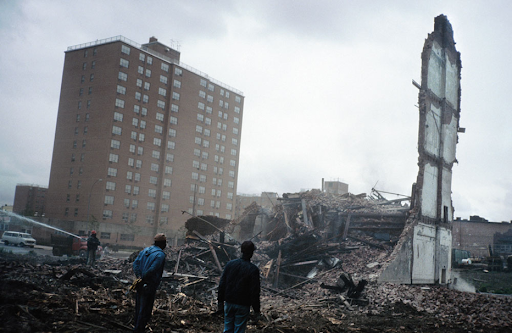
This article is adapted from a recent presentation given at ‘Bushwick History Night’ hosted by Greenpoint History Night.
Structural conditions—housing, long commutes, the physical environment—influence distress. The mind is not context-free. As a resident psychiatrist, I’m constantly struck by how much suffering is shaped by structural conditions rather than individual pathology.
People are embedded within places. Places form the scaffolding for community and social structure. Those structures lend resilience. To not consider systems-level factors is to risk mistaking social dilemmas for individual pathology.
New York City, like many American cities, underwent an unfortunate experiment in dismantling its own social infrastructure. It happened in three major acts.


Redlining
During the Great Depression, the government passed extraordinarily effective laws to prop up the economy, including the National Housing Act. Through this, the government insured home loans, serving as the basis for the modern mortgage system. The Home Owners’ Loan Corporation established a risk template for existing neighborhoods which was used by private banks to systematically deny investment. In the first 25 years, 98% of the loans were given to white Americans. This contributed to a massive wealth disparity between Americans, not to mention the opportunity cost of good infrastructure and good schools in wealthy neighborhoods.
Urban Renewal
The second insult was urban renewal. In the mid-twentieth century, urban renewal policies at the state and federal level razed entire neighborhoods for highways, public housing, and other new developments. The idea of slum clearance and rebuilding parts of the city deemed unsalvageable garnered widespread support, including from one of New York City’s most popular mayors, Mayor LaGuardia: “Tear down the old … Build up the new. Down with rotten, antiquated rat holes. Down with hovels. Down with disease. Down with crime. Down with firecraft. Let in the sun. Let in the sky. A new day is dawning. A new life. A new America!”
There were disparities in projects by neighborhood. Upward of 70% of public housing projects were built in formerly redlined areas, according to overlay estimates. Today, Brownsville and East Harlem have the highest concentration of public housing in the entire United States. Only a fraction of the displaced were rehoused in these projects.
Bushwick experienced the destruction without materialization of new projects. Bushwick absorbed displaced residents from nearby neighborhoods without investment to support the increased population.
Planned Shrinkage
By the 1970s, the city’s fiscal crisis compounded decades of neglect. Several factors contributed to New York City’s deficit: decades of suburban growth fueled by the GI Bill and highway expansion, rapid deindustrialization, shrinking federal support for cities under Nixon and Ford, and good old-fashioned fiscal mismanagement. With pseudo-scientific justification from a RAND corporation study, city officials began withdrawing essential services across the city in order to save money. They closed fire stations, police precincts, and schools most dramatically in Black and Brown neighborhoods. Entire blocks of the South Bronx burned. In total, 80% of housing in the neighborhood was destroyed or abandoned. This process also affected Harlem, the Lower East Side, Brownsville and Bedford-Stuyvesant.
In Bushwick, roughly 30% of its population left between 1970 and 1980. Fires, financial neglect, and withdrawn social services hit the neighborhood hard. Then came the blackout of 1977. Lightening struck transmission lines from a now defunct nuclear power plant, leading to an overloaded power grid. Decades of neglect culminated in looting, fires, and destruction during this darkness. Decades of neglect culminated in looting, fires, and destruction during this darkness; so much so that a Bushwick living room served as the stage for a mayoral debate between Mario Cuomo and Ed Koch that year.


Why Social Structures Matter
Rod Wallace would later describe this collapse as a “synergism of plagues.” Wallace is a physicist turned public health researcher who applied rigorous mathematical models to epidemiological issues. He described cascading epidemics—an interrelated and reinforcing web of displacement, disrupted social networks, homelessness, drug use, and HIV. He discussed the contagiousness of urban decay, with effects starting locally and spreading to other parts of the city. Wallace argues that social structures build resilience. Structures like multigenerational households, extended kin, informal caregiving, community organizations, churches, tenant associations, local businesses, friendship circles. They provide support, stress regulation, mutual trust, channels for the spread of information, and they buffer against the spread of disease.
From Neglect to Nightclubs
So how did Bushwick go from the face of urban blight to Vogue’s seventh coolest neighborhood in the world? The short answer: cheap space. Low property values and open land attracted artists who were priced out of more expensive neighborhoods. Artists brought audiences. Audiences brought cafés, bars, and performance spaces. Venues brought nightlife. Bushwick became a cultural hub. Economics layered onto resilience.
Bushwick keeps redefining itself as the landscape changes. Despite social dislocation and structural violence, people keep creating place. They rebuild the scaffolding that buffers against stress. My mentor, Mindy Fullilove, has extensively studied that psychiatry of place.
Rising rents and gentrification threaten to undo the networks that made revival possible. Gentrification rapidly reverses decades of structural and cultural neglect. However, long-term residents are often barred from receiving the benefits of enriched social, infrastructural, and cultural changes. One of the glaring ironies of gentrification is that neighborhood investment drives locals away, producing the same result as neglect.
But by stepping back and asking why Bushwick looks the way it does, we can draft how we want it to look moving forward. We can choose to bolster the scaffolding and make it easier for people to create community.
Adam Alghalith is a psychiatry resident in New York City who is interested in cities and social psychiatry.
Top photo courtesy of Meryl Meisler.



Leave a Reply