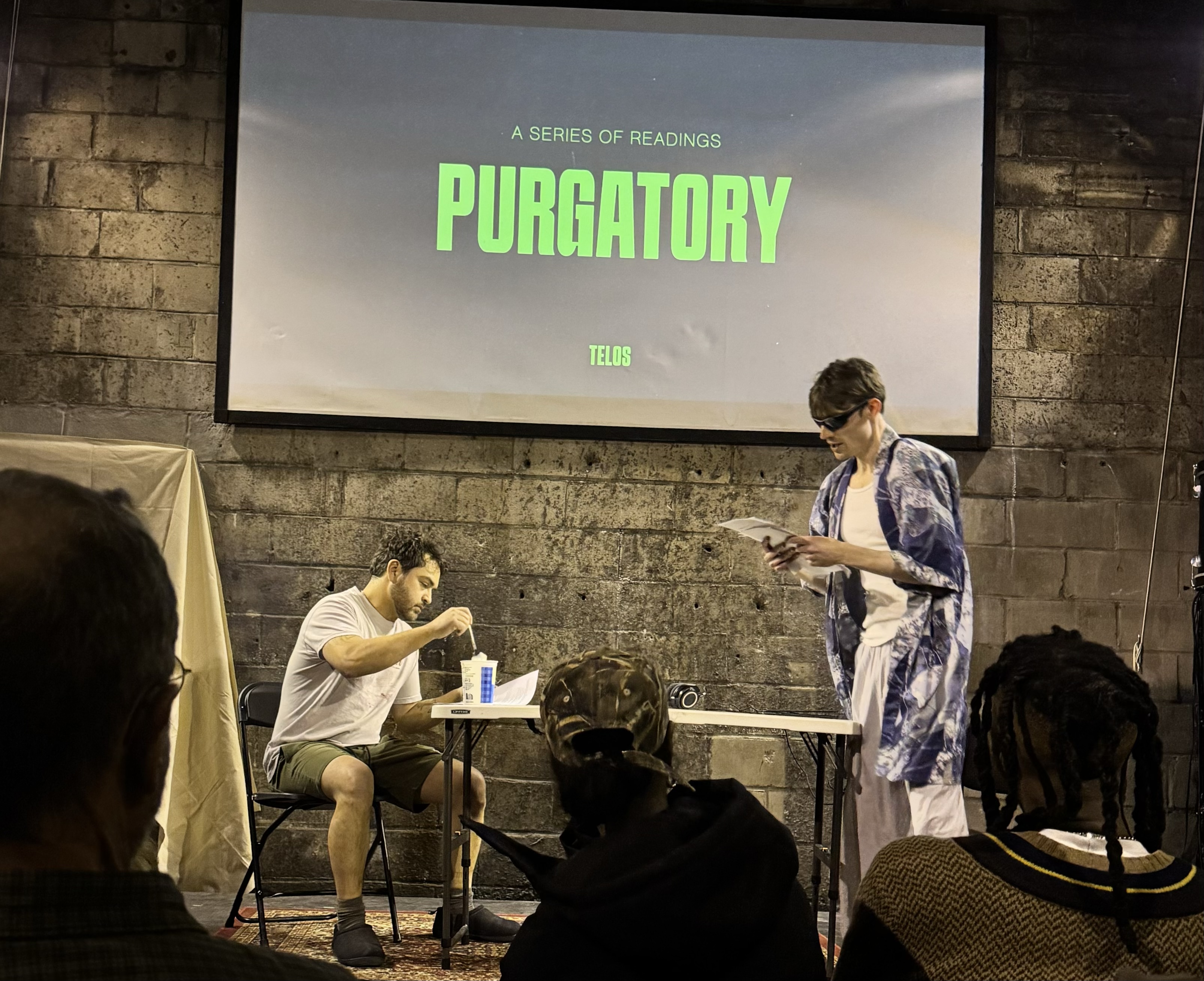
The Telos Ensemble’s Purgatory series of one-act plays at Unit J (338 Moffat St) suggests that some things are still raw—like unprimed canvas—and possible, at least on the periphery, by the Bushwick Branch tracks.
Around the stage, a hanging pull cord with no curtain to draw; a disassembled drum kit stacked like a totem pole; piano draped by a moving blanket; the door to the dressing room ajar, then closed, though it opens again on its own (slightly less ajar); and a low window covered by bed sheet: take in all the details imagine, then imagine them gone, overtaken bysketches performed by actors who’d only received their scripts 24 hours prior, as their author Dan Blick, explained. This was a place for a playwright’s fantasies to manifest for others. Tonight, it was for a trio of one-acts written by Blick, one of the two actors behind Telos.
Artists (playwright, actors) materialize dreams for people who come after. This is how you change a neighborhood, even out. On the concrete wall, pocked with drill holes and stained with faded spray paint like old mold damage, new things hang: imported art, a family photo, pictures of other cities internalized by everyone inside so they can go back out at the end and make another Berlin of Bushwick.


“Room 212”
We begin at the aftermath of a hotel hookup between Melissa (Hannah Vliet) and Dylan (Matthew Laureano) But she’s really talking to a wall that’s just alive enough to not care. It’s a non-Socratic dialogue, tending toward undiscovery: Dylan doesn’t provide conflict or any new tactics to push her in the direction of truth. She distracts herself with coke.
The arrival of Dylan’s friend Mike, played by Ronan Schwarz, eventually initiates some conflict. The hookup was a vigilante sting operation that turns into an interrogation. We’ve all been there: first, a one night stand, then an opaque dispensement of justice; hell for the worst of us, hell for all of us. Melissa lashes out by insulting Dylan’s sexual prowess. The unseen men in her life are depicted as running the logistics of terror.
I don’t assume the humor—more prominent in the subsequent plays—was Blick flinching away from the brutal and serious. The cruelty of the world is alive and well and he makes it sort of sound like it’s laughing at us. On stage, everything but sex turns out to be a lie.
“Shrooms & Social Climbers”
A couple, Mia (Stella Marcus) and Harry (Saadiq Vaughan), trip together. On shrooms. The conversation winds around the discomfort of drugs, West Village bar politics, and problematic age gaps. Absent men are, again, depicted as exploiters.
At first, this one appears lighter in tone, more a conversation than an unfolding thriller. But at the end, Mia requests Harry kill someone on her behalf. It’s unclear if she’s serious. It ends soon after. Yet again, these women have done, or are about to do, something wrong.
Just as in the last one, “Shrooms & Social Climbers” is another contrived situation: not contrived in the negative sense, but that the situations are manufactured. We force ourselves into discomfort, through sex or drugs or crime. Beneath normal distractions are something dark and alive that grabs at our throats.
“Bohemian Rhapsody”
The final play is a farce between two roommates, Tim (Telos cofounder Mitchell Pope) and Eric (Rich Carrillo, in a ‘Ridgewood Reservoir’ t-shirt) play out a standard two-hander that begins with a not-so-close reading into Queen’s most famous song.
In the first two pieces, men have small penises or are creeps, but here they’re impossibly stupid, or stupid in the way that smart people often are that makes them incapable of managing idiots. Beneath everyone is an incompetent—criminal, idiot, either way incapable of adapting to norms.
Because women are absent from this story, Tim, in a kimono, takes the feminine lead (driving conversation, corrupting his opposite), while Dan plays secondary in another dialogue that ends in madness. His positioning as the feminine lead hints at the illusion of gender differences. Men don’t just have to be voices of reason or arbiters of justice: they can be bad people, too, as Tim compromises the more straight-laced Eric in conducting a drug deal over Reddit.
Laugh all you want (there’s an Oscar Wilde reference somewhere): it’s still bleak out there. Another abrupt end. There are jokes, there is depravity, there is no closure.
//
Contrivances reveal the depravity beneath all people. Conversations lead only to incrimination. Sequentially, as the one-acts lighten in tone, they progressively reveal how empty we are: they show there is no joy that doesn’t unravel away from truth. You’re born already off to a bad start. You can only get more insane from there.
If we turn Blick’s vision onto the world, what’s out here? More roommate drama two blocks off the J train? Probably worse: a trafficking network at a vintage store (no one’ll believe you). Break up at Ayat, die at TV Eye while someone tells a knockknock joke to themselves behind the bathroom door.
Through the latter half of these, I heard electronic music coming from the next room. Another story imprinted onto distant spaces. After leaving, I passed that party and it reeked of cigarettes and I liked imagining no one was having a good time in there either. Outside, the snow had melted and hardened into cruddy ice days ago. I should’ve slipped and fell and farted and died.
If you are in Stockholm, Sweden on the 26th or 27th of February, go see the Telos Ensemble’s next performance: ‘Castles.’ Otherwise, follow along with them on Instagram.
Aaron Tomey is from Georgia, lived in St. Louis, and now lives in Brooklyn. His essays have previously appeared in Hobart, Bushwick Burner Phone, and Apocalypse Confidential. He can also be found on Twitter: @ecstatic_donut.
Photos provided by Dan Blick.



Leave a Reply