At a Friendsgiving, I got defensive once the Albanian talked about his work on a PHD in Shakespeare. Books are my bag, and here was this handsome guy—girlfriend and all—demonstrating passion and rigor. Passion and rigor are also my bag.
He looked like he knew the name of every book ever written and thought of an opinion on all of them. So I told him that I loved Tony Tulathimutte’s Rejection so much that I wanted to assassinate the author. 1
Not out of jealousy, but as a favor. His next book wouldn’t fall flat, because there’d be no book. He wouldn’t write a story that wasn’t as felt as all the things I felt and shouldn’t have felt when reading “The Feminist.” There’d be no more stories. He lives in Crown Heights. He’s right there, 2 neighborhoods away.
He’s right there, but that’s two trains away and buses leave me feeling impatient and dumb.
//—/-/
After a reading at NYU, I circled the block to muster up some courage. I walked back in and then Geoff Dyer was asking me if I was a student there. I told him I was just a midwestern yokel, and a big fan. He laughed at “Yokel.” Breathing the same air as your heroes isn’t so bad. Dyer was so visibly pleasant, tall and delicate, with a good handshake. I bet Tulathimutte was a nice guy, too. I didn’t have it in me to kill anyone.
Dyer signed my copy of his new book, and asked to borrow my pen to sign a woman’s book. I told him I had to leave, and it’d be my honor if he kept the pen. I left and told all my friends that Geoff Dyer stole my pen. I was trying to take note of Dyer’s lecture, where he admitted to hiding small lies in all of his memoirs. “We’re all trying to be our idols and desperately failing” (Schledorn 32). No one believed me.
She is America. She is a whole made of parts and pieces from everyone around here.
Greta Schledorn’s Now More Than Ever is full of bad habits, pilates, a binary of cigarettes/vapes tearing our narrator in two. The deja vu of being around others, knowing them well enough to split every salad they order (I counted around 5-6 shared salads), but feeling so distant as to rarely name them. The medicated and unmedicated exhaustion of the working intelligentsia. And all of it happens here. I’m finally reading a book that justifies living in Bushwick.
In the novel, Bushwick is presented as an afterthought, a pitstop for more relevant places (LES, East Village). Around here is just a bed to rest in for most. It’s a logistical hub, a launchpad for cooler places, cooler things. I look around and see all the commissioned graffiti and don’t really blame anyone for fucking off and away most of the time.
The novel floats around current events, like the Vegas Cybertruck attack and New Year’s in New Orleans (40, 67). And none of it matters. Plots are only important to people who think swords with names are really cool.
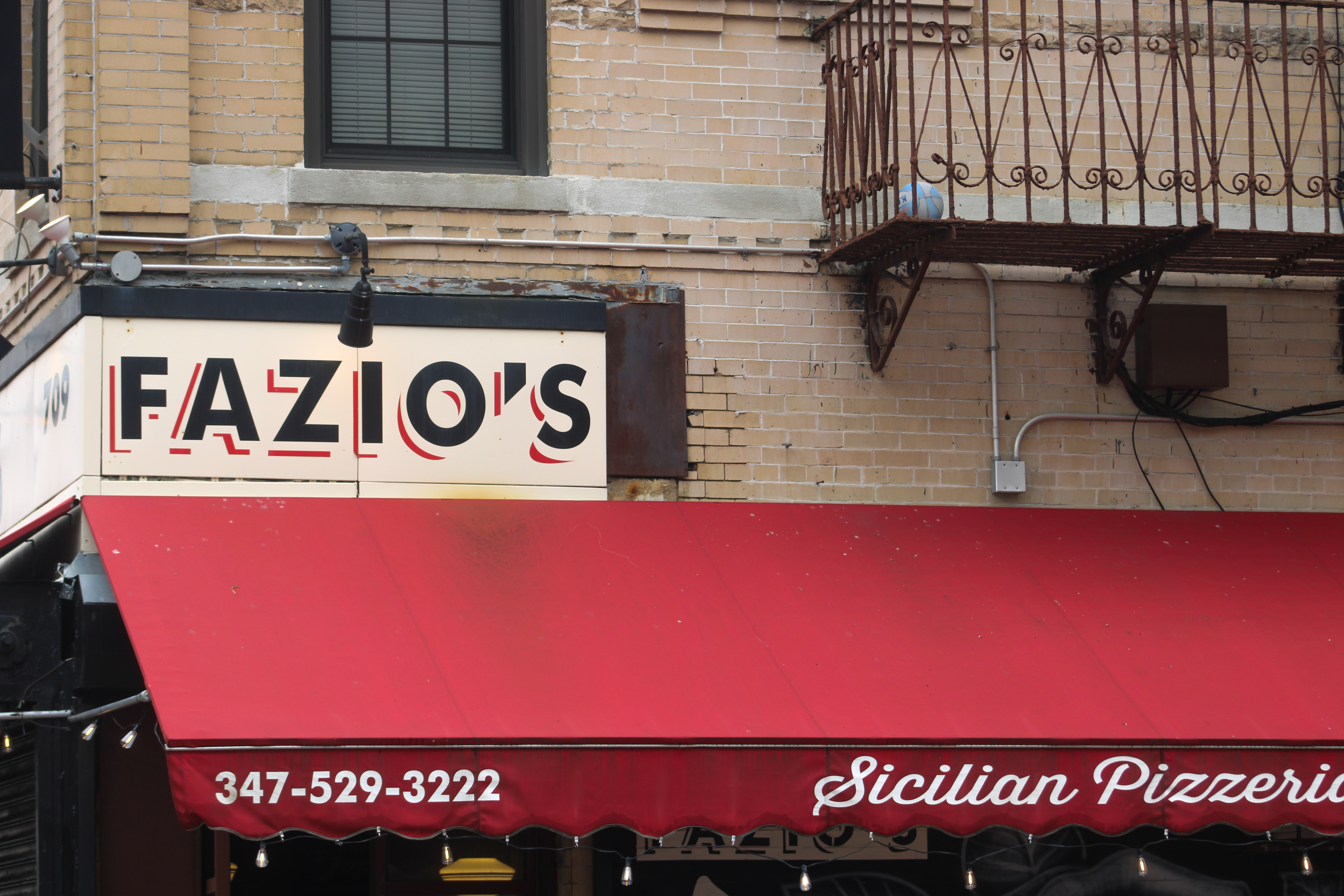
Now More Than Ever is about the elasticity of the worst parts of ourselves, and how that’s okay: “Maybe I am mean. That’s not a crime, that’s not the worst thing you can be” (31). Claiming to change is a recurring theme. But the character is only reliably herself, the same as always. Development is an illusion, a trick she doesn’t mean to play. She’s a friend in a way. I find myself taking advice from her. There are five local restaurants in the novel: Sunrise/Sunset, Mominette, La Cantine, Tabaré (assuming it’s the Bushwick location), and Fazio’s (34, 40, 82, 87).
Food is an essential part of the book. Though the narrator claims to “keep forgetting to eat” because she’s “too locked in,” there are several sections of her at consecutive restaurants (11, 25, 34, 61). She’s such a gourmand that she can’t be trusted when saying, “I haven’t been eating enough because everything tastes bad and I’m tired of it all” (36). The shared salads distract her from an essential lack: nothing will satiate her hunger for more success at work, in writing, in love, in life. The square peg won’t fit, the round one neither: the gaps in all of us take new shapes daily. Every day is the worst nightmare imaginable for people who practice manifesting.
She has a former lover that haunts her, an ex from Florida that she almost married (38, 66). She is corporate, attends readings, is medicated, intermittently obsessed with fitness, addicted to nicotine, dabbles in cocaine. She is America. She is a whole made of parts and pieces from everyone around here.
The narrator pops up at Maria Hernandez Park (118, 125). She drinks and dances at Left Hand Path, Kato, Carousel, Trans-Pecos, Mood Ring, Alphaville, Birdy’s, Happyfun Hideaway, Cherry on Top, Elsewhere, Jupiter Disco, Bar Cornelia, TV Eye, and Honore (34, 35, 40, 43, 43, 44, 87, 87, 120, 153, 175). She eats tater tots at Bonus Room (43). She goes only as far north as Central Park (9), with brief sojourns south to Bed-Stuy’s Saraghina (120, 152). Outside of that, the action takes place on the L train corridor. There are pitstops in Williamsburg along the way to LES/East Village (10, 23, 34, 40, 44, 49, 62, 74, 82, 87, 120, 152, 165, 175, 176). Nights out and around town are a smear of names. We want to tell people where we’ve been. “[I]t’s more interesting to be a romantic in a city like New York. It’s more romantic. There’s more to push against. There’s more tension, more to resist, more to push through” (83).
The story itself is an endless “middle… right in the middle, like we always are” (161). Here is an excerpt that illustrates its standard bandwidth:
“Made the age old mistake of thinking goodness mattered. Did pilates and got a bottle of wine from the wine store down the street and pizza from Fazio’s. I have a crush on the boy at the wine store and a crush on the boy at the pizza place” (34).
Fazio’s is a fine place—I think it’s the best pizza in Bushwick—but it’s not worth a long walk. And there’s a guy at Fazio’s who comes across as a bit curt or abrasive, but that’s okay because this is New York and he’s handsome, too. I didn’t think much of it.
The narrator claims men tell her, “Oh sorry you live in Bushwick that’s too far” (96). A good deli is two blocks away. A good coffee shop: three. A great restaurant: get on the fucking train.
The line between memoir and fiction is regularly called into question. “I’m starting to blow up all these stories,” she says, “to turn events in my life into something someone might find interesting” (101). Later, she adds, “It becomes a novel when I remove myself, as much of myself as I possibly can, and replace myself with someone I invented and make her interact with people I invented too” (109). Whoever’s in the novel, I’d guess she lives in between the Halsey L and Myrtle-Wyckoff stops, given her appearances, in her novel, at Bar Cornelia and Fazio’s (118).
Later, the narrator says, “Luigi Mangione is the perfect example of why it matters so much to be hot” (93). I can’t imagine the Fazio’s boy clearly, but in my mind he’s as handsome as Mangione, or handsome in that same visibly Mediterranean way. Is he the same guy who’s sold me pizza?
I think about Geoff Dyer, how that wiley guy only seen in books ended up being real. There are real things in books. There are so many real things in books that it’s cowardly to read a book and finish it and expect nothing more of it. I want to reach into a book, grab hold of something and pull it out, consider it and maybe let it go into the world.
It’s got to be that boy I kind of remember. “I know which one,” I wrote in the margins. I wonder what a muse looks like in real life. “It’s not cringe to do anything” (51). She also says, “I never write reviews because I really don’t feel interested in writing like that” (65). It’s such a fun game selecting the advice I like best.
//—/-/
And so I’m outside Fazio’s, looking in, hoping he isn’t there, but there he is: “the boy at the pizza place.” I walk in and order a Diet Coke and he turns around to fill a cup. Despite Schledorn’s advice, a premonition of cringe grabs at my throat.
He turns back around. I ask him if he’s got thirty seconds to hear a story that involves him. I describe Now More Than Ever to him, how Fazio’s makes an appearance in it, and that I think he makes an appearance, too.
He seems interested. I ask him for 30 more seconds and he agrees. I take out my copy of the book and hold it up to him. I hand it to him with page 34 open. He reads the section, then calls over his coworker, who also reads it and says, “Dude, that’s you.”
I get his number. He’s worked there for four years. I ask him for a photo to send to the author. He asks why, and I explain that I’d like to know if he’s the guy in the book, or the guy who’s the inspiration of the guy in the book, or if I’m just completely wrong. Then I start explaining the idea of autofiction to him while a dozen people come in. I tell him I’ll text him, which I do after getting home and reading Now More Than Ever again.
A friend tells the narrator that she’s “positive for the first time in my life” (121). The chapter prior was a standard list of the going out itinerary. It’s the life of a zombie attached via astral cord to someone distant, screaming, “Did basically nothing all day” (127).
Lines like, “I wanna stay in a hotel!!! … And I was like yeah no shit I belong in a Four Seasons,” occupy the same book as, “How beautiful it must feel, to fall into the water and float” (48, 8). One person talks like five different people in any given day. The incongruity can produce a surprising tenderness: “I’m starting to freak out about the recession. But it felt nice to be held while I slept, to have someone pour me coffee” (126). These moments cut through buzzwords—“aura,” “trad,” and “mog”/“mogged”—like tweets are repurposed as public wisdom and I count the phrase “that was like” used as a conjoining phrase seven times. (35, 72, 80, 104, 156, 139, 163). The language never “lock[s] in.” There’s no closure in story or structure.

I’m at the McNally Jackson in Williamsburg with a friend. I buy books by Theodor Adorno and Fernanda Melchor to impress the staff. No one notices. I ask the cashier how her day is going and she stutters a bit. I tell her not to worry, that I too also want to die whenever I stutter in response to basic questions. I wish her a good day while she checks out my friend’s books.
Outside, I tell my friend that, in hindsight, I wasn’t sure if that bookseller thought I was a huge asshole. My friend confirms that the bookseller, along with all of her coworkers, probably thought I was the hugest prick ever. I feel acid and collapse. It’s my worst fear. It’s hard to remember that no one wants me to die exactly, that it was just another day for them.
As the narrator says, “I want to feel insane. I want to feel really fucking insane.” (79) I get off on the Halsey L and go back to Fazio’s and tell my friend to wait outside.
The boy’s there again. He says he did receive my texts, but he had a big party later that made him lose track of the whole thing. He was starting to seem vaguely off put. I was overstaying my welcome. I tell him I mostly wanted to say hello so I could come in again for pizza in such a way that I appear sane and not expecting anything more than pizza. I don’t exactly mean it.
“We’ve made it too easy for people to get what they want. We shouldn’t have what we want, we should want it” (119). He gives me a free Diet Coke and wishes me well. He’s given me a lot of grace for a stranger.
So I’m left only to guess. “So really a muse is whatever you remember,” (114). I’ve practiced obsession too openly. Now’s the time to start feeling embarrassed.
//—/-/
Through its language, depiction of North Brooklyn and LES scenes, and the daily mechanics of life, Now More Than Ever pans our lives which, like Everlast bags, are so capable of taking hits and being shaken, but always hanging in the same stasis.
“Sometimes I feel like this is all an act. The writing. It’s real while I write but then I rearrange things, create another image. But which is closer to the truth? The truth is much less interesting” (148). It’s all ostensibly fiction. Closure isn’t any closer with the Fazio’s boy. It’s awfully hard to be a detective.
I DM the author on Instagram, but the message doesn’t go through because she doesn’t follow me. As she writes in her novel: “I can’t just have everything hand delivered to me. Things should be hard and take a lot of time.” (58) So I DM the account of the small indie publisher that released the book and someone there says they’ll pass the message along. The author then follows and unfollows with no response. Free press isn’t too flattering when it’s months late, either.
I want to know, or at some point wanted to know, like a real journalist, to unknot lines like, “who’s the real Greta? Like I would know” (141). I wonder if we’re still entitled to our own lives when we operate so publicly.
In her book, she writes: “I feel like a new person. I’m not coming from an ugly place. I’m coming from a place of beauty,” not destined for a trainwreck, only an unfolding.
Aaron Tomey is from Georgia, lived in St. Louis, and now lives in Brooklyn. His essays have previously appeared in Hobart, Bushwick Burner Phone, and Apocalypse Confidential. He can also be found on Twitter: @ecstatic_donut.
- Editor-in-Chief Andrew Karpan has confirmed that Aaron has no plans to assassinate Mr. Tulathimutte, and also verified—via confidential sources—that he’s also well known to be a coward.
↩︎



Leave a Reply