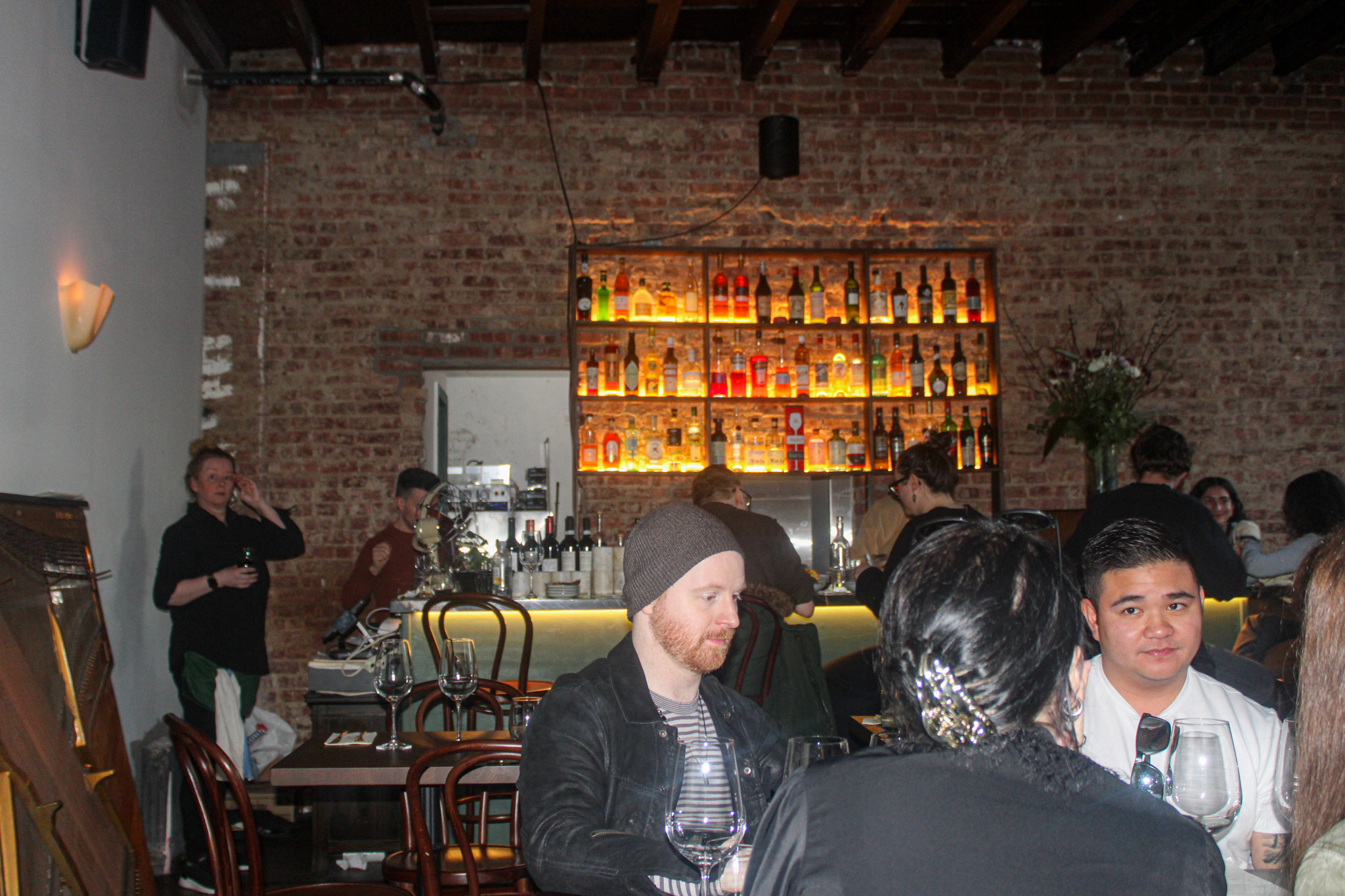
You can see the stainless steel kitchen from its unobstructed storefront window. Cicchetti (185 Howard Ave.), Ocean Hill’s newest wine bar, seems like a portal to another world, one that’s not just Italian (Venetian, specifically), but something like bricolage: Egyptian alabaster behind the bar, homie chairs of unknown origin, vintage Thai silverware purchased in sets from Staten Island and suitcases shipped from Florida.
The candles were thankfully real, and its menu small enough to lend a sense of trust when modern dining and grocery experiences are spoiled by the paralysis of choice. Cicchetti makes the decisions for you.
Apertivo cups of spicy cashews and roasted chickpeas reminded me of pork rinds. Crostini with mounds of anchovy butter, cannoli puree, pesto and flossy porchetta. Meatballs, sans pasta (this is not the Olive Garden experience) and eggplant in rich red gravy with toasted bread.


Aspiring creative directors occupied six tables in the center of the room. There were two women at a corner table—one with green streaks and another Bangs-Having American—and a family too (of three) at another, and of course I picked up their child’s fallen woolen cap. No heroes needed here: the future’s already happening. This is a space for the many faces of today’s Ocean Hill.
Inside the visually tasteful, inviting interior, Cicchetti’s food was delicious, direct. I can’t offer any wine coverage (beyond the wine menu having many beautiful, baffling names), but Grime Square photographer Andrew Karpan seemed to enjoy his Barbera red.
//—/-/
The above was a small bite (to translate Cicchetti’s name) before the rest in this review: little histories from the past and the histories we’re making today.
As co-owner Emanuele De Biase told me before (more on that later), “When you have to build a modern city, every time you dig, you find something.” Sometimes you’re eating deli slop at home and you have a thought and it becomes so many thoughts that so quickly get out of head.
//—/-/
Earlier this month, I was walking home from the Ralph Ave C station down Howard. As always, I passed by House of David (191 Howard Ave.), the local Black Hebrew Israelite church. A man sat out front, enjoying the first short-sleeve weather since October. Just past him, outside the next door, I saw a new restaurant opening, complete with lily white babies and people drinking wine and a woman speaking Spanish maybe.
With Brevoort Houses (296 Ralph Ave.) so close by, Cicchetti looked more like an alien terraformer; having arrived to make the habitat along Howard more hospitable for other offworlders, it would make bleach seep up from the sidewalk cracks until the chemicals dissipated under the sun into a citrus spray. Its presence was so powerful I thought it alone had created Badaboom (421 Bainbridge St), which was both catercorner to it and had been operating since last June. Change is mechanical—inevitable, pressing—and there’s nothing exactly like hope in it.
I walked by three black people who paid me no mind, and then saw two white women and felt relief, followed by guilt over said relief. Moving to Brooklyn now is not like ’05 Williamsburg—post-industrial blank slate—or 20th century Manhattan—all consuming city of towers and light—but a question of how much you’re willing to squirm from incidental guilt that hums like tinnitus. The literature and discourse are out there, have been out there: you know very well what you’re doing.
Restaurant openings and closings are nothing new. Sometimes whole clubs close. But I’ve walked by this brown-bagged storefront for months now, and one day it changed. That Spanish I heard was probably Italian: I had walked by Cicchetti on its opening day. By the time I cut through Saratoga Park to head back into Bushwick, I was finally, thankfully angry.
Cicchetti’s liquor license had been active since January. Things are always going on in the background, especially when I’m not watching. Why didn’t Cicchetti think to call me? Curious that they’d be so quiet, since the last time Ocean Hill had Italians during mob hitmen Happy Maione’s era.
Ocean Hill is a mix of brownstones aggregated around Saratoga Park (Saratoga Park), though the surrounding housing stock takes on a more vinyl-sided character the farther west you go. From Saratoga Park, new signals have been pulsating, and from the earth has come the aforementioned Badaboom, Olmo (103 Saratoga Ave.), september (83 Saratoga Ave.), and Earth People Wine & Spirits (801 Halsey St.). They’re all openings, wounds, portals to a new world.
Ocean Hill was once a bastion of black homeownership, but rising property taxes have forced many residents to cut their losses or have their homes end up on auction blocks. Brownstones in the area now approach two million dollars (per Brownstoner, 660 Macon is going for $1.85 million). It’s closer to Williamsburg, where Brooklyn first found out how to bleach the old world. Despite the neighborhood’s history, it’s seen as a much more acceptable target for urban pioneering than Harlem. There was never an Ocean Hill Renaissance, no historic cultural capital that complicates the modifying of a place. Changing things won’t ever produce as much op-ed resistance.
This was my chance to platform a community voice, but I also needed someone to be angry with me, so I called the House of David one afternoon and spoke to a Benjamin there, who told me he didn’t have a problem with his new neighbors so long as they were good for the community. I forgot to ask if he liked Italian food.
But what community, exactly? Cicchetti seemed designed not for the community around right now, but for the community that could be. Why wasn’t Benjamin with me? Where’s the consideration of history?
Ocean Hill has a history of organized action that aligns it with other communities of color outside of the more picturesque blocks of western Bed-Stuy. The neighborhood was the central battleground for the 1968 New York City teachers’ strike, which pitted the then-newly created board of the Ocean Hill–Brownsville Demonstration School District, created by the DOE to represent the area’s residents of color, against the largely white United Federation of Teachers. After 36 days, involving 58,000 teachers throughout the city, and closing most of the city’s schools, the union eventually wrestled back control of the schools in Ocean Hill and Brownsville. The community was just a front line of pawns; they were always starting second.
Now, developers don’t want to associate Ocean Hill with Brownsville, which, despite one decade-old bet, is still too raw for cracker consumption. Until hooved ballet flats clomp fearlessly out of the Sutter Ave L at 2 a.m., you’re left with leasing agents cravenly up-naming Ocean Hill into Bed-Stuy on their Craigslistings—draining Ocean Hill of its association with Brownsville and that long history—and they’ll stay praying for the coming days when any bottle thrown into the streets shatters, but from that glass someone’ll make a shitty newbuild that looks like a drafty 3D window. It’ll all be Extended Williamsburg eventually.
Since Benjamin wasn’t much help, I still had to platform other community voices in Ocean Hill—particularly subaltern voices that agreed with me—but I didn’t know anyone in Ocean Hill. I needed a way to seek comment and local sentiment on my ass at home. So I slid onto Sniffies, messaged seven cruisers, and received two responses. Open or DL, everyone in the community should be heard. (The surveillance state makes victims of both the horny and the poor: the Ocean Hill-Brownsville Alliance formed at Atlantic Plaza Towers (216 Rockaway Ave.) to fight off the deployment of facial recognition in the public housing development in 2018.)
One anonymous cruiser—6’1”, 180 lbs., 7” cut, vers top, as I remember it—said he hadn’t heard of the restaurant. He also asked if I had a great ass, to which I told him, “I’m sorry fr [for real;] my ass is like really flat,” but would love his comment regardless, to which he said that Cicchetti would be “better for the neighborhood,” before deleting our conversation.


Another cruiser—5’7”, 115lb, 6.5”, slim, gay, vers bottom, twink—said, “[I] haven’t been there yet[.] I’m not sure what I think of places like that yet[.] I have mixed feelings as it is another chi chi cocktail venture place,” before adding, “[N]ot a fan of [O]lmo, but love [B]adaboom.”
Even though I was there strictly for remote business, I found myself combing my hair, wondering if the ruins of my hairline were obvious; it felt like fretting over “wearing my nice dress to the glory hole,” as one Bushwick local once put it to me. I later told my girlfriend (forgiveness is better than permission) that these comments —from cruisers to local religious officials—seemed too tacitly positive. There had to be anger somewhere. I couldn’t be alone. “You’re insane,” my girlfriend said (update: as of publication, I am once again single).
And why am I angry? Well, I had a rough childhood, for one. But this specific anger comes from a precious place: the Ralph C was the first station I ever checked into. In 2022, I’d stayed in a basement apartment off Macon, while on a weeklong vacation, the only time I visited the city before moving two years later.
But now, even that station angers me. It’s a testament to the operational limits of how far someone will go to work their Midtown laptop job 3 days/week, or to commute—flying under restaurants not listed by the Infatuation—to all the places any transplant would rather be.
The latter often involves digging a hole to China, taking the C east to Broadway Junction, waiting through a mismatched headway, all so they can get on the L—extending the logistical brutality the true pioneers at Bushwick-Aberdeen must feel—and head deep into Bushwick, or forking off at Myrtle-Wykoff to take the M up to Forest Ave to fuck a project manager: all of it a gentrification simulation of the long L train out of Brownsville and Canarsie, so close but so logistically far away unless you sweat your ass off on a Citibike like a rube (ants don’t pedal; get into the fucking bug shuttle—now!). A folded, nonlinear commute, an awkward origami effect: if you’re around here it means you’re stuck in the creases. You only end up this far out in pursuit of the fabled 1 bed 2 bath in a quirky tenement, spacious as a chickpea in its pod, or because you figured out a way to get priced away from the Wilson L.
Whatever was here before me was never for me, and it’s all gone now, like Anmwey Eatery (prev. 185 Howard Ave.), which occupied Cicchetti’s current space from 2019 until May 23rd of last year, when they had a celebration of life before closing down forever. All I could gather online was the owner’s deactivated instagram handle, and what might’ve been her real name, which I couldn’t verify with the niece or friend that I contacted (neither responded.) All I truly knew was that Anmwey’s name was probably derived from Haitian Creole “Anmwe,” which means something like “Oh my God!”
//—/-/
I find all these New Wave Saratoga places impossibly gaudy and designed to affirm the tasteful wastelands behind everyone’s eyes, like mirrors in which the viewers appear to have had very successful Botox, though I’d also be remiss to say I’ve eaten at any of them, or even eaten real Haitian food. When I get beans, rice, and chicharrones at Marthitas Kitchen #2 (1571 Broadway), I sometimes hit the cashier with a little “Yo querido.” Their hot sauce is a bit too intense. While I have been to Venice, I didn’t enjoy it.
Truthfully, I don’t enjoy a lot of spots around me. I like Fazio’s (709 Knickerbocker Ave.) on the other side of Broadway, and there’s the Spot Cafe (231 Ralph Ave.), which has reliably cheap and bad coffee, and its storefront appears at a different distance from the Ralph C every time I pass by. Once, the Dominican coffee man (contextually, “barista” seems demeaning here, papi) was so soaked in cologne that my coffee smelled like him (complimentary).
And then there’s Early Yves (210 Patchen Ave.), which might appear to be the platonic ideal of an American third-wave cafe, but its customers are so laptops-committed to directing creativity or managing products as to not even give the impression of being open to chance conversation. It’s a WeWork for people who write about their sex lives on Substack, everyone typing away, rattling and dislodging the sediment—Aesop granules and Amazon package cardboard dust—under their cuticles.
And I love it. I have a desire to feel rabidly uncomfortable, to be made insane by all the eyes on and against me, as I cross the street and enter Early Yves. What else do all those eyes have to look at but me of all people? I’m giving them a show, so deserving of ruin brought on by a reading twink bot army that assaults the comment section under all my thoughts with “CHOPPED,” “CHOPPED,” “CHOPPED.”
When I wear my Retro Jordan 1s, I worry people don’t like me. And I want anyone who’s ever been to Cicchetti to feel that way, too.
The world is one big demon, and I’m still alone in seeing it. I finally decided to call Emanuele De Biase, who opened the Venetian Cicchetti. I thought I was meeting the devil.
//—/-/
De Biase was born in Rome, which, as he says, “starts with dysfunction, which is partly the fault of, you know, Rome as a city.” He lived in England for four years before settling in Brooklyn. “I was an antitrust economist in the last job I had before this one,” he said, telling me that he helped in Epic Games’ still ongoing antitrust case against Apple over fees to use the app store on iPhones.
He said he didn’t want Cicchetti to be “yet another Italian place.” Later, he dwelled on trying to achieve “this whole idea of democratic elegance [in Italy] of being able to provide a pleasantly aesthetic experience at an affordable price.”
Sure, great background, but there had to be something else there. We’re low-flying vultures over Ocean Hill. I asked De Biasewhy he moved here.
“I’m very comfortable about these things, maybe to a fault. But that’s one of the reasons why two of the three pre-opening events were in black-owned spaces”—Peace & Riot (401-403 Tompkins Ave.) and Bishop Gallery (630 Flushing Ave.)—“because one of my concerns in the beginning was to actually discuss this with black business owners.”
Emanuele said he was glad that he could start a business that wouldn’t be “yet another segregated space.” The neighborhood meant more to him than just cheap retail rent: he lives half a block away from Cicchetti, which he says he wants “in the long run, to be a community space.”
“One of the things that’s taught me the most as someone who comes from another part of the world has been teaching in high school,” he said. He taught at a charter school in Greenpoint before moving to a different charter school off the Kosciuszko J for his last year of teaching (he still volunteers there). “I would have not had any comparable knowledge of the neighborhood” or “the problems of integration… [or] gentrification, if I hadn’t been a high school teacher for seven years.”
Well, fuck. He helped litigate against Apple. He taught kids Latin. Further research confirmed he’s also a classically trained violinist with a PHD in classics from Roma Tre, so he’s modest, too. Among all these transplants, I’d found a beatified saint. I thought back to being in Early Yves so many times and seeing so many laptops. Maybe all those people were really cool too. I wonder how many of them also had highly paid white collar jobs they would give up to teach Latin before going on a wine bar odyssey. Maybe everyone’s having a great time changing the world but me.
“I’ve been going through a lot recently in my life,” he said, “But one of the things that really was pleasant to discover is how much the community was just eager to see something grow.” Residents and passersby, he told me, had stopped to ask him about Cicchetti during their renovations. People were walking down this street I walked, crossing paths and talking on it. I never got the Partiful. “It’s really an aspect that I did not expect. Like that really gave me a lot of hope in a very micro sense,” he said. “Because if you read the news, it’s just very depressing.”
He was on a roll: “Last night , the last table was a couple that lives literally, I think, on Chauncey. And they were like, ‘We just wanted to have a glass of wine.’” He went in for the kill: it was “an African-American couple, and they wanted to be [here].”
“And there was really something… It didn’t matter that [they were] the last table… The idea that a neighbor found a place where they felt comfortable… It’s something that takes away all the tiredness of being there right at the end of the shift. I was like, maybe what I’m, what I’m doing has a little bit of meaning.”
I ended the phone call wondering how to feel anything but dead. His neighbors welcomed him. The community at large liked him. It was only me out here scowling.
It’s actually bad to feel things sometimes. It’s only an extending of the end, reheating history that’s so far away from my time and origins. We are so ultimately alone in our anger while cruising for comment, forcing the role of community voice onto the nearest black people to Cicchetti’s modest outdoor seating: their many authorities were assumed, never earned. No one hates the things you hate as much as you can. I’ll always be alone, wondering around in those worst moments with myself.
De Biase wondered about Anmwey Eatery, just as I did. When he took over the address, he found an old Samsung tablet there. He charged it and, inside, were photos of the owner. He tried to get hold of her, if only to have a conversation, but she was already gone. Keeping the record, late in the way of autopsies: an archive fits so well in the hand. Some things stay gone, and here we are all the way down here, vanguard ants building up someone’s fiefdom while making homes within it.
Cicchetti is at 185 Howard Ave. in Ocean Hill. Follow along with them on Instagram.
Aaron Tomey is from Georgia, lived in St. Louis, and now lives in Brooklyn. His essays have previously appeared in Hobart, Bushwick Burner Phone, and Apocalypse Confidential. He can also be found on Twitter: @ecstatic_donut.
Photos taken by Andrew Karpan.




Leave a Reply to Faith TrabelsiCancel reply