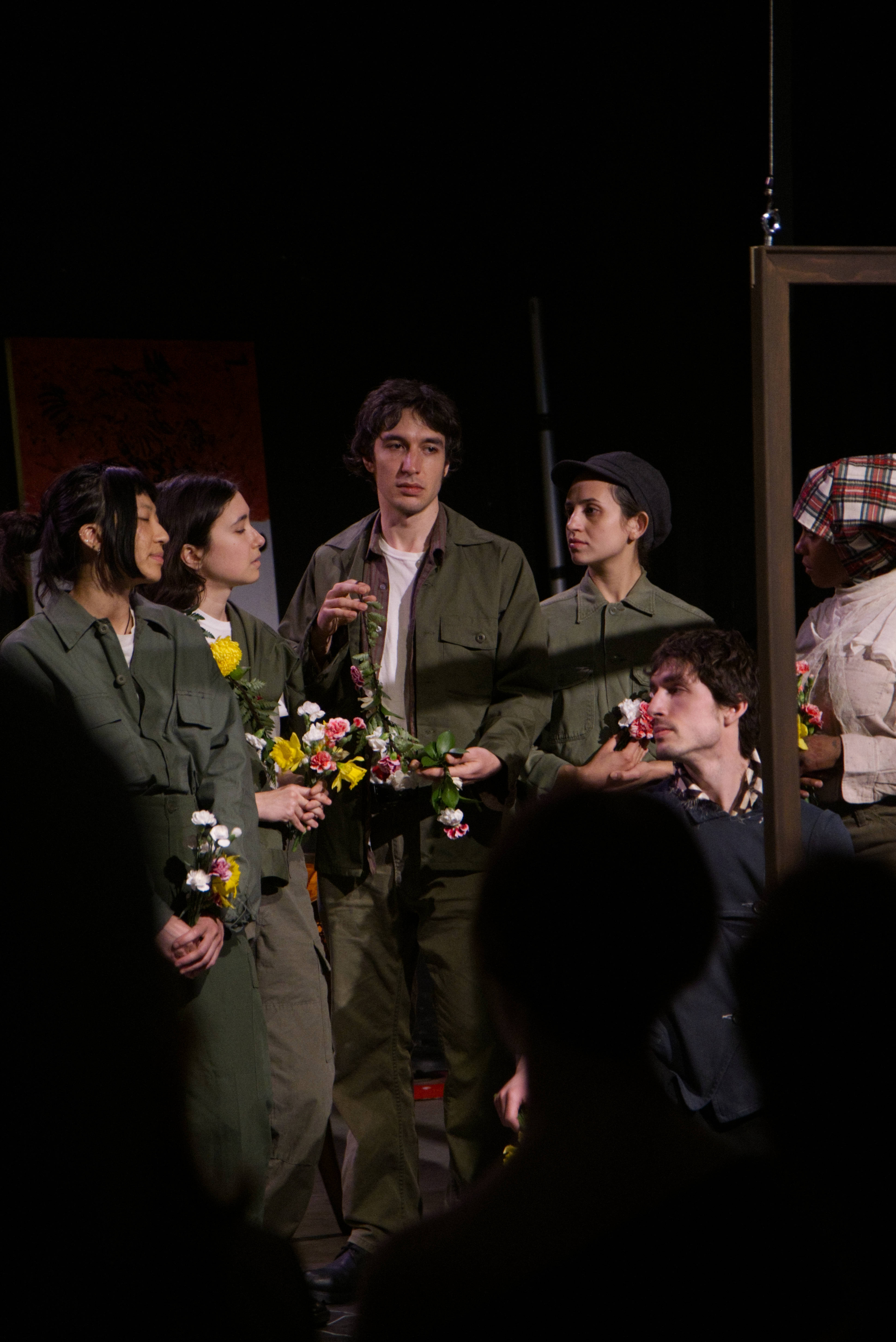
Of course it’s not about us. Our dreams are more than hobbies. I, for one, am left handed; I’m meant for something big. In Sebas Alarcon’s new production of Peter Weiss’s Hölderlin, we find a secret society that crumbles immediately, after which the story follows its essential component: one of many losers. The story drags revolutionary ideas through their limits to see the shape of what’s left of them.
Weiss’s play usually carries the subtitle A Play in Two Acts, though as Alarcon said when introducing the play, there was “no money,”1 so only half of the show is performed, reframing the middle as the end that we the East Williamsburg audience at Life World (563 Johnson Ave.) left to work with.


The story follows Friedrich Hölderlin (Tenaya Nasser-Frederick), who first talks of revolution with friends, enough to constitute a secret society that includes Sinclair (Isa Spector) and Hegel himself (Candice Saint Williams, live-translating dialectics in the way of trained Shakespeareans), the latter resolving God in all the events below Him, arguing with everyone as to whether people or civilization must change first for civilization for us all to have something to revel over. With cigarettes and fresher faces, Alarcon reframes philosophical discourse as a collegiate hangout, or what it always ever was.
The Two Gendarmes (Billy Ray Robbins III and Bob Murphy) ruin any attempt at even thinking of revolution. The Second Gendarme’s buffoon cruelty highlights the failure to even think of revolt: he delivers a dropped-pants, white-undies ass whooping to Sinclair, who first brandished a gun so easily disarmed (child’s play receives a child’s punishment). The other players on stage scream with him; they also do nothing beyond that. The ruling class and their tools experience violence as a natural element, domination with an ease seen only in those who wanted to hurt others all along.
So often, pretension with regards to class conflict manifests as empty subtlety (‘nuance’), when what’s needed now is a show that’s naked and brutal like a hammer, as it is outside right now, so we might be reminded that nothing has changed since excess grain made spreadsheets and kings.
Alarcon’s formal direction—a play featuring a Greek chorus; Aaron Carico as Singer and Goethe providing direct narration; ornate stage blocking and dialogue often spoken in verse—at first appears quaint, out of step with social issue-driven contemporary drama. But a step back from the present is needed to challenge audiences to make connections today. In that, it’s a refusal to pick a pet issue and run with it, as contemporary plays are wont to do.
History is integrated with and made the same as the present through costuming by Willa Schwabsky and Ines Sawiris, which integrates present apparel (Murphy as First Gendarme in ballcap, blazer, and t-shirt) with historical dress (Hölderlin’s habit) and the surreal (the wire frame dress worn by Angelina Hoffman as Charlotte Von Kalb). This is an age-old story that infects every day.

Hölderlin is reduced to tutor in the house of Heinrich Von Kalb (also Billy Ray Robbins III). He teaches his son, Fritz Von Kalb (Clara Kim), who is briefly comic, jumping into his father’s arms and curling into such a small ball, though they later twist and contort on the ground. What’s first harmless later becomes profane: Hölderlin catches Fritz whacking off. In this, Fritz internalizes his father’s boorish nature (characterized by a defense of colonialism) into a sense of entitled deviancy. Even after getting caught, Fritz resumes whacking off. This child of the ruling class is inherently rotten, so Hölderlin beats them, but what he’s done brings only more disgust.
Having failed to conform within the class structure he once despised, in the end he’s driven to madness beside Friedrich Schiller (Guillermo Resto). Hölderlin brays like a donkey, failing to even be smart. Here are our heroes, our greatest revelators. Aren’t we glad to see them, see how they think so much, how they think up of all of this and that, and for it all to do nothing more than stir their brains up and leave them worse for wear?


In “Artist as Producer,” Walter Benjamin says, “The activists… can wave their arms as much as they please: they cannot do away with the fact that even the proletarianization of an intellectual almost never makes a proletarian.” Hölderlin is the warning: risk dying or become a fucking donkey, driven dumb by non-progress. I’m well on my way myself (hee-haw). In “Goodbye to All That,” her essay on leaving New York, Joan Didion says of the rich and the whiny she later came to avoid, “I had already met them, always.” If we’re all entering a collective Germanist era, I’ll introduce a new word to the discussion: tagwerk, the amount of land that can be worked in a day. We’re moving at about a clod a week right now.
Alarcon’s production is a softer, still essential image in my greater vision of theater, where I hope to one day get Park Slopians to sign NDAs to sit in front of a black box and be heckled and spit on for at least an hour, and to be charged $50 for the pleasure. Because they see plays—see clown and see tragedy and their ravings about Clybourne Park—to feel bad in a way that makes them feel good. The metropolitan who tries every day to see themselves as beautiful, and sometimes succeeds, is incomplete. They should get out of town. And the urbane thinkers in their secret dive societies should go piss up a rope.

P.S. The Life World Bathroom Situation: Uptight occupant UNNAMED has an attitude problem. Why would they leave the door unlocked? Why, upon me opening the door while they were busy and deep in the mirror, did they not peek their head out to make eye contact and hiss at me like a creature? Appalling etiquette, world without mothers, no organization toward better days. Anyway, the line was more orderly after the show (sign of hope). Always wish they stocked hand towels.
Sebas Alarcon’s production of Peter Weiss’s Hölderlin ran at Life World in East Williamsburg on the 3rd & 4th of April. Follow Alarcon for her work in film and theater.
Aaron Tomey is from Georgia, lived in St. Louis, and now lives in Brooklyn. His essays have appeared in Hobart, Bushwick Burner Phone, and Apocalypse Confidential. He can also be found on Twitter: @ecstatic_donut.
Photos by John Stinely.





Leave a Reply