
This article is thanks to the wonderful support of the Kevin Michels Foundation.
Writing in 1966, the critic and painter Fairfield Porter announced, “Art has so much variety that it is tempting to try to find a common denominator. But the denominator is vitality… Something is either alive or it is not.” Art has reinvented itself at least half a dozen times since then. In 1965, Barbara Rose ushered in Minimalism with her expansive essay, “ABC Art,” and less than two years later, the movement was decried by Michael Fried as “literalist art” in his unsympathetic screed, “Art and Objecthood.”
Artist Dan Graham—an acolyte of Minimalism—was part of a lineage of the “articulate artist/critic,” a group that included Robert Smithson, Robert Morris, Sol LeWitt, Dan Flavin, Donald Judd, and others. Graham’s ethos, an even simpler criterion than Porter’s, was that “All art should be for fun.” A devout follower of rock and roll, Graham is perhaps best remembered for his 1984 experimental art film Rock My Religion, in which he draws a direct throughline between the religious persecution of Shaker messiah Ann Lee and the torment rocker Patti Smith experienced, outlined in one of her most indelible works, “Piss Factory.” Soundtracked in part by Sonic Youth, the film was part of Graham’s attempt to assert that punk was a “kind of revolt of the working class against the repressive conditions of late capitalism,” writes Brian Wallis. At the time, Sonic Youth’s Kim Gordon and Thurston Moore were Graham’s upstairs neighbors on Eldridge Street; Gordon, writing for Texte Zur Kunst, credited Graham as her guide to New York. “He altered the course of my life,” she wrote in 2022.

Following the acrimonious split between Moore and Gordon in 2011, Sonic Youth disbanded, and Gordon, who received a BFA from the school now known as Otis College of Art and Design, began a renewed focus on her fine art practice. This piece isn’t a review of Graham but it attempts, in part, to use Graham’s framework to critique the recent show “Count Your Chickens,” a survey of Gordon’s work since 2007 put on at the East Williamsburg arts nonprofit, Amant (306 Maujer St.), and curated by Patricia Margarita Hernández. Spanning sculpture, paintings, select readymades, and the show’s centerpiece, a video installation titled Jeanetta and Alex (2026), the presentation is clearly indebted to a punk rock sensibility.
In the spirit of punk, it’s limpid, like seeing 2/4ths of the original Ramones end a set at the county fair with a cover of “Surfin’ Safari.” Baked into the exhibition’s premise is the glaring question: “Can Kim Gordon—or for that matter, any aged, rich artist—still be subversive?” In a way, the answer is yes and no. Richard Prince still feels dangerous, even if his gimmick has been largely accepted by the art establishment. But as Porter said, the art is either breathing or it’s dead, and if Kim Gordon’s art isn’t dead, it sure smells funny.
Take for instance, her “Early Suburbs” series from 2023-2024. On three fabric sheets, she has painted the names of neighborhoods in LA County that have seen various waves of gentrification. This is how the gallery’s press release describes them: “[B]oldly hand painted to echo protest banners, [the works situate] the viewer within a field of displacement and resistance.” Here’s how I’d describe them: Sloppily sopped, replete with streak marks, Kim Gordon’s banners are an afterthought. She invokes Beverly Hills and its largely white and affluent population, but for whom is this news? On the wall, the best these banners can do is attest to their credentials as consciousness-raising art. While I recognize this isn’t an either/or proposition, wouldn’t Gordon be better off packing it up and hitting the streets? Certainly, with her celebrity, it would mean more to plan a direct action and use the banner as agitprop than to reduce it to a schmatta in the enclosed space of the gallery.

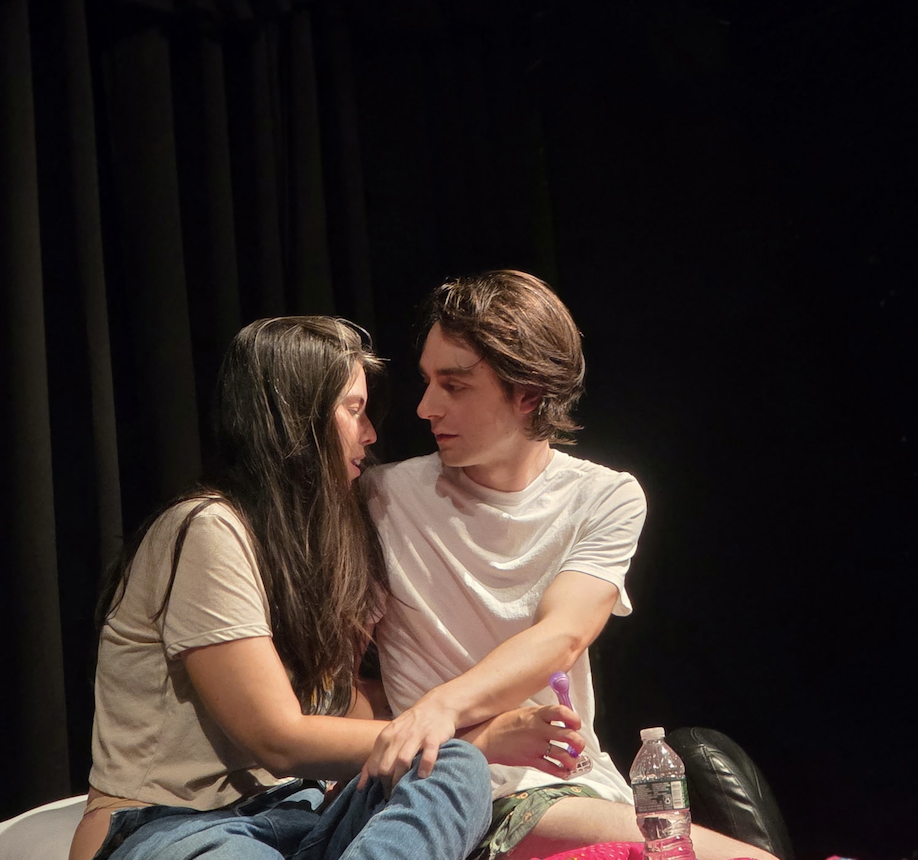
Speaking to punk, Dick Hebdige, in his seminal study of semiotics, Subculture: The Meaning of Style, says that punk, “undermined every relevant discourse.” Graham opens his essay, “Punk as Propaganda,” by quoting the New Wave band Devo. He writes, “They aim to “remake and remodel” their sources in order to create a new, synthetic, or reconstituted form.” When Devo covered The Rolling Stones’ “Satisfaction,” it was with a herky-jerky tension that undermined the commercial parody of the original song’s intent. What, I ask myself, is Gordon bringing to these works that is new? In the video, Jeanetta and Alex (2026), the eponymous duo, poet Jeanetta Rich and artist Alex Hubbard, play guitar in concert with former Hyperallergic editor Natalie Haddad, stating that the work elucidates a theme common among Gordon’s work: “the discrepancy between the romance of stardom and the realities of life.” I wonder then, is being unrelatable punk? Certainly, feelings of alienation can lead one to start a punk band, but isn’t the point of art to relate? Isn’t the point of punk to galvanize? Why stress the feelings of otherness when it feels antithetical to punk’s ethos? Who does Gordon suspect the audience would be, and why should they be in solidarity with a celebrity who mistakes punk aesthetics for punk politics?

One guiding principle I kept coming back to involved pretending these eight, crudely painted oval-shaped canvases (all 2025) were not made by the bassist from Sonic Youth and were instead hung anonymously, to be judged purely in formalistic terms. They’re slapdash and not in an art-brut way that makes one reconsider the fascistic tendencies surrounding art that looks good. They’re bad in the way that when your mom FaceTimes you to ask if you still want them in the garage, you say, without much regret, “Put them on the curb.” Is that fair, though, I ask myself? Is Kim Gordon’s authorship part of a post-conceptual pact running through the work? To speak of it in terms of color palette, am I robbing it of some je ne sais quoi that elevates it from hollow critique to incendiary commentary?
I think I may be talking in circles now, but no. I would say the images that compose the series, Image for a painting (all 2022), are lazy. They’re iPhone photos of hotel rooms printed on canvas and digitally marked up with gestural lines. Similar to Jeff Koons’ series “Made in Heaven” (1989), they seem to say, “Here I am, stripped,” to which I say, “Go back to your room and get dressed right this instant.” The three works don’t come off as vulnerable so much as self-pitying.
The most successful piece in the show is The Collective (2023), which features a splotch of Guston red bisected by some blues while upward of 20 holes punctuate the canvas, creating space for the white gallery wall to push through. I don’t have a deep reading of this one; I just think it’s the only one that feels alive. It looks good and sometimes that’s all that we can ask for.

Alex Wexelman is a writer who lives in Queens. He writes about art and music.




Leave a Reply