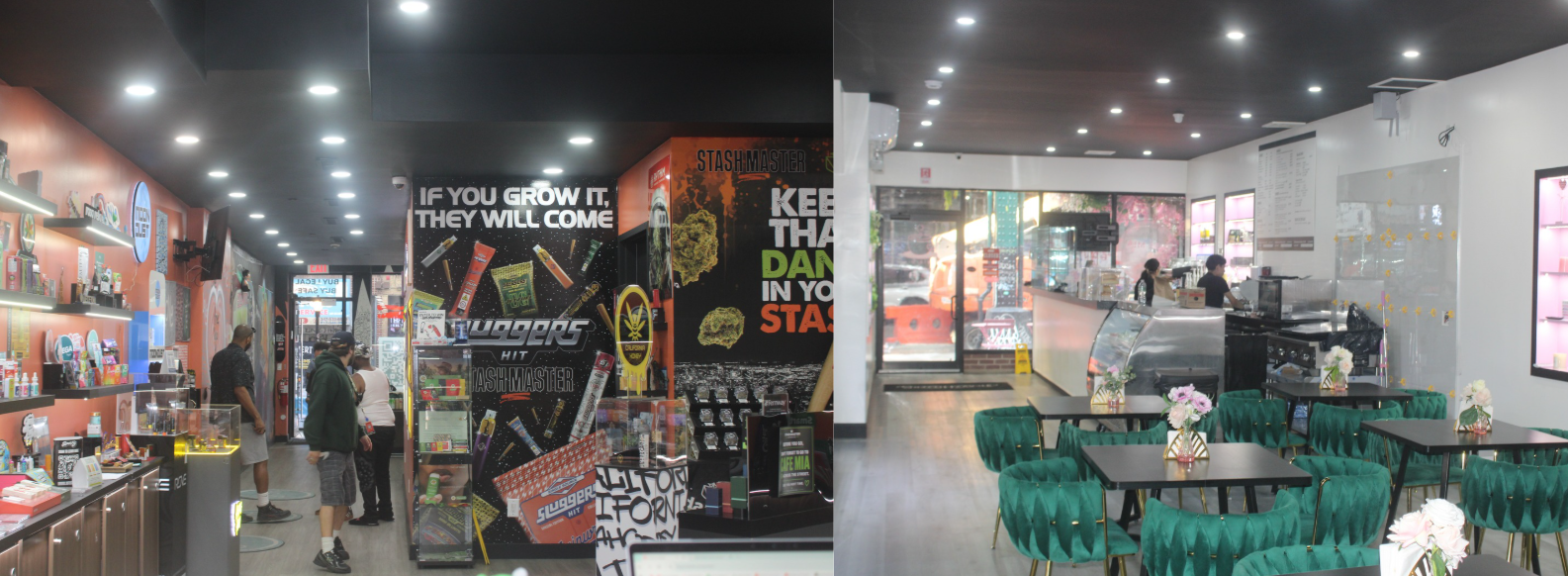
Side by side in East Williamsburg, there’s both Muz Muz Shop & Café (296 Graham Ave.) + Grams Cannabis Dispensary (360 Graham Ave.). One is for the morning rush: the acceptable upper, hardly a drug at all. And the other brings you down from the memory of that morning rush. In a century of shifting legalities, permissibility has lumped together caffeine, weed, and alcohol as Things That Make Us Feel Different. Any feeling needed, on demand: they will always materialize because you can buy them.
Over in nearby Bushwick, and rather than being side by side, Emerald Cafe and Emerald Dispensary sit across the street from one another at the intersection of Myrtle, Suydam, and Evergreen. They’re part of the Emerald Magazine empire, a weed media and lifestyle brand that also has dispensaries in Carroll Gardens and the Upper East Side, along with another cafe closer to Ridgewood (119 St. Nicholas Ave.). Nearby, Stashmaster (1119 Broadway) operates across the street from Cafe Mia (1128 Broadway) under the J train, both of them having opened in the last two years.

Like every bookstore that’s also now a coffee shop or a bar, every business feels the need to diversify. Every restaurant wants to be a “space for community,” and their fear of people and of economic insecurity will not leave them.
“Coffee in the morning, alcohol at night,” sings Father John Misty, but like the rest of his third album he was overstaying his welcome on a tired concept. People are drinking less than ever, and they’re smoking more than ever.
Up in Harlem, another business operates the same. Thinking of Haarlem, maybe this is the NYC iteration of the Amsterdam coffee shop, segmented into different storefronts by incessant community board attendees I’ve only had the displeasure of reading about. It’s not local to North Brooklyn, but there are three cafe/dispo hybrids within a two mile radius.
So on my birthday, when I talked to Stashmaster/Cafe Mia owner Arty, he asked me if I wanted free weed. I imagined smoking on that shit that makes me intuitively forget how to handle situations which used to not scare me. But it’d been close to seven years and I didn’t feel like changing that, so I told him I’m sober, because every day now I think, “I’m a humble guy with healthy desire.”


I looked at the wares: Moonbow, He He, Chocolate Dipped Bananas. There’s something childlike in all the strain names. If not that, it’s industrial (Diesel, GSC). A big sign asked, “Are you a Stashmaster?”
“We [dispensaries] all sell the same product,” Arty told me. “Everything has to do with branding, especially when you’re running a business. You have to have a culture.”
Stashmaster makes a brand of the outlaw. On his qualifications, he said: “Back then, I had people just call me. ‘Are you around?’ Yeah, I was around.”
Stashmaster’s interior included underlit shelving, a Raw cone the size of a baseball bat, and products in packaging dyed in bright, saturated colors, most of their fonts graffiti-inspired. Everything signaled toward the teenage urge to feel joy and giggle, which felt more honest than every Midtown dispensary that looks like an Apple Store.

After mentioning another Stashmaster location coming to deep Maspeth in a former American Legion Hall (66-28 Grand Ave.), Arty said, “I like to be in spots where there’s history. This block—Broadway and DeKalb—was always known for drug trafficking.”
Stashmaster’s location has its own history, too: “This place was a rundown, illegal smoke shop,” he said, with walls covered in layers of graffiti. Now much of the graffiti was on canvases hung on the wall.
“We’re in a little bit of a Green Rush. [Consumer tastes are] changing from liquor to cannabis.”
Weed is easy business in these early days. “But coffee, it’s a lot slower bucks. You’ve got to be creative. You’ve got to be a real businessman to make it here,” he said.


Cafe Mia was more monochromatic (pink) than Stashmaster. A large floral display out front offered some respite to the perpetually half-active construction zone under the J. “There are a lot more hard days here,” Arty said of the coffee shop. “The fact that I named it after my daughter, it gave me a reason to keep fighting. I can’t mess up this name.” He added: “Always a hustler, always trying to figure out what to do.”
I wondered about the tired-eyed Bushwick residents who would get a coffee before picking up prerolls to smoke before starting their work-from-home shift. Arty thought about the same often: “I’ve got three customers over there. How do I get them to come over here?” He created a rewards system (Mia Bucks) to keep people tightly knit on his block.


“Truthfully, I’m not from North Brooklyn. I’m from South Brooklyn,” he said.
Arty moved to Brooklyn from Azerbaijan as a child. He grew up and still lives in Bensonhurst. In the past, he said, “I really didn’t come here to Bushwick, per se, or Bed-Stuy. I would come to Williamsburg, [and] chill by the restaurants there.”
While in Bushwick, he said he’s been “Giving out turkeys for Thanksgiving [and] sponsoring summer camps in a partnership with CB4 president Robert Camacho.” Outside, he stopped people to give them free pastries.
I wasn’t exactly any closer to an answer. Business owners are individualistic. They all have their own stories and desires. Despite my begging, Muz Muz/Grams and Emerald never followed up. Materially, maybe it’s as simple as “Coffee and bagels [being] a big thing around here” in Brooklyn, as Arty told me: a lot of eggs, more than one basket. Spiritually, we all have our own answers.

P.S. I don’t believe in hybridities. Bushwick is the place for many to realize that, a how-to in consuming mindsets: nightlife and sexual permissibility, music and the arts, alternative living.
We are not a thousand things at once, but a sequence of unique performances, each with its own desires and chemical needs. The universal, manifesting locally: if you can’t equalize, you might as well induce extremes.
We don’t live in a comfortable world. It is exhausting to experience and discuss; up close or far away, it hurts the same. It all throws the body for a loop, and the mind follows, and so we regulate all the cognitive burden. We want to be ripped in half, pulled in different directions, to become tidal.
People will smoke anything not to become the “tall large narrow faces” that “have an almost oriental cruelty in the eyes and the ends of the lower lips” that James Agee saw in Brooklyn Heights. “In South Brooklyn in a state of lamentation,” as Emily Witt writes in Health and Safety: that is what consumptive culture tries to resolve.
We have to consume and it needs to affect us, to make our whole attitude and outlook upon life change, however briefly. This is the sunny side of drug culture: easy ups, easy downs. The cafe, the coffee shop, the dive or liquor store: it’s all a surface under which is ket, coke, molly, some laced shit you smoke that makes Joe go Bye Then.
We are going to ingest new freedoms and happinesses to plunge into basement escape or nightclub pause, where we cannot comprehend the word serenity and know peace, before the morning comes, “Our serotonin levels plummeting, we were told we were mistaken,” as Witt says. Then Sunday is gone, and we have to ready ourselves so that feeling of uselessness and self-pity can disappear briefly enough so we can return to work.
In the morning, still groggy from a night made high by pot suppositories, hook yourself into the cold brew machine, alive and dragging you from bed by its intravenous tubes, its needles hooked under your skin. These are not extravagant promises. They are being fulfilled, sometimes quickly, sometimes slowly, whichever you can afford.



Leave a Reply