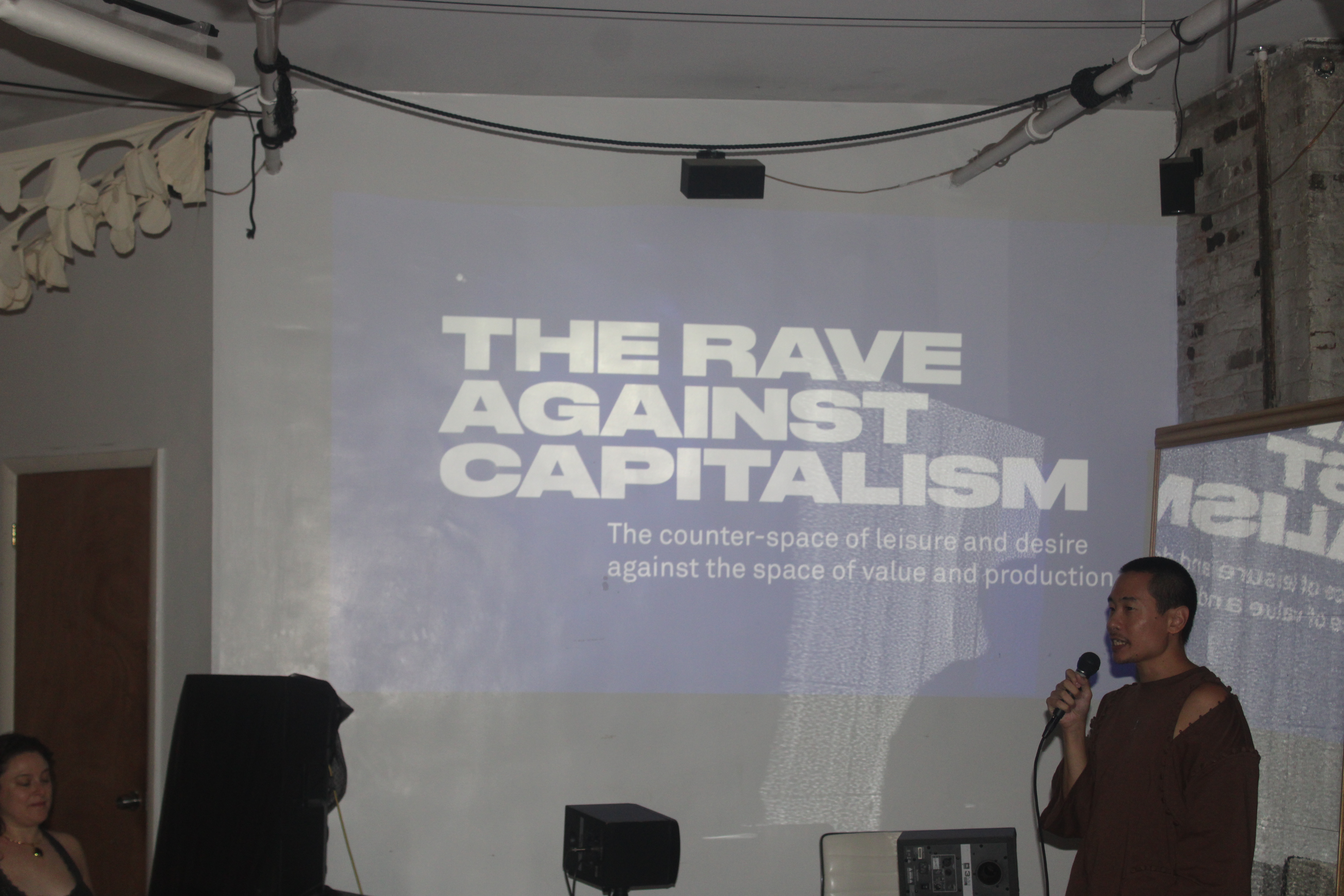
In a second floor loft in East Williamsburg, one attendee told me he wanted to take the lessons learned while raving and make them escape into the world. He was still wearing business casual and a large watch from work. He wanted to transform his workplace, and I believed him.
The writer Geoffrey Mak led the class, seated on and around couches, through the final lesson of his “Rave Methods” lecture series on the aboutness of raving, co-hosted with Chris Schultz. There, Mak, Schultz, and fifteen students navigated what Mikhail Bakhtin, in “Rabelais and His World,” describes as “the borderline between art and life. In reality, it [the carnival] is life itself, but shaped according to a certain pattern of play.”
That sense of play occurs in less-than-ideal times. “I think neoliberalism is over. I think we’re in something worse,” Mak said, paraphrasing McKenzie Wark, with whom he co-edited the anthology Writing on Raving.


Their discussion was not focused on dance or safe drug use, but one’s relation to a space designed to be consumed, and said space’s relation to the greater, more productive world. Henri Lefebvre describes a world that has produced a “subordinated space split into two kinds of regions: regions exploited for the purpose of and by means of production (of consumer goods), and regions exploited for the purpose of and by means of the consumption of space.”
There are places of work and places of not-work: the work-from-home desk and the rave. In the latter space, every weekend or every night, people attempt to replicate the carnival, which, per Bakhtin, “is the people’s second life, organized on the basis of laughter. It is a festive life.” Unlike medieval or present-day Latin American carnivals, the festivals in Bushwick are discrete, contained experiences, and on demand year-round. A rave is not wholly a carnival: only its pieces reassembled into something distinct.
The class’s most urgent concern was capital and the ability of raves to collectively resist. Everything is political, so the question is one of measurability: how important is each individual act’s politics? Schultz cautioned against the liberative qualities of nightlife: the weekend hordes of Murray Hill boys descend comfortably into Bushwick because conservatives can find as much comfort in the club as anyone else.
When talking before the lecture with another student, he and I came to claim that capital has so effectively co-opted individual subcultures (hippies, punk, rave) as to have captured rebellion itself (something best understood by the last alleged rebel: the historical archetype of the hipster). The free and natural always becomes monetized: raves, initially spontaneous and free activities, develop around them whole ecosystems of landlords, alcohol distributors, AV experts, promoters, and ticketing platforms.

The capturing capacity of capital is best summed up in the genre most popular in Brooklyn nightclubs: techno, the genre of post-industrial capitalism. Techno as a genre—genre itself being a categorization that circulates and valorizes certain qualities—is full of abstract sounds: an electronic hi-hat represents the sound of a material hi-hat. Just as a computer represents information visually, industrial techno auralizes information, and techno has become increasingly popular as western economies have settled into desk-bound knowledge work.
“Certain deviant or diverted spaces, though initially subordinate, show distinct evidence of a true productive capacity,” writes Lefebvre. “Among these are spaces devoted to leisure activity.” Nowadays (56-06 Cooper Ave.) used to be Boro Kitchen Cabinets, a cabinetry manufacturer that opened in 1935 and closed before Nowadays came in 2015. Knockdown Center (52-19 Flushing Ave.) used to produce glass and doors. A beach, under the right circumstances, could be ruined into a port.
In his lecture, Mak referred to the industrial qualities of techno as dystopic. I disagreed: it’s an understatement. Nowadays, a former factory, neighbors a radioactive dumpsite and a graveyard. Raves often occur in the remains of work and production. A local rave is apocalyptic. One dances away where things have already ended, dances near resting places, dances near the half-life thorium remains. An apocalypse is the end of one thing, the beginning of another. Whatever’s coming next happens among corpses.
The above are primary cultural and economic functions of North Brooklyn. Past the only recently more refined venues of Williamsburg, spaces in East Williamsburg and Bushwick focus on simulations of the carnival. “Space wouldn’t divide itself like this on its own,” Mak said on the specialization of neighborhoods. These neighborhoods over-optimize the night.
Lefebvre says that “Desire, on the other hand, has no particular object, except for a space where it has full play: a beach, a place of festivity, the space of the dream.” A local club is the launchpad on which one breaks “out of the temporal and spatial shell developed in response to labour.” But this is not like the “total passivity on the beach,” where one goes to experience “mere contemplation of the spectacle of sea and sun.” This is a place of sex and drugs and hyper-movement.
In “The Only One At the Rave Paying This Much Attention,” Mak chases a state where “it’s just me and the speakers.” Every clubgoer seeks out an experience and accelerants for said experience that, as Mak says on Adderall, “never makes a moment something other than it is.”

One wants to exist in a space and consume it, in the sense of Lefebvre, and learn something past the point when Mak writes that “Despair comes down and I face the limits of my own interiority.” The club is a collective experience that can optionally—when one has the luxury of remaining unbothered—be a secluded experience, where Mak writes, “I am on this dance floor and this is what I am made of.”
But, as Mak’s language implies, maybe there is no radical breakthrough to be had at a rave or anywhere. Lefebvre writes, “Leisure is as alienated and alienating as labour.” One can’t escape différance (differing from and deferring to a referent): the club is not-work, not-home, not-alienation. Ridgewood’s quiet, sunny afternoons contrast with the chaos of Bushwick nightlife. One can’t seek escape in the antecedent.
Trying to escape from all of this feels impossible, but I was amazed by the collective belief that Mak’s class had. They believed they could think their way out of this. My only experience teaching was being a writing tutor and incompetent undergraduate teacher’s assistant, but even I could see that the class was teaching itself, and Mak gave them space, acting as interlocutor rather than instructor.
The lecture, while genuine, was a reminder of the terminal development outside. Church fire, redevelopment in Downtown Brooklyn: Lefebvre notes that “countries in the throes of rapid development blithely destroy historic spaces—houses, palaces, military or civil structures… The old is swept away.” We’ve been moving so quickly long enough to invite salon considerations.
I think back to the Carnival blocos in Rio, where I was only slightly younger but so much more capable of naked, stupid love for another. The subtropical heat and the heat of bodies, of being subordinate to a more collective movement only interrupted by camelôs selling Brahma to everyone except the few children and me, who drank Guaraná.
When I returned months later, I found it was no longer a space for joy. I didn’t realize then that I had fallen in love in a place subordinated to festivity, briefly altered before returning to its norm: just another place to live a life and end the short things that only went on in concept. I had only known Rio as a party, so I never really knew it.

In “Meet Me in the Darkroom,” José Sanchez hybridizes memoir and literature review (the latter of which critiques Mak’s Writing on Raving anthology). He writes that “in the clubs of Bushwick, you’ll often hear a set with a funk carioca track, though most of those dancing presumably don’t understand the lyrics or know the genre.” For an essay that is so acutely aware of white encroachment into queer and POC nightlife spaces, Sanchez misses the small contradiction here: Brazilian funk as it appears in Brooklyn is the sound of the colonizer. Western tastemakers harness foreign displays, at the speed of computing or eight-hour flights, all to entertain locally and provide yet another effete and arbitrarily unique Brooklyn experience. It doesn’t matter if a clubgoer can’t parse “ai caralho de porra;” they understand the underlying codes: western dominance, information and its power.
Sanchez was right to frame industrial techno, and funk carioca by extension, as fetishized as avant-garde “because the outer reaches of techno border on undanceable noise, it’s perceived as a more ‘serious’ music than house.” At some point, years ago, I too thought Death Grips was the future of music, and I live every day disappointed because of it. In the club, I’m only briefly overjoyed before imagining that someone else is looking at me, then reminding myself that no one is probably watching, then feeling sad that no one’s watching, then feeling guilty that I wanted someone to watch me, and by that time I’m out of sync with even the best plastic beat.
The basement below the loft hosts AA meetings that have saved my life at least once, because the world can come undone even after years of sobriety. In sobriety, everything becomes more horribly sensitive. You’re ready to cry or fight, and ready to do both poorly so long as it means something other than the aching, anxious waiting. The only thing holding me at bay is a daily Lexapro dose and my Juul, a sort of rentier platform for my last substance, SaaS for nicotine: all experience captured, from end to end, the constant work and mystery being how to disrupt it.
So much to learn, and I was only around for one lecture. Another attendee told me their final meetup would be at the club, a visit to Nowadays to take their lecture into its subject.


Leave a Reply