I kept thinking the opener at Trans-Pecos (9-15 Wyckoff Ave.) sounded familiar. They sounded like Jesus Lizard, like Shudder to Think, like other bands that I want people to know that I know of. They had to’ve been ripping off someone I could name, but they were Cohort B, who I saw open for Jesus Lizard in late 2024 at Brooklyn Steel.
They were calculated and relentless beyond the soft interludes that have lent a mostly earned sense of depth to hardcore since the mid-’80s. Cohort B presented anger as something to be done while being handsome and defiant. Anger was a hobby, in the way of fashion: a passion, but something to be deprioritized on a weekly basis.


If Cohort B were the stylish young bucks, follow-up Shiverboard were the Garbage Patch Kids: goateed, gangly, wide-eyed frightening. They were a mess of extreme genres (grind-, metalcore) that shook the floorboards. They interrupted songs with clips from Shiver or Bug (the bassist couldn’t confirm), a few jazz-adjacent chords, and a hopefully fictional ad that promised parasites and biofilm were the origin of all our problems.


They reminded me of the worst I’ve felt when standing naked in front of my mirror after second dates gone wrong: deflated and formless, insufficient chest hair, a spine pre-curved for desk work. On stage, their frontman appeared defiant like a child, screeching like Cartman, as if everything was so wrong and always would be, so our best option was to wallow publicly in our own shit, and to grin while doing it because we’re being watched and recorded, and it’s a beautiful thing to disgust someone.
The crowd loved it, and they thrashed to prove it. Most of them smelled. Even the women smelled like brine beneath perfume. Grease, abuse, confetti shreds: you’re born exhausted, forever afterbirth-slick, and then you die, but first you laughed, and it felt good to do that. Great job all around.


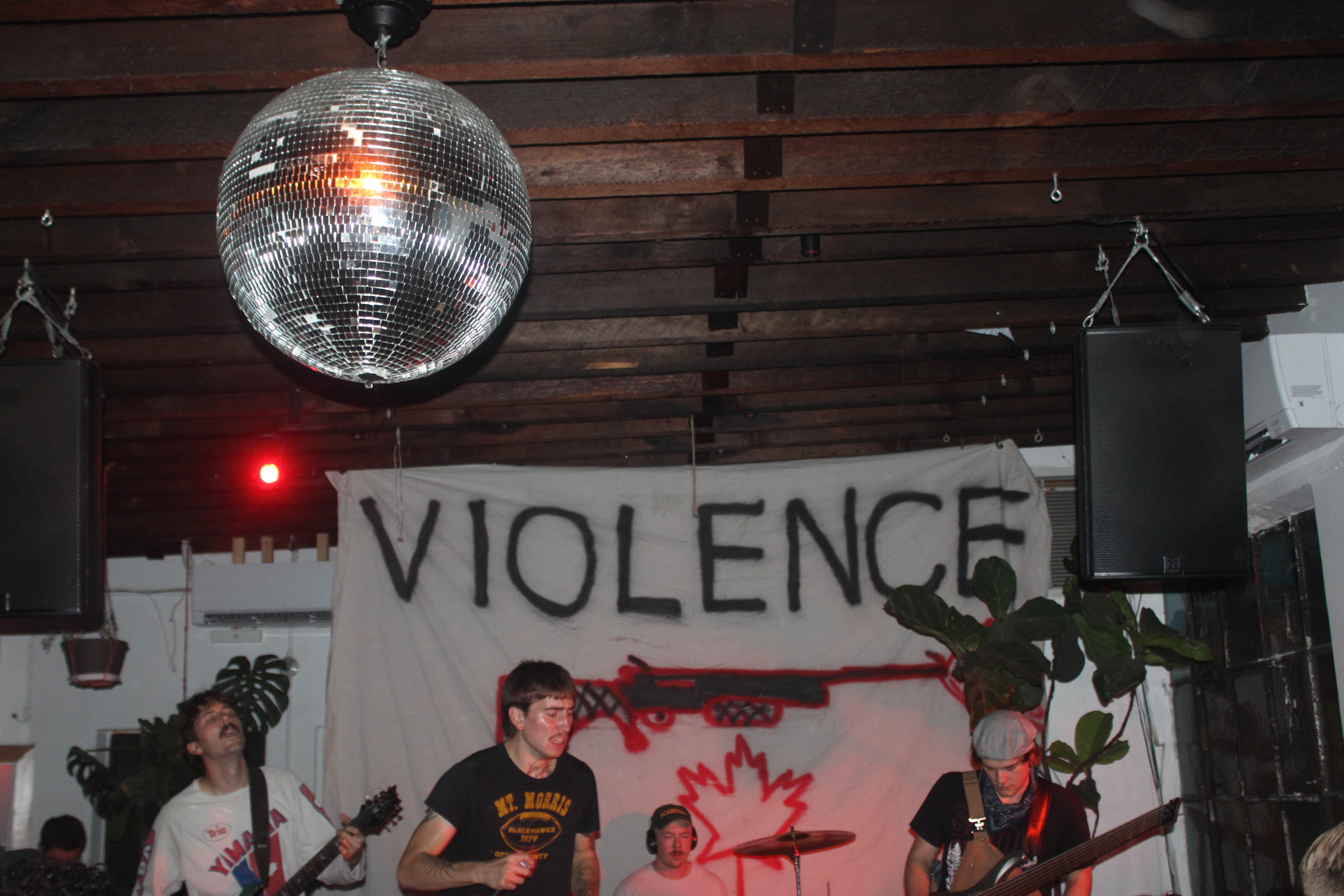
Finally, Montreal’s Truck Violence took the stage. Frontman Karsyn Henderson wore a high school football t-shirt. Beneath it, a tree tattoo branched up to his neck. Guitarist Paul Lecours dressed like a pioneer, complete with overalls. Their looks expressed nostalgias for different eras of white comfort. On a banner, “Violence” was written in red above a gun and the Canadian maple leaf. It was a totem to the stifled urge to be in an image of violence, and nothing more.

Later, Henderson was shirtless, and my earplugs could barely hold back the noise. The crowd at Trans-Pecos was mad for them. They moshed even after the loudest moments ended. Despite the group’s surface apoliticality (in contrast with the more explicit Chat Pile), Truck Violence’s blend of metal, post-hardcore, and country offers insight into the cracker condition: country as an object of nostalgia1, metal to claim a stake in our collective rage. It was impossible on a borrowed Canon to capture the circulation of the mosh pit. It might as well not’ve happened.
Their song “I bore you now bear for me” recalls Modest Mouse’s The Lonesome Crowded West, an album dedicated to flyover country. From New York, Henderson’s native Alberta is a mix of Midwest culture and Texan economics. From our effete islands, all North American scum are flattened into sameness. We are all wheezing and confused. “Death itself aged, moving out of the bowels of children and into the lungs and arteries of the middle-aged and elderly,” write Anne Case and Angus Deaton. Our healthiest years are behind us. Every day now is a battle against struggle interfaces.

Metal is a constant reclamation of masculinity, even as it often critiques it. The smartest metal bands—Converge, Isis, etc.—prove that only real men can call themselves pussies. One can access that feeling just as easily by moving to Ridgewood or Bushwick, where the local collective—mostly the 38 active accounts left on Twitter—seeks to make an archetype of 12 guys they’re concurrently mad at, because hate always has a target, and you want it to be the same as everyone else’s.
Henderson’s sullen, confused demeanor (Daughters comes to mind), the band’s whiplash volumes (Slint), their folk and metal contrasts (early Baroness): it’s not any one band’s job to upend all conventions, but they were all like so many things I can name, like this, like that, like-like-like—
All music discourse collapses under the weight of references and the pressure to perform Wikipedia-style cataloging. It’s the domain of overgrown film studies minors who attend Letterboxd like it’s a natural wine bar.

In her review (8.0) of their 2024 debut Violence, Nina Corcoran asks, “What’s lost when national identity speaks on behalf of individuals?” This “national identity” is addressed only through the provincial (Truck Violence is from Alberta), and she does not link it to anything more than a banjo. Here, the idea that music means anything is abandoned, and the rest of the review is a series of lost descriptors.
Corcoran describes Truck Violence’s genres as “towering brutalist sculptures welded from rusty steel beams.” That implies genres to be in any way distinct, when transitions are delivered naturally, whether incremented or turned on like lights. She says that the band “crack[s] your skull open with lashing noise rock,” as if this music were a violent surprise, when it’s not: these feelings are inevitable, our standard. She ends the review by comparing them to Chat Pile and Elizabeth Colour Wheel.
Two years later, Corcoran reviewed (7.8) their sophomore album, The weathervane is my body, and she writes, “Truck Violence transform from a burdened colossus hunched over in pain to a tearful creature who’s finally free of that weight.” She does not say or imply what this might mean, or why it’s important. This is a genre of writing largely confined to thinking around music, instead of about it.

In both reviews, Corcoran insists on calling frontman Karsyn Henderson a “singer-poet,” despite singers and poets being two different things. The latter works exclusively in text: if music is added, it’s no longer a poem, but a song. As if being a singer isn’t good enough, as if they must be made more than what they are, so a writer must impart in them wrong meanings and expectations that, by nature of form, the singer is not prepared to meet. No frontman will ever be Walt Whitman because they don’t need to be.
Music journalism functions as communications for terminal hangers-on. Eli Ennis’s review (7.6) of Chat Pile’s Who Loves the Sun begins with “Despite the fact that their music sounds nothing alike, Chat Pile are to the 2020s what Deafheaven were to the 2010s.” This opener appears designed to elicit a reaction like mine, because it is easy. I once told an ex-girlfriend, “Your favorite bands haven’t even heard of my favorite bands,” and she cried and called me an asshole, because I was being one. This is a genre of low expectations, so much so that I can write just as badly as anyone else without even trying.

But maybe I’m kicking an already downed industry. Pitchfork is selling a paywall, and BrooklynVegan is dead. The eulogies for the latter lamented the loss of a few jobs, not the work made during them, because by then BV had turned into PopSugar for emo night revivalists. “You will be submitted to the blackmail of debt and to the tyranny of austerity,” writes Bifo Berardi. Music criticism feels designed for skimming, even when its subjects include urgent artists like Truck Violence.
On “Undressed you layn’t before,” Henderson sings, “To have a collection of prose written about me / And ultimately, that’s my goal / To be written about.” We yearn to be chronicled, to be the chronicler. We’re all doing it practically for free now; prosumption doesn’t pay. Here we are, and the white boys aren’t alright, and their chroniclers have their asses out. The members of Truck Violence hugged each other at the end. They were beyond words. Thank God for that.
- “Guns buried in the backyard” straddled the line between pastiche and parody. In tone, it is pastiche; in form (as a banjo interlude between two heavy tracks), it appears as parody, subverted reprieve. We can only wonder if there was anything worth cherishing in the heartland. ↩︎



Leave a Reply