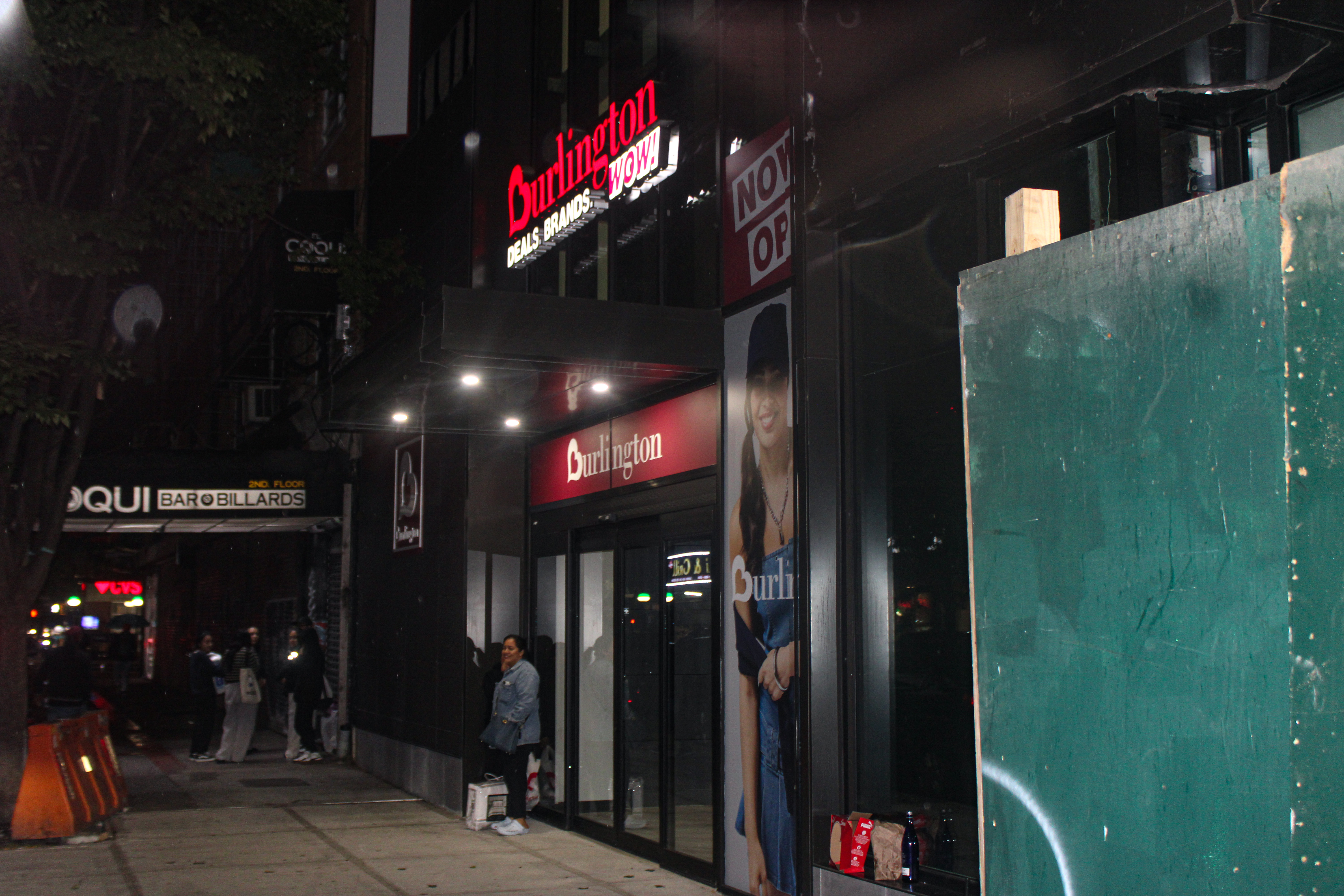
After perhaps half a decade wrapped inside a wall of construction, a Burlington (54-23 Myrtle Ave.), née Coat Factory, is finally opening in Ridgewood.
It’s opening quietly and without much fanfare, perhaps tangentially important to any but the most long-winded observers, though some will remember when it had the potential to be something else, when the massive tower represented both a dream and a future nightmare along a border corner of Queens.
Ridgewood was a neighborhood where “everything is just the right height,” as the local camera-toting gadfly John Wilson once told Curbed, and the tower, immediately visible from anywhere in the area and entirely unoccupied, seemed to rebut this idea, as if to say, “Not for long.” For years, however, the retail space had yet to be occupied, its condos yet to be filled. A housing lottery came and went. The building itself cycled through names, interchangeably and without end. First it was the “Ridgewood Tower,” then it was “Myrtle Point,” and in more recent years has stabilized at “The Ridgewood.”
“Most of my career was taking over broken projects,” Jeff Simpson told me. Simpson had come into the project midway through and would not be the last to take on the seemingly endless project. He would move millions of dollars into it before it destroyed his professional life.
Simpson was something of a once and future real estate maven, at one point deploying some $50 million in at least ten various large-scale projects throughout the city through his venture Arch Real Estate Holdings. Simpson had been getting ruminative lately. Restless. For some time now, his money has been tied up in one of these broken situations.
“And Ridgewood was a broken situation,” he said.

Between late 2020 and early 2021, Simpson was moving through “approximately $14.8 million to fund [Arch Real Estate Holdings’] recapitalization and refinancing of Myrtle Point,” as a recent filing in a bankruptcy court put it. That case pits Simpson against the source of that $14.8 million: Kevin and Michael Wiener, a pair of brothers from Toronto, who invest in real estate under the name 35 Oak Holdings. Simpson had sold them on the idea of investing in the Ridgewood Tower, a project that dated back to 2017, and was slowly turning into one of the kinds of broken situations Simpson was looking for.
The 17-floor tower was the idea of architects at S9 Architecture, a firm behind large, ambitiously designed apartment projects throughout the outer boroughs. “Normally we look at the context and we look at the neighborhood character,” John Clifford, one of the various architects at S9 once told me, when describing the firm’s project in Northern Queens, to replace the junkshops of Willets Point with massive 12-story apartment buildings. When I talked to him, he went on at length about the differing neighborhood “vernaculars,” a language of little touches, here and there. In his opinion, Willets Point didn’t have any of those, at any rate.
What vernacular his firm was trying to evoke in Ridgewood felt both obvious and mysterious. Parts of it, like the massive balcony and flat facade brought to mind the towers that hugged the East River in Williamsburg, and yet the shape of it seemed to look like nothing more than a modernistic thumbs up, a kind of humiliating temple. It was all the dream of Meir Babaev, a luxury developer from deep Queens.
“We were developing in Williamsburg… and as land prices started going up dramatically in Williamsburg and even then Bushwick, the next market that had the great transportation with the L line and the M line was Ridgewood. It was a natural progression of where development would take place. We were trying to get there early,” Babaev said in 2016 to Michael Stoler, the real estate interviewer with a program that airs on Sunday mornings at the top of the 8 a.m hour on Talk Radio 77 WABC, as well as on YouTube.
Stoler later asked him what kinds of retail he wants to put in the building. “Potentially, a retailer like Whole Foods or a retailer like Trader Joe’s is potentially a game-changer for Ridgewood,” Babaev said back then.
Babaev settled for a Target and a Burlington. But it was the self-evident ridiculousness of the design that spoke to Simpson.
“They over-designed it. The building was a dream,” he told me. He had thoughts about architects with vision. “Architects go loose. They go wild. They need developers, guys like me, to say, ‘Slow down.’”
It might have bankrupted him, but Simpson could not help but think fondly of it still.
“Someone had to slow these guys down…and so I saw this as an opportunity,” he told me. He found ways to move the money around. He would secure capital for the project, like he always had. The Wiener brothers, nevertheless, regret being made aware of the chance to lose their $14.8 million.
“Oak would not have consented to the equity purchase in Ridgewood Tower, and would not have funded millions of dollars into the project had it known that the deal was dependent on Oak’s affiliate signing carry and completion guarantees that it had not been advised about, that it had never agreed to, and that would expose Oak and its parent to substantially more risk in the project than it had intended to take on,” they said in bankruptcy court.
Nevertheless, the project persisted.

“We had Burlington done. We had Target done,” Simpson told me. He remembered touring the building in 2023. It hadn’t been an easy project. A year earlier, Holger Molino, a construction worker from Newark, fell to his death down an elevator shaft while working the site. Another construction worker, Jose Mejia Aguilar, would file suit against the project, claiming that an “improperly secured beam” fell on his head. That case is still moving through a county court in the Bronx, slowly approaching trial.
“It was unquestionably a pure accident,” Simpson told me, about the one that killed Molino. He remembered it well. “I felt terrible. We all did. But it does happen from time to time.”
Elsewhere, the Ridgewood Tenants Union had found Babaev’s address and showed up in Jamaica Estates to yell at who they imagined were his neighbors. “Why should he and his neighbors get rest when Meir Babaev is causing our community to lose our sleep and our homes over the displacement his project will bring?” one of the group’s leaders told QNS.
“Maybe you’ll disagree with me because you live there [I live in Ridgewood]. But I don’t think it was a bad thing for the neighborhood,” Simpson says now. But by 2023, the building was almost ready to open its doors. Other retailers had been lined up too.
“We had several retailers. I don’t think I can say who they are, because I don’t know if it was ever public or not. But they’re well-known major chains,” he remembered. “It should have been finished a long time ago.”
By 2023, however, Simpson would be forced out of the company in a coup led by Jared Chassen and the Canadian brothers from Oak, fights over which would spill into state court, another saga that remains ongoing.
“He’d worked with me, at that point, 12 years. He was at my old company with me. I brought him with me. I paid him a lot of money. I trusted him with everything. I didn’t think he’d backstab me. Well, he did,” Simpson says. But Simpson didn’t blame him. Chassen had been a pawn in the larger scheme of things.

“He’s irrelevant. He’s a child. He’s a wingman at best.”
Management following Simpson building the tower have been less successful in finding further investors, and the project has since sat, incomplete, for years. The building has sat through an endless wheel of foreclosure auctions. The last was Sept. 10.
“They’ve tried that a bunch of times, and it hasn’t worked out the way they want, so they just sort of like, cancel it and do it again,” Simpson said.
Now, Burlington has finally shambled inside, though there is no clear timeline on Target’s arrival, or when the apartments—marketed at 130% of the area median income—will be occupied. MGNY Consulting, which managed the housing lottery, did not respond to a request for comment.
Maybe the Tower outlived the fears of its earliest enemies. Living near a Target doesn’t sting like it used to, and Burlington doesn’t target the 18-35 demographic as well as Trader Joe’s. If not a cultural gentrification, maybe the Ridgewood Tower is a material gentrification: a space has been made for big-name retailers in a place they never paid much mind to. Now they were paying attention. The Tower was a sign of the Whole Foods to come.
Photos by Andrew Karpan.


Leave a Reply