It was New Year’s Day 2017 when I DM’d Richie the Barber “MEEP MEEP” after seeing him on an old clip of America’s Got Talent. He responded: “HONK HONK.” Clowns have always been there for me. I still kind of remember Tim Curry in It jumping out of that book and threatening to fuck or eat those kids. I cried all the way to the water park. Some clowns haunt, too.
I first saw KACHONK in Starr Bar, performing in the Fool Around the Block variety show: sun-allergic pale in a genderless bodysuit, visibly confused and always frustrated. So burdened by the weight of today, the weight of actual objects. KACHONK carries and shakes a large suitcase full of cutlery that is so loud it’s probably got an amp inside it.
One of the more debasing parts of life in NYC is having to carry all of your shit around in psuedo-reusable Target bags, stained Trader Joe’s totes, and wire carts. You know the wheels will break. You keep on dragging along regardless. Hoofing it is mandatory. Just recently, I fucked up a half-dozen eggs for the first time in my life in a blue plastic Aldi bag whose strap snapped, making me realize all of our shit, our stuff, will one day publicly be on display on concrete. Those things are us, and it’ll all be hanging out there naked as the day God made you.
Despite living increasingly disembodied lives through devices that, every year, interface more directly with our brain, we still have bodies. It’s an impossible situation. KACHONK represents that impossibility. They’re reminiscent of early representations of automata. The white makeup hints at mime and German Expressionism. It’s an idea out of place, transposed onto a present that we perceive as being so different from the past, when it really isn’t, when it’s always been the same: the assembly line became the grind, pulp novel into Marvel-slop, newsreels via TikToks voiced over by European inflections that I want to strangle away.


I never knew a clown could make me feel so much that wasn’t terror. I had to know who KACHONK was and where they came from. So I followed up with Suz Murray, the actor behind them. We met at Crossroads Cafe right as a pair of hasidic EMTs came in to cart off a woman who seemed more angry than agonized. We waited for it all to finish before starting.
KACHONK was born in the atmosphere, somewhere near the ISS. Murray comes from Weare, New Hampshire, 30 minutes out from Manchester, though it appeared to them farther away from civilization. “I forget that Weare is a square,” Murray says, looking at a map of it on their phone. It was in Weare where Murray first practiced during a visit from Chicago’s 500 Clown troupe. Weare’s in the past now. “I have friends who live there, but no family,” Murray says. They left to study acting at NYU. Life happened. They became a video editor and camera operator. Inspiration is an accident. Accidents are our default.
KACHONK was conceived when Murray got back into performing while doing live video feed projection work and performance for Lisa Fagan and her CHILD Performance Company’s 1-800-3592-113592. KACHONK was finally born out of a production of Vivian Oblivion, directed by Matthew Antoci, at the Brick in Greenpoint, followed by a solo show at the Idiot’s Hour at Baker Falls and a one-night performance at the Target Margin Theater in Sunset Park. They were inspired by performers like Hannah Mitchell (“one of the clowns I’d dreamed of finding”), these days doing a one-woman show about trad wives called TRAD.
It was strange to hear all of this from Murray, strange to be looking at them and not at KACHONK. When I met them briefly at Fool Around the Block, they were in full makeup. I walked into the interview assuming I’d still be talking to their nose—gray makeup, in this case.
Every clown’s anatomy includes a nose, literally and in the abstract. A buffoon’s red nose, Pantalone’s mask, a Greecian phallus. “[KACHONK’S] mask is the case,” says Murray, referring to their suitcase.
It originated from a visit to LIC’s Materials for the Arts for a project. They gathered their supplies in a large suitcase that began rattling. They later tested it on an audience, and it always got laughs: “I love that it makes people jump. Then they realize that, A, they’re okay; nothing is falling from the ceiling. And B, that’s it coming from the suitcase and they see how stupid it is.” We see terror everywhere. Laughter comes after the relief of realizing it’s not around for now.
The suitcase embodies the absurdity of having a body that carries things through situations that disrupt our precious internal monologues. “The cacophony that comes from it. When I’m doing that action, I have more freedom. The focus is going to the case. I can just kind of exist and the case is acting.” And when a crowd goes quiet, “It’s something I can always fall back on and people will love it.” People find so much joy in being scared of things they already know not to be afraid of.
The inspiration comes from Murray’s own career on the backend of productions; professionally, they strived to be the most deliberately conspicuous cameraperson. It reminded me of seeing the Pro Padel League City’s Cup in Midtown. The 5D tennis enamored and then quickly bored me. I watched the last matches through the lens of the nearest cameraman.
There’s always an intermediator laboring to facilitate experience. “So much physical labor for such a tiny moment where you’ll actually film,” Murray says. “So many people involved to shoot a 30 second commercial. We’re all doing this to sell shoes.”
KACHONK moves like an alien who learned from robots. Murray has a fascination with old technologies: fat-backed monitors, humming PC towers. KACHONK’s color scheme is based on the plastic shades of 90s PC towers and monitors. The way that color’s neutral brown yellows over time: we see its aged, present color in the aisles at Goodwill, and its old, pristine color at once, nostalgia and our haggard present.
I asked them what job KACHONK is doing. They said KACHONK is the person that turns on hold music, the Cisco song (“Unity from a Touchtone telephone”) heard when dealing with customer service sludge or another AI voice soliciting donations for a fake police union. “I’m really fascinated with mundane tasks and jobs that feel pointless while you’re doing them,” they say. Switchboard operators were rendered obsolete; now, we invent jobs because that’s easier than perceiving telecommunications as being so seamless. Everything is connected and it doesn’t make us any more comfortable.
“There’s just so much that’s happening so quickly. And what interests me is kind of looking backward, but just slightly, and seeing how tactile technology felt,” Murray says. “As technology moves, it’s losing this tactile feel. I’m interested in keyboards that click and clack. There’s this artist that makes phone cases geared toward accessibility. They’re huge and chunky. It’s a desire to stay grounded, stay human, to avoid the goo-pod.”
Goblin mode, an all-encompassing bed to rot into, crumby and wet with body and bottle sweat. You’ll never melt into it, despite your best intentions. You’ll never float there. You’ll pass time and fry your eyes in front of 10,000 screens. Work is the only alternative to entertainment.
“I think KACHONK is inches away from being put in the goo-pod. They’re doing their job to avoid it,” Murray says.
“I’m torn. We’re making the phone more comfortable. Maybe we just need to get rid of the phone,” Murray suggests.. I imagine days where I don’t have to worry about technology. That’s either three dehydrated days in the wilderness, or heaven, but either way the escape hatch is death. “Oh well,” they add.
When we talk about getting away from technology, it’s only the bad parts. We love having answers to all questions at our fingertips, the feeling that we can experience reality without ambiguity. But we can’t have it both ways.
I imagine a clown in heaven, infinite red noses floating between clouds, and there would be no computers, no touchscreens playing porn-gore lightshows. That doesn’t seem right; it seems lazy. I asked Murray to imagine it. “A clown kind of thrives in failure, so heaven might be a clown’s hell. They’d definitely make trouble, make obstacles that they could then overcome.” Burden and technology would chase KACHONK into the afterlife. They’d reach into a passing cloud the size of a large dog and pull out a rotary telephone that immediately receives a call from a vacation salesman (“yeah, I get you’re in paradise, but have you ever pissed in an alley in New Orleans?”). They try to hang up the phone, but they keep missing the cradle. Then they try throwing the phone, but it’s stuck to their hand. They begin living (after)life with a lame hand. They try to use chopsticks with that hand, which is their dominant hand. It doesn’t work. They shove their face into a bowl of cold ramen and eat out of it like a trough. They look up: their face is spotless.
So much of my experiences with KACHONK are imagined. I’ve only seen them once, and I’ll have to wait until March to see them open for Pompom Pirate in East Williamsburg’s LIFE WORLD. Until then, I can only wonder what KACHONK would do on a train when their back really hurts after a long day, but all the seats in their car are occupied. Murray says that KACHONK would “Lay down flat on the floor,” while they themself would “Suffer, standing, taking deep breaths, trying to adjust. A stretch at each stop.” Anything to avoid the goo-pod that reminds us how depleted everything seems now.


Most of this interview is pulled together from memory: on playback, the audio made Suz and I sound like parents from the Peanuts. The quotes came from a follow up call, when I became their faithful stenographer for fifteen minutes on a Sunday morning.
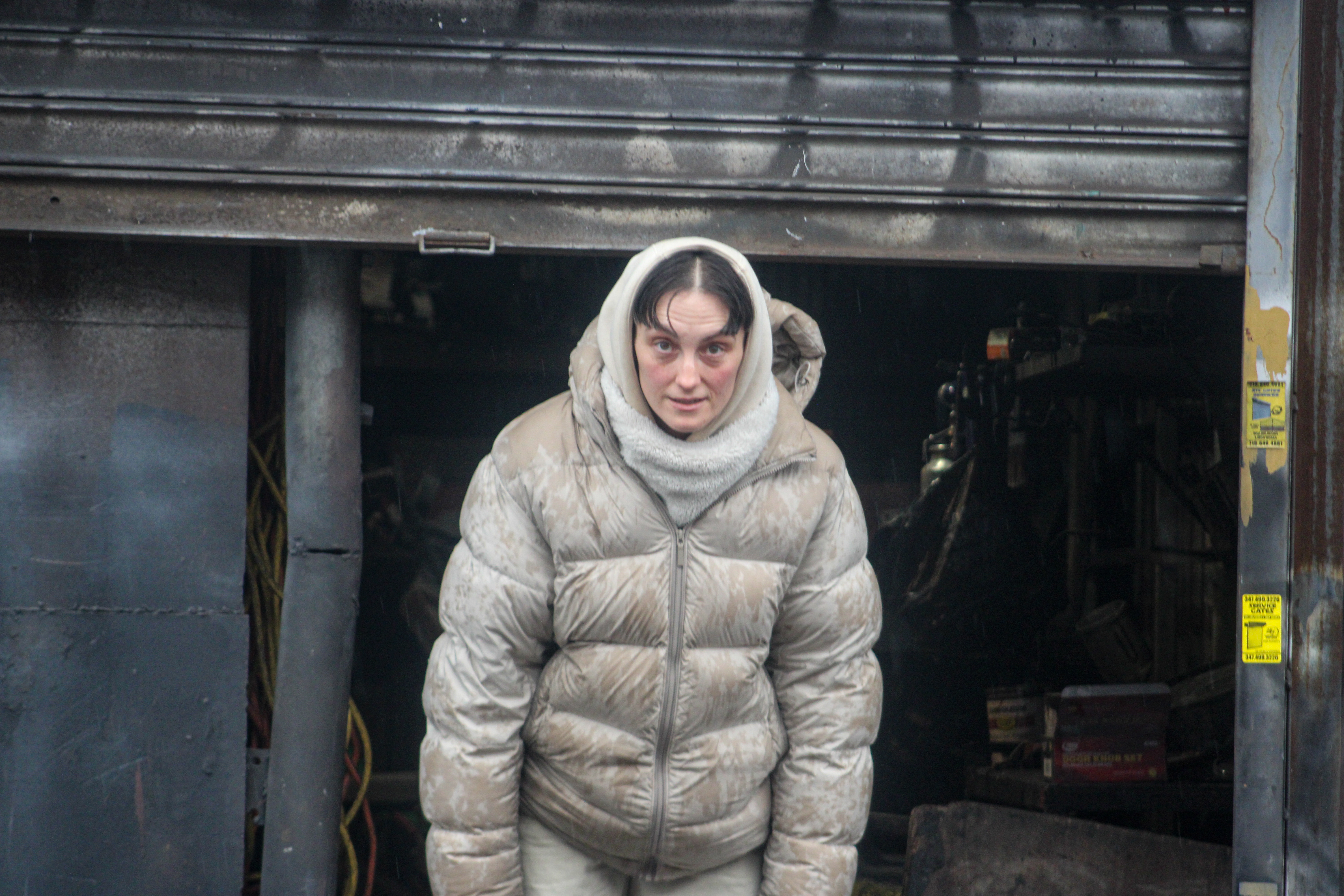
I remember that, directly after our interview, Suz and I (and Andrew Karpan, EIC and resident photographer) walked East Williamsburg in the rain. Murray mentioned wanting to find a pile of old computers. We settled on an ironworks studio off Thames Street.
I imagined how ridiculous people must’ve thought we looked while photographing on warehouse docks, around cables, in front of a tiny three-wheeled car parked on the curb. While Murray was photographed in front of a textured brown wall, a man paused down the street, so as to not interrupt the shot. I motioned for him to pass, and as he did, we offered to photograph him. Andrew took a few portraits, and I promised to send him the photos (I did, eventually).
Murray says, “Some form of clown [will last] because of the connection that happens. There’s a trend I see in clown shows of a no-standup rule. There’s a veil between the comedian and the audience [there]. But with clown, there’s authentic audience connection: a performer basing their action and movement on the audience. There’s that ultimate connection there. I think we need more of that in society.”
I’ll keep waiting. Things and noses might change before then. “I’m developing a smaller KACHONK case. And it is louder. It’s maybe too loud.” Noses shrink, plans grow. “I’m hoping to have a 60 minute show put together for the summer. You’ve got to let it marinate. Some people can just throw a thing together, but I like to play a lot before I can put something together.”
Our clown is dormant, not dead. They’re waiting in heaven, trying to open a door to God with 47 old rotary phones stuck to their gray hands. I wonder how a clown could ever end up there, how a clown even dies. “I think they evolve. Their names can change. Their costumes and wigs can change,” Murray says. “It’s kind of a reincarnation of the same soul. I can’t escape myself.”
So they never die. Only in hypotheticals do they end up in heaven. Murray was the ghost of KACHONK, who was waiting to come alive again. We want ghosts to win, to rematerialize: we chase rebuilding past selves seen in selfies, to make plastic of what’s aged so much. “My clown already looks a little ghosty,” they say. “They look like a normal person walking down the street.”
Follow Suz Murray for updates on KACHONK’s next appearances, including their March 4th and 5th opening set for Pompom Pirateat East Williamsburg’s LIFE WORLD.
Aaron Tomey is from Georgia, lived in St. Louis, and now lives in Brooklyn. His essays have previously appeared in Hobart, Bushwick Burner Phone, and Apocalypse Confidential. He can also be found on Twitter: @ecstatic_donut.
Photos taken by Andrew Karpan.



Leave a Reply