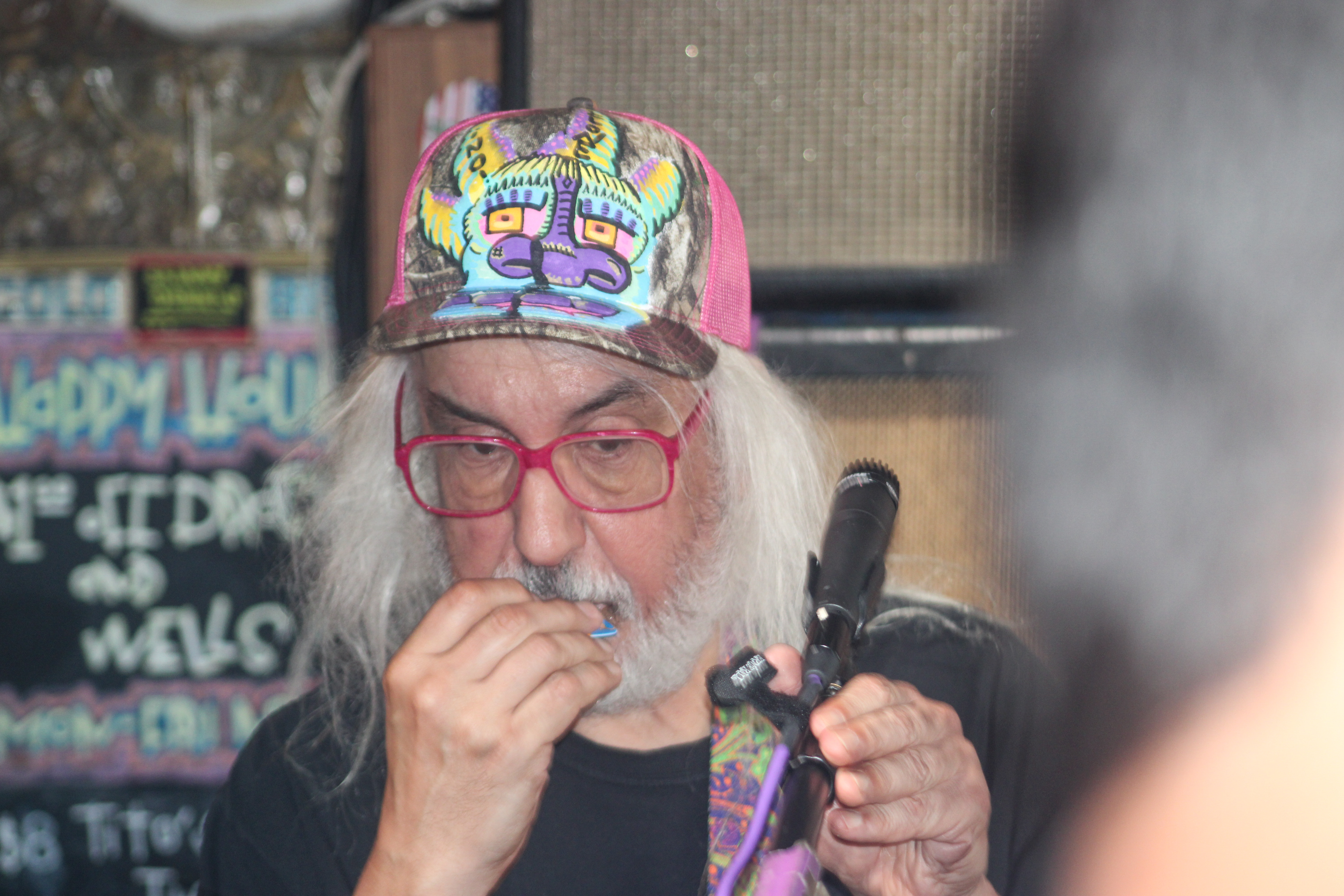
The crowd at Williamsburg’s Skinny Dennis (152 Metropolitan Ave.) was a constellation of graphic hats and t-shirts: Jesus and Mary Chain (a mugshot of David Bowie was his iPhone screensaver), Bed-Stuy Bikes (RIP), a camo hat declaring “Bussin’ Style” in cursive, Argonaut Books, Pterodactyl Club, Staffers’ Baseball. All of it was one big declaration that every man over 35 knows of at least one thing, all of them worn by men embodied by J. Mascis: a child in a big hat that shreds forever.
It was supposed to be a cultural moment. It was supposed to be at Maria Hernandez Park. “The free Dinosaur Jr show in Maria Hernandez with Thurston Moore and They Are Gutting A Body of Water is going to be generational,” predicted Pitchfork freelancer David Glickman.
A week earlier, Fender announced a series of shows headlined by Dinosaur Jr. with openers including Snail Mail and Thurston Moore (who hopefully had avidly read Alex Wexelman’s pan of his ex-wife’s art show in East Williamsburg). These shows were all put on by Show Brain, which often mobs both Maria Hernandez and Tompkins Square Park with all-ages punk shows by bands that I’ve never heard of, with names like 95 Bulls, First Sex and Sunny Daze and The Weathermen.
After doing this for some years, the group managed to book Dinosaur Jr.—a group described once by the writer Jessica Hopper as “magnets for the devotion of teenage weirdos,” via a deal with the Fender brand, which understood the aforementioned as its demographic, and would pay for everything.
Show Brain had booked Maria Hernandez countless times before, and did so again with the same paperwork they always filed for the usually 80-person crowds who could be counted on being passively interested in the likes of, say, Sunny Daze and The Weathermen. The Thursday before the show, the Parks Department pulled the permit and the show would later be moved to TV Eye (16-47 Weirfield St.) in Ridgewood, where I once caught a surprise set by TV on the Radio.


This time, Steve Gunn opened. Gunn was a former touring guitarist for Ty Segall, who got a record deal from Matador a decade ago to put out a few Neil Young-style folk records, mildly popular at the time. Gunn was off the label now, but was nevertheless sharp still live, playing what some called “American primitive” ambient songs that generally stretched to over ten minutes apiece.
Gunn looked youthful for 49, like a little leaguer that just got pulled out of an aging chamber. It’s 2026, and New York City is officially subtropical, and it was nice that he still wore flannel for us. Then, a final wash of sound that ended abruptly, and he promised to meet everyone in the room for drinks. The last time I saw Dinosaur Jr. live, they were doing their residency at the Bowery, playing the self-titled album with a handful of fans like Kevin Shields and Kurt Vile; it was a show I remembered well, having almost gotten into a fight with a forty year old there, and the group would end each set in those days by getting everybody on stage and jamming out a version of “Cortez the Killer,” and this is pretty much what Gunn was doing too, all by himself.
By the time Mascis and his formerly fired employees made it to “the Lung,” Mascis appeared on the verge of falling asleep. Behind me, a woman collapsed and was carried out; Lou Barlow stopped, concerned while Mascis stared ahead, ready to snore. “He’s trapped in the corner!” Barlow had joked with drummer Murph, made small by an array of amplifiers. Mascis didn’t say anything about that either. “It’s amazing the way he [Mascis] does it. He has a pretty amazing way of non-aggressive, aggressive way of controlling situations that is totally breathtaking. People fear him. It’s amazing,” Barlow told a website called Thrillcall.


It was a lively little event, though security had kept the room from filling up too much so Fender could operate at least three video rigs that tracked Mascis and Barlow’s Fenders. For most of the show, the cameraman in front of me shot the guitars in a tight zoom that made the rest of the room feel like a commercial set. Earlier, I had run into a smart and charming Fender employee from Los Angeles, who told me that there was some kind of secret release coming out in October. This show, in the shape of an organic popup, would become promotional footage.
If it felt adolescent to imagine that the arrival of new guitars was a vital trade secret, then that captured the spirit of the group itself. Notoriously, Mascis fired Barlow in 1988, shortly after the band scored its first minor radio hit “Freakscene;” or, rather, he had Murph fire Barlow by claiming the band were breaking up after an on-stage fight in Naugatuck, Connecticut, after Barlow blasted too much feedback while playing “Severed Lips,” from their first album. Mascis then booked a tour of Australia with Barlow’s replacement. “You fucking assholes!” Barlow screamed, as recounted in Michael Azerrad’s Our Band Could Be Your Life. “I can’t believe you didn’t have the balls to tell me to my face!”
By 1993, Mascis fired Murph too. He then toured a series of albums recorded with, as Hopper puts it, “a series of scabs.” There’s the idea from Azerrad and others that this era of the band is its weakest, but I generally disagree, and I find something pure about the minor alternative radio hits Mascis made with his non-band; songs like “Feel the Pain” that have a kind of glazed sentimentality that comes off as automobile slick. Those were valuable too.
At any rate, by the mid-2000s, Mascis would give up on that idea too and return to Barlow and Murph, and they’ve been touring ever since, their newest album out that Friday. Barlow, sweaty and jumpy, delivered “Freakscene” with an energy that felt almost infectious.


Under a massive, immobile baseball cap, Mascis looked like a kind of dignified clown. The new stuff was great, a return to a form described by Hopper as “fumbling dorkiness.” These days, it was, as a different Pitchfork freelancer put it, “groaned admissions of loneliness.” In front of me, an excited roadie in shades was shaking his phone up and down throughout, while repeatedly throwing up horns, over and over again. I wasn’t sure who he was doing this for. After it ended, I watched him try to fight a nearby photographer, waving around the group’s setlist like a battered flag after Mascis walked past. Mascis didn’t say anything to them and to us; after the set ended, he merely went, “I guess I’ll see you tomorrow.”
Maybe it’s embarrassing to have friends for more than 40 years. Get a life! Having interchangeable employees you can barely stand gives some dignity to the idea of driving around New York to record advertisements for the Fender brand. The Fender cameras were there to catch them playing those songs with Fender guitars. They might’ve caught the sounds of us listening to songs that sounded so good.


Leave a Reply