At an October meeting of Bushwick’s Community Board 4’s Economic Development and Housing & Land Use committee, chairperson Anne Guiney said that a “statement of significant differences” about environmental testing at 860 Flushing Avenue revealed that there are “more volatile organic compounds” than previously disclosed.
Among 14 chemicals detected on the lot were mercury, lead, and tetrachloroethene (PCE), the latter an industrial solvent and known carcinogen.
This problem replicates in Gowanus, where the firm Toxics Targeting said in a 2024 report that there were “shockingly high levels” of trichloroethylene, or TCE, in the indoor air of homes and buildings there. Property owners are reticent to disclose levels, often out of fear of plummeting property values.

The Explanation of Significant Differences, certified Oct. 26 by the state Department of Environmental Conservation (DEC), describes elevated levels of “polycyclic aromatic hydrocarbons (PAHs) and metals in soil and petroleum-related VOCs in soil vapor,” the former of which includes benzoanthracene, a contaminant mentioned in previous DEC documents.
Regarding the increased toxicity, I called B Contractors and spoke to Shea Gluck. He commented that his team was working to remediate the alleged toxicity, but did not disclose specific details. He then added that he would not comment, after which he hung up. Gluck did not respond to multiple follow-ups for comment.
One course of action detailed in the document is a sub-slab depressurization system, which mitigates soil vapor and can be installed after the laying of a foundation.
Ownership of 860 Flushing Ave. traces back to George J. Macchia of the Macchia Group and Shimon Kleinman of B Contractors and private developer Simon Brach, per recent ACRIS filings. Macchia, Kleinman, and Brach did not respond to requests for comment.
The site is a former BP gas station that opened in 1946 and closed in 2025 to make way for the eight-story building, which will include 59 apartments and space for retail. The site is a brownfield in remediation under the State’s Brownfield Cleanup Program, which offers tax incentives for “the redevelopment of urban brownfields” like 860 Flushing Avenue.
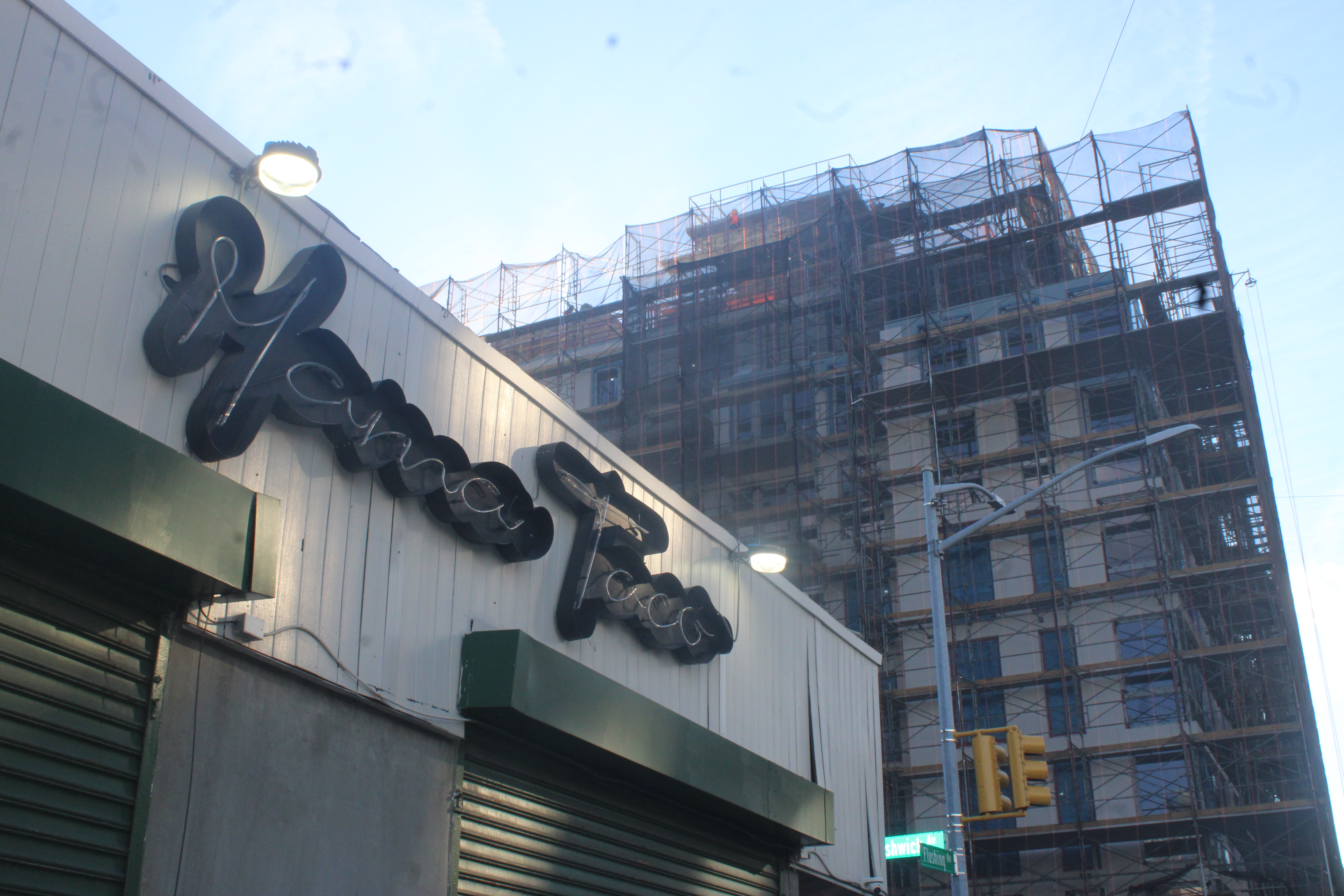
As visible on November 11, the building has already been topped off, with construction of the facade happening under netted scaffolding. All of this is business as usual. “The developer is performing the environmental cleanup activities in accordance with work plans approved by DEC,” said a DEC representative.


Within 500 feet of the contaminated development are Bushwick Playground, Garden Playground, P.S. 120, and Bushwick Houses (372 Bushwick Ave.), the latter of which is usually only attended by media “when something bad happens,” said William, a lifelong resident of the NYCHA project who asked that his last name be withheld.
Pointing to the development, he said, “They did construction over there, and the rats came over here [to Bushwick Houses].”


The public was notified through traditional channels: the site has been discussed at Community Board 4 meetings in the past, and a DEC work plan from May lists documents being dropped off at the Bushwick Public Library, which later closed in June for renovations.
But the news didn’t make it out to Bushwick Houses. William said, “They [government agencies] never mentioned none of that.”
“It was a beautiful area,” he recalled. “Then the developments came. So much has changed since the time I was little, to now.” In the last decade since the opening of luxury condominium The Rheingold (10 Montieth St.), this stretch of Flushing Avenue has verticalized. Completed and in-progress developments rise for blocks between Evergreen and Broadway.


“The last politician to come here and say something and care was [Mayor Zohran] Mamdani,” he said.
At the October meeting, Housing & Land Use Chairperson Guiney said that the increased toxicity of the site “cannot be good because there’s a lot of housing that is there in terms of the NYCHA campus and a lot of housing that is going up right next door.” Toxic lots, new apartment units to answer insatiable demand: Gowanus by another name.
Poisoned ground is business as usual for North Brooklyn, where Italian-American and then Latino communities have long dealt with illegal dumping and toxic waste throughout the 20th century. Near 860 Flushing are two Superfund sites: the Meeker Avenue Plumes in East Williamsburg and Newtown Creek.
From the dumps sprouted new, publicly subsidized developments, including 214 Starr St., where Starr Bar is located; 16-26 Madison St., the former site of a knitting mill; and a massive development at 1510 Broadway in Bed-Stuy that’s anchored by a Chipotle.
From the dirty earth, market-rate units.
Photos by Aaron Tomey.


Leave a Reply